
Types of waterfall
Plunge waterfalls
Water leaves the rock entirely and falls free through the air.
Water leaves the rock entirely and falls free through the air.
In a plunge waterfall the water loses contact with the rock face as it drops, so it falls as a free column or curtain. It is the classic postcard shape, and usually means a hard layer of rock at the lip over a softer layer that has been cut back beneath it. Tall plunges often turn to mist before they land.
How to recognise one
Look for a clear gap between the falling water and the cliff behind it, and a deep pool or a spray cloud at the base.
For the geology behind the shapes, read how waterfalls form.
192 examples
Plunge waterfalls to visit
 Full guide
Angel Falls
World's tallest uninterrupted waterfall
 Full guide
Kaieteur Falls
Among the most powerful single drops on earth: 226 metres in one plunge
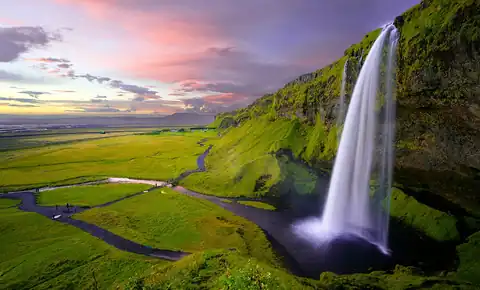
Seljalandsfoss
One of the few waterfalls walkable on all sides
 Full guide
Havasu Falls
Most famous turquoise waterfall in the American Southwest
 Full guide
Skógafoss
Iceland's classic 60-metre curtain, with 527 steps to the top
 Full guide
La Fortuna Waterfall
Signature waterfall of Costa Rica's Arenal region
 UNESCO
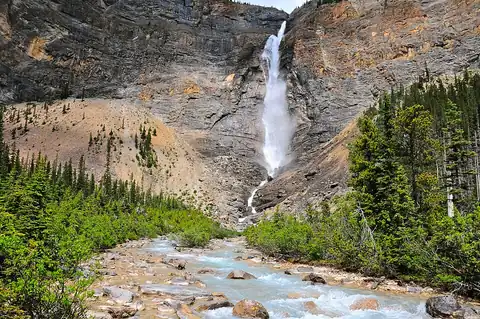
Takakkaw Falls
One of Canada's tallest waterfalls
 UNESCO
Wallaman Falls
Australia's tallest permanent single drop (268 m), 305 m in total
 UNESCO
Jim Jim Falls
One of Kakadu's most dramatic escarpment plunge pools
 UNESCO
Nevada Fall
Upper anchor of Yosemite's famous Mist Trail
 UNESCO
Bowen Falls
One of only two permanent waterfalls on Milford Sound
 UNESCO
Stirling Falls
One of only two permanent waterfalls on Milford Sound