Lonely Planet IcelandLonely Planet
Guidebook
Lonely Planet Iceland
Lonely Planet · 2026
Newest Lonely Planet edition: Ring Road planning, road and weather advice, and practical detail for every major Icelandic waterfall.
Iceland · Southern Iceland
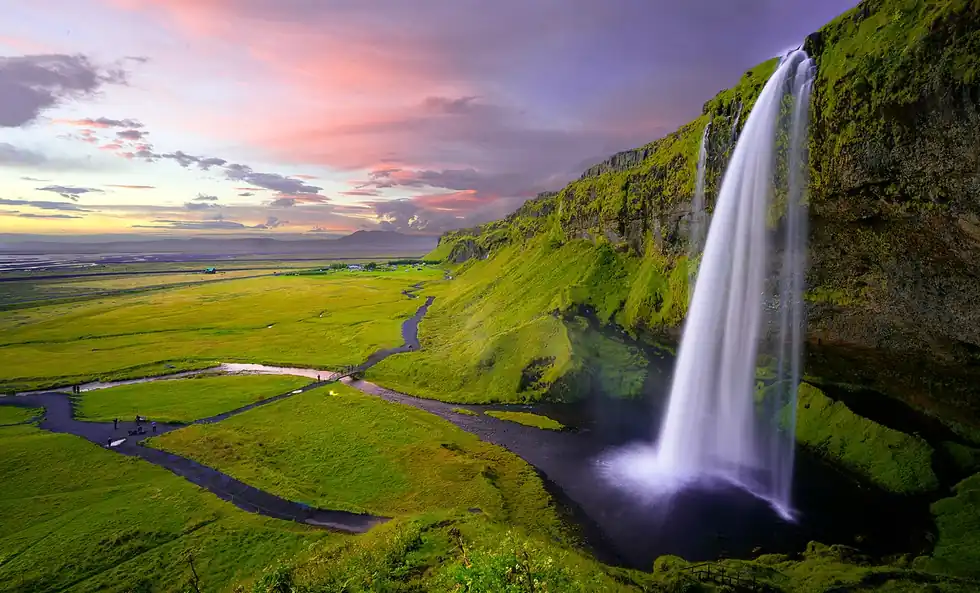
The falls drop clear of an overhanging cliff face left by an ancient coastline, leaving enough space behind the curtain for a footpath to loop completely around it. Waterproof gear is essential — the walk behind means walking directly through the spray.
Checked September 2026 by David Bussell
Seljalandsfoss drops 60 metres (197 ft) on the Seljalandsá. It is a plunge-type fall, and the nearest base for a visit is Hvolsvöllur, with KEF the closest airport. Access to the main viewpoint is rated easy.
As a plunge waterfall, water leaves the rock entirely and falls free through the air.
No commercial adventures run at Seljalandsfoss itself — the experience is the approach and the view. Guided day trips from Hvolsvöllur are the easiest way to combine it with the area around it.
Also good forHikingPhotography
Summer keeps the behind-the-falls path open and dry-ish; winter ice can close it entirely.
Entry: Paid parking
 This waterfall
Seljalandsfoss
Iceland
Height60 mWidth—
This waterfall
Seljalandsfoss
Iceland
Height60 mWidth—
 Most similar
Skógafoss
Iceland
Height60 mWidth25 m
Also a plunge waterfall, of similar height and in Iceland too
Most similar
Skógafoss
Iceland
Height60 mWidth25 m
Also a plunge waterfall, of similar height and in Iceland too
 Largest curtain
Victoria Falls
Zimbabwe · Zambia
Height108 mWidth1,708 m
Largest single sheet of falling water
Largest curtain
Victoria Falls
Zimbabwe · Zambia
Height108 mWidth1,708 m
Largest single sheet of falling water
 Tallest on earth
Angel Falls
Venezuela
Height979 mWidth—
Tallest on earth
Angel Falls
Venezuela
Height979 mWidth—
 Widest on earth
Khone Phapheng Falls
Laos
Height21 mWidth10,783 m
Measured across the whole multi-channel system
Widest on earth
Khone Phapheng Falls
Laos
Height21 mWidth10,783 m
Measured across the whole multi-channel system
Angel Falls is 16× taller than Seljalandsfoss. Victoria Falls is 1.8× taller. We don't have a reliable crest width for Seljalandsfoss yet, so it is left off the width chart. Tallest · widest lists.
 3:26
3:26
 1:51
1:51
 15:38
15:38
Chosen from YouTube; videos belong to their creators and play from YouTube's privacy-enhanced player.
Guidebook
Lonely Planet · 2026
Newest Lonely Planet edition: Ring Road planning, road and weather advice, and practical detail for every major Icelandic waterfall.
Guidebook
Rough Guides · 2025
Current Rough Guide with region-by-region coverage of the south coast, Mývatn area, Snæfellsnes and Vatnajökull.

Guidebook
DK Eyewitness · 2024
Map-heavy illustrated guide, handy for picturing the Golden Circle and south-coast falls before you drive them.
Natural history
Thor Thordarson & Ármann Höskuldsson · 2022
Field geology of Iceland's volcanic landscapes, explaining the lava, basalt and canyons that shape falls like Svartifoss and Dettifoss.
63.6156, -19.9886
Seljalandsfoss is in Iceland (Southern Iceland). The nearest base is Hvolsvöllur and the closest airport is KEF. Its coordinates are 63.6156, -19.9886.
Seljalandsfoss drops 60 metres (197 feet). It is a plunge-type waterfall on the Seljalandsá.
Peak flow is May to September. Summer keeps the behind-the-falls path open and dry-ish; winter ice can close it entirely.
Beyond the viewpoints: hiking and photography. Access to the main viewpoint is rated easy — a short walk or roadside viewpoint.
The usual base is Hvolsvöllur, and the closest airport is KEF. A short walk or roadside viewpoint from there. Paid parking.
Nearby

Írárfoss is a waterfall in Iceland.

Gluggafoss is a waterfall in southern Iceland, specifically in the Fljótshlíð area. As the most prominent…
Full guide Iceland's classic 60-metre curtain, with 527 steps to the top

Urriðafoss is a waterfall located in the river Þjórsá in southwest Iceland. With a flow rate of 360 m³/s, it…