
About this place
The Mekong: Turbulent Past, Uncertain Future
Milton Osborne · 2001
History of the Mekong, including how the Khone Falls blocked French dreams of a river route into China.

Laos · Champasak Province
The Mekong's last great obstacle before Cambodia: a braided system of cascades and rapids nearly 11 km across, anchored by the thundering 21-metre Khone Phapheng on the mainland and Li Phi Falls on laid-back Don Khon island.
Full guide Checked September 2026 by David Bussell · 28 sources
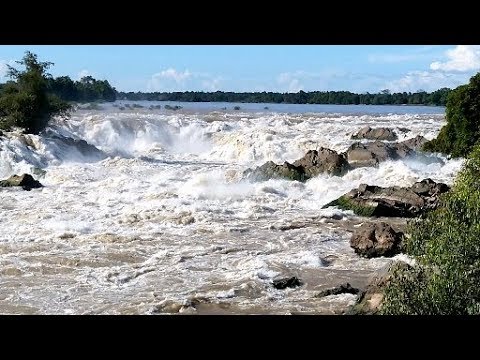
Khone Falls is not one waterfall but a whole river breaking apart. Just north of the Cambodian border the Mekong splits into dozens of channels around the islands of Si Phan Don, the 4,000 Islands, and every one of them tumbles over a band of rock. Measured across all those channels, the Khone system is about 10,783 metres wide, the figure behind its usual billing as the widest waterfall system in the world. Khone Phapheng, the biggest single cascade, drops at most 21 metres, but the river pushes an average of nearly 11,000 cubic metres a second through the system, more than four times Niagara's average flow, with a recorded peak above 49,000.
It helps to keep the names straight. "Khone Falls" (or the Khone Falls system) is the whole 9.7-kilometre stretch of rapids and cascades. "Khone Phapheng", which people also search as Phapheng falls, is the largest, most powerful cascade, on the eastern channel beside the Lao mainland, reached by road through a ticketed park with a visitor centre, paved paths and several riverbank viewpoints. Li Phi Falls, officially Tat Somphamit, is a separate, smaller set of cascades on the western side of Don Khon island, reached on foot or by bicycle from the guesthouses.
Most people base themselves on Don Det or Don Khon, two islands joined by a French colonial railway bridge, and see both falls in a day: Li Phi by bicycle, Phapheng by boat and tuk-tuk from the mainland village of Nakasang. The same falls that stopped French gunboats in the 1890s explain the rusting locomotive and the old railway embankment you cycle along. Add a kayak trip through the rapids, sunsets over the river and an easy onward route into Cambodia, and Si Phan Don earns three unhurried days. The one thing you can no longer do here is see the river dolphins: the Lao pool lost its last one in 2022.
Mainland, near Ban Thakho; 12 km from Nakasang
This is the cascade that gives the system its reputation, a churning, spray-soaked wall of water where the main flow of the Mekong funnels over the rocks east of the islands. A ticketed park with a visitor centre sits above the river, and a short paved path leads to a string of viewpoints along the bank, with steps down towards the rocks for close-up spray. Inside the visitor centre, look for the Manikhoth tree, a huge trunk pulled from the river that features in local legend.
Western Don Khon, 1.5 km from the railway bridge
Li Phi, the 'spirit trap', is a run of fierce cascades crashing at odd angles through a rocky channel on the island's western side. Trails through the trees lead to a series of viewpoints, and a set of suspension bridges and a zipline now let you get directly above the water for an extra fee. It is smaller than Phapheng but more intimate, and the late-afternoon light makes it a popular sunset walk. A sandy river beach lies about 2 km further on.
Do both if you can: they are a 45-minute cycle and a boat-and-tuk-tuk hop apart, and each costs a couple of dollars. If you only have time for one, Khone Phapheng is the bigger spectacle; Li Phi is the easier one to reach from the islands and the better place to watch the sun go down.
October and November pair big, spray-filled falls with visible cascades and easing rain; December to March brings the clearest channels and the best weather, and August to September the most raw, muddy volume.
River level decides everything. The Mekong swells from the monsoon rains to a peak around August and September, burying some cascades and roaring through others, then drops steadily until the rocks and individual channels stand out in the dry season.
The best compromise. The river is still high and loud, so Phapheng throws up heavy spray, but the water is dropping and more of the individual cascades show. The rains ease, the islands are green, and the rice on Don Det is being harvested. Visitor reviews single out the end of the rainy season as the time Li Phi is at its most powerful.
The falls at their most readable: exposed rock, clearly defined channels and cascades, easy walking along the banks, and the most comfortable weather of the year. It is also the busiest time on Don Det and Don Khon, so book the better riverside rooms ahead. Volume falls month by month, and by March the cascades are noticeably thinner.
The lowest water and the highest temperatures. The falls shrink to their bones, which suits geology more than spectacle, and midday is punishingly hot on the exposed viewing areas. It is quiet on the islands outside the Lao New Year holiday in mid-April, when domestic visitors pour in. Visit the falls early and spend the afternoons in a hammock.
Maximum power. The river turns brown and fast, Phapheng becomes a wall of noise and mist, and some smaller cascades vanish under the rising water. Rain comes in heavy bursts, paths get muddy, and high water can restrict access to the lower viewpoints and the rocks at Phapheng. Rice is planted on the islands in June and July.
Don Det plants its single rice crop in June and July and cuts it by hand in October and November, so the falling-water months coincide with gold fields, threshing and cycling paths lined with drying sheaves. From mid-November to mid-June the paddies lie fallow and the cows graze freely. It is the season when the islands feel most like farming villages rather than a backpacker stop.
Falls fees are 2026 figures from a March 2026 guide, dondet.net and 2025/2026 visitor reports in Lao kip, converted at about 22,400 LAK to $1 (September 2026); transport, tour and boat prices are 2026 rates published in US dollars by dondet.net. Treat all figures as a planning guide, not a quote.
Buy your ticket at the visitor centre, look at the Manikhoth tree display, then follow the paved path five to ten minutes down to the viewpoints along the bank. The closest puts you in the spray of the main cascade, and in the dry season steps lead down onto the rocks. The noise is constant. Most people spend an hour; there are cafés inside the park and a temple nearby. Swimming is prohibited and would be lethal.
Year-round; lower viewpoints can close at high water
Pay on the day — nothing to book in advance.
From the old railway bridge it is 1.5 km to the gate, with signposts all the way; from central Don Det it is about 45 minutes by bicycle or two hours on foot. Forest trails lead to a string of viewpoints over cascades that hurl the river through a rocky slot. Stay for sunset, then ride back with a torch, because the southern end of Don Det is unlit. Swimming at the falls is not allowed.
Year-round; most powerful October – November
Pay on the day — nothing to book in advance.
A chain of suspension bridges now crosses the Li Phi channel, putting you directly above the white water rather than looking at it from the bank. Visitors who have done it at the end of the rainy season describe walking five bridges just over the water. The fee is steep by local standards, so decide once you have seen the falls from the free viewpoints. Ask at the gate whether all sections are open that day.
Year-round, subject to river level
Pay on the day — nothing to book in advance.
A zipline runs over the Li Phi cascades inside the falls area, sold separately from the entry ticket. Current operating hours, age and weight limits were not published in the sources found, and reviewers advise checking that it is running before you plan around it. Expect a short safety briefing and a line strung over some of the most violent water on the island.
Year-round, weather permitting
Pay on the day — nothing to book in advance.
The classic Si Phan Don day. You paddle between the small islands, run grade 2–3 rapids, stop for a grilled-fish lunch on a quiet island, then continue downstream to Veun Kham, where a vehicle takes you to Khone Phapheng. After the falls you are driven to Nakasang and paddle back to Don Det at sunset. Two guides accompany each group; there are no half-day trips or unguided rentals because of the currents. Book the day before.
Mainly dry season; ask about high-water days
Wooden longtail boats wait at the Don Det pier for quick crossings to Nakasang or Don Som, and can be chartered for longer loops through the channels, including towards Khone Phapheng and sunset trips. Bounmie, recommended by the neighbouring Baba Guesthouse, charters his pirogue and a tuk-tuk; any pier boatman will quote. Agree the route, time and price before you set off, and do not expect crossings after about 20:30.
Year-round
Pay on the day — nothing to book in advance.
The French built a 7 km narrow-gauge railway across Don Det and Don Khon to haul boats and cargo around the falls, and it ran until about 1940. Ride the old trackbed from Don Det, cross the 170-metre concrete viaduct, and stop at the Orenstein & Koppel locomotive of 1911, the only steam engine left in Laos, under its shelter at Ban Khon. A second rusting engine sits near the old French landing pier, 5.5 km from the bridge.
Year-round; muddy June – September
Pay on the day — nothing to book in advance.
The dolphins that once lived below Khone Falls are gone from Laos, so if you want to see them, continue into Cambodia. At the 60-metre-deep Kampi pool near Kratie town, local boatmen cut their engines near feeding grounds and wait for grey backs to surface. The Mekong population was estimated at 118 in mid-2026 after six calves were confirmed that year. Keep your distance and use the licensed boats at the viewing site.
Year-round; mornings are calmest
No booking needed.
On the way between Pakse and the islands, the Khmer temple ruins of Vat Phou climb a hillside above the Mekong near Champasak town, the sight Pakse tour desks most often pair with the falls. Split the journey here with a night at a riverside resort and you break the three-hour run south into two easy halves. Go early, before the heat builds on the stone staircase.
Year-round; cooler early morning
Older guides and some 2026 websites still send you to the southern tip of Don Khon to watch Irrawaddy dolphins. Don't count on it. The small group in the Anlong Chheu Teal pool on the Lao–Cambodian border fell from eight animals in 2007 to one, and that last dolphin was found dead on 15 February 2022 after getting caught in illegal fishing gear. Gillnets, electrofishing and the disruption around the Don Sahong hydropower dam, operating on the Hou Sahong channel less than 2 km from the border since 2020, are all blamed. The Mekong's remaining dolphins, about 118 by mid-2026, live in Cambodia between Kratie and Stung Treng, with Kampi near Kratie the easiest place to see them.
Stay on Don Khon for quieter riverside hotels with pools near the railway bridge and Li Phi, on Don Det for cheaper guesthouses and more going on, or in Pakse or Champasak if you are on a short trip and would rather day-trip south.
Don Khon's best-known hotel, with a pool, restaurant, tour desk and floating studios moored on the river, whose porches face the sunset. Around 400 Booking.com reviews; staff arrange scooters, boats and falls trips.
Riverside rooms with balconies a two-minute walk from the French railway bridge, which guests watch from the terrace, plus a large pool with loungers. Rated 8.8 on Booking.com from about 120 reviews; Li Phi is a short ride away.
Spacious, air-conditioned river-view rooms with big terraces and hammocks, friendly family hosts, and restaurants across the road. One of the highest-rated places on the islands, 9.1 on Booking.com from nearly 300 reviews, and walkable to Don Det.
Large riverfront rooms with patios facing the sunset, right beside the pier for boats to and from the mainland, with a restaurant and bicycles for guests. Handy for early boats to Nakasang and the Phapheng run.
Seven spacious rooms with balconies, air-conditioning and hot water, facing the Mekong near the Don Det pier, bicycle hire and kayak offices. French-, English- and Thai-speaking owners; rated 8.9 on Booking.com. Book ahead, as it fills up.
Air-conditioned river-view rooms and suites, an outdoor pool, garden and restaurant serving Lao and European food on Don Khong, the biggest and sleepiest of the 4,000 Islands, about an hour from the falls.
Long-running central hotel in a former cinema and casino, about 3 km from Pakse airport, with a rooftop restaurant and bar and a breakfast guests rate among the best in Laos. Good base for a long day trip to the falls.
Riverfront and pond-garden villas with an outdoor pool on the Mekong near Champasak and Vat Phou, rated 9.7 on Booking.com from about 200 reviews. The comfortable way to break the journey between Pakse and the islands.
Search all Don Khon stays on Agoda or compare on Booking.com
The nearest airport, on the edge of Pakse and about 145–150 km north of the falls. Lao Airlines flies to Vientiane, Luang Prabang, Siem Reap, Ho Chi Minh City and Guangzhou; Lao Skyway also serves Vientiane. A taxi straight to Nakasang costs about $90 (2.5 hours).
The capital's airport, with the widest choice of international flights; connect to Pakse by air. The road south from Vientiane is in poor condition, and overnight sleeper buses to Pakse take about ten hours.
Bangkok is the main gateway, via a flight to Pakse through Vientiane or overland via Ubon Ratchathani and the Chong Mek–Vang Tao border; Siem Reap and Ho Chi Minh City have direct flights to Pakse.
From Pakse, hotel-booked minivans leave around 08:00 for Nakasang or Don Det (about 2.5 hours, $6–8 including the boat). Public buses from the Southern Bus Terminal, 8 km out of town, run hourly from 07:00 to 15:00 (about 3.5 hours, $5). From Nakasang it is a 500-metre walk to the river and a short boat ride to Don Det or Don Khon ($1.50 per person, more after dark; no crossings after about 20:30). Khone Phapheng is 12 km south of Nakasang by tuk-tuk; agree a return fare with waiting time, reported at 60,000–80,000 LAK or about 200,000 LAK for two. For Cambodia, travel agents on Don Det sell through tickets to Stung Treng, Kratie, Phnom Penh and Siem Reap (about $35 to Siem Reap in 2026, leaving around 09:00) via the Nong Nok Khiene–Trapeang Kriel border; VET Air Bus and Asia Van Transfer are the companies most often recommended.
Laos changes visa rules and temporary exemptions with little notice, and fees at land borders can differ from the airport. Travellers have long reported small unofficial 'stamping' charges at the Nong Nok Khiene–Trapeang Kriel crossing. Check laoevisa.gov.la and your government's travel advice shortly before you go, and avoid lookalike eVisa websites that charge extra.
 This waterfall
Khone Phapheng Falls
Laos
Height21 mWidth10,783 m
 Most similar
Great Falls
United States
Height20 mWidth—
Also a cataract waterfall, of similar height and with kayaking
 Largest curtain
Victoria Falls
Zimbabwe · Zambia
Height108 mWidth1,708 m
Largest single sheet of falling water
 Tallest on earth
Angel Falls
Venezuela
Height979 mWidth—
 Next widest
Guaíra Falls
Brazil · Paraguay
Height40 mWidth4,828 m
Angel Falls is 47× taller than Khone Phapheng Falls. Victoria Falls is 5.1× taller, but Khone Phapheng Falls is 6.3× wider. Tallest · widest lists.
 1:53
 5:13
 3:39
Chosen from YouTube; videos belong to their creators and play from YouTube's privacy-enhanced player.
About this place
Milton Osborne · 2001
History of the Mekong, including how the Khone Falls blocked French dreams of a river route into China.
Guidebook
Rough Guides · 2024
More recent than the Lonely Planet Laos, useful for current transport between Luang Prabang, Pakse and the 4000 Islands.
Guidebook
Rough Guides · 2024
For a multi-country trip, one book covering the overland routes between the Southeast Asian falls on this site.
Guidebook
Lonely Planet · 2020
Covers Luang Prabang, the Bolaven Plateau and Si Phan Don, the three bases for the Lao falls on this site.
The Khone Falls are on the Mekong River in Champasak Province, far southern Laos, in the Si Phan Don (4,000 Islands) area a few kilometres north of the Cambodian border. Pakse, the nearest city and airport, is about 2.5–3 hours north by road. Most visitors stay on Don Det or Don Khon islands and reach Khone Phapheng by boat and tuk-tuk via Nakasang.
The Khone Falls system as a whole is usually cited as the widest in the world, at about 10,783 metres measured across all the Mekong's channels. Khone Phapheng is the largest single cascade within that system, up to 21 metres high, not the whole 10.8 km width. The system is also the largest waterfall in Southeast Asia by volume.
A March 2026 guide gives 55,000 LAK (about $2.45), while some 2025/2026 visitors report paying 30,000–33,000 LAK, plus a small parking fee. Li Phi (Somphamit) Falls on Don Khon costs 30,000 LAK (about $1.35), with its suspension bridges and zipline charged extra. Pay in kip cash at the gate.
Take a boat from the Don Det pier to Nakasang on the mainland (about $1.50 per person), then a tuk-tuk 12 km south to Khone Phapheng. Agree a return fare including waiting time before you leave; reports range from 60,000–80,000 LAK to about 200,000 LAK for two. Alternatively, the full-day kayak tour from Don Det ends at the falls.
No. The last dolphin in the transboundary pool below Don Khon died in February 2022, and there are none left in Laos. The Mekong's surviving population, estimated at about 118 in mid-2026, lives in Cambodia between Kratie and Stung Treng. The Kampi pool near Kratie is the easiest place to see them, a day's bus ride from Si Phan Don.
October and November give the best balance: high, powerful water, visible cascades and easing rain. December to March is the most comfortable, with clearly defined channels, though the falls get thinner as the dry season goes on. August and September bring peak, muddy volume and heavy rain, and April and May are very hot with the lowest water.
No. Swimming is prohibited at both, and the currents are deadly. In the dry season people swim at sandy river beaches on Don Khon, including one about 2 km beyond Li Phi, but there are no lifeguards and the Mekong's currents are strong, so stay in the shallows and never swim after drinking.
Yes. The Nong Nok Khiene (Laos)–Trapeang Kriel (Cambodia) border is a short drive south of the islands, and travel agents on Don Det sell through bus tickets to Stung Treng, Kratie, Phnom Penh and Siem Reap (about $35 to Siem Reap in 2026). Cambodia offers visas on arrival at $30, and Trapeang Kriel accepts the Cambodian eVisa.
Khone Phapheng Falls is in Laos (Si Phan Don, Champasak). The nearest base is Nakasong / Don Khon and the closest airport is PKZ. Its coordinates are 13.9598, 105.9865.
Prices, fees and entry rules change. We re-check full guides regularly; spotted something out of date? Tell us.
Nearby
Laos's tallest twin waterfall

Bou Sra Waterfall, also referred to as Bousra, Bu Sra, Busra or Boo Sra Waterfall , is a scenic waterfall now…

The K50 Waterfall is a waterfall in Kon Chu Rang Nature Reserve in Sơn Lang commune, Gia Lai province, in…

Elephant Waterfalls is a waterfall in the Central Highlands of Vietnam. It is located about 25 km from Da Lat…