Ancient Luang Prabang & LaosDenise Heywood
About this place
Ancient Luang Prabang & Laos
Denise Heywood · 2014
An illustrated guide to Luang Prabang's temples and history, the town most Kuang Si visitors stay in.
Laos · Luang Prabang Province
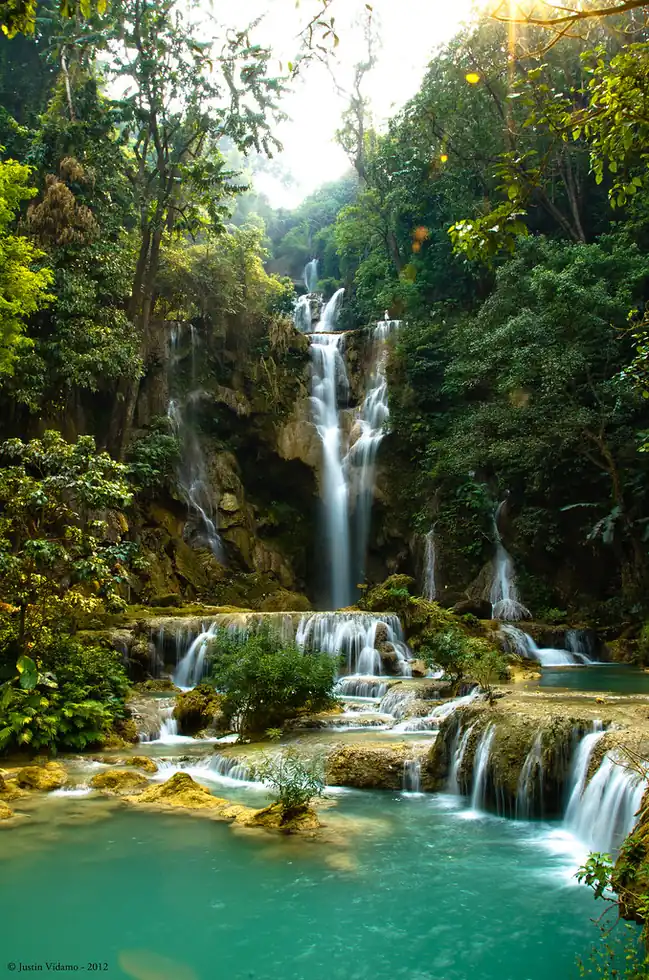
Milky turquoise water spilling down a staircase of travertine pools in the forest 30 km from Luang Prabang, with a bear rescue centre at the gate. In the dry season you swim in the lower pools; in the monsoon it runs brown.
Full guide Checked September 2026 by David Bussell · 54 sources
Kuang Si is a limestone waterfall in the most literal sense. The stream that feeds it is so loaded with dissolved calcium carbonate that it coats everything it touches, building soft, rounded travertine rims that hold the water back in a chain of terraced pools. The same minerals scatter sunlight into the milky, almost opaque turquoise the falls are famous for. At the head of the chain the main fall drops roughly 50 to 60 metres (sources disagree) over a broad, moss-streaked limestone face in three main cascades, then breaks into dozens of smaller spills and ledges as it works its way downhill through the forest.
You experience it from the bottom up. An electric shuttle runs from the ticket office and car park up to the trailhead, where the path passes straight through the Tat Kuang Si Bear Rescue Centre, run by the charity Free the Bears, before reaching the first pools. Wooden walkways and footbridges then climb beside the cascades past several swimming pools with rope swings and changing huts, ending at a bridge and viewing area facing the main drop. From there a steep staircase of around 540 steps climbs to a paid viewpoint and café at the top, where a zipline runs back through the canopy.
Most people treat Kuang Si as a half-day trip from Luang Prabang, the UNESCO-listed former royal capital, and that is exactly the right scale for it: two or three hours of swimming and walking, a slow look at the bears, lunch from the stalls at the gate. What makes the effort pay off is timing. Arrive when the gate opens at 8am in the dry season and you get cool, clear, near-empty pools; arrive at noon in August and you get a crowded brown torrent you are not allowed to swim in.
Trailhead, just above the shuttle drop-off
The first stretch of the park is where most of the day actually happens. The path runs through the Free the Bears rescue centre, where rescued moon bears and sun bears climb and doze in forested enclosures, then reaches a run of stepped pools with changing huts, benches, a rope swing and a tree for jumping. These are the designated swimming pools, and the water is cold, clear and shallow at the edges, with small fish that nibble at your feet.
End of the walkway, about 10–15 minutes above the lower pools
The walkway ends at a wooden bridge facing the full drop: a wide white curtain splitting over mossy limestone into a deep, churning basin. This is the photograph everyone came for, and the best vantage for it is early morning, before the crowds pile onto the bridge. It is also the one place people most often get wrong. The pool beneath the main fall is closed to swimmers, and currents here are strong even in the dry season.
Staircase from the left side of the main fall (as you face it)
A steep staircase, reported at 542 steps, now climbs from beside the main fall to The View, a viewing platform and café in the trees, and the start of a five-line zipline back down through the canyon. The climb is a proper workout and slick after rain. Be warned that the forest largely hides the waterfall from the top, and the natural upper pools above the main drop are signposted off-limits. Go for the climb and the zipline, not the view.
Spend most of your time in the lower pools and at the main fall, which is where the colour and the swimming are. Only climb to the top if you want the exercise or the zipline; the view from The View is of trees, not the waterfall.
November to February gives the clearest water and most comfortable weather; March and April stay swimmable but can be hazy, and May to October turns the pools brown.
Rain decides everything. In the dry season the pools are clear turquoise and swimmable; in the monsoon the same stream turns brown and fast, and swimming is often unsafe or closed.
The classic Kuang Si: clear, milky-blue pools, pleasant walking weather and the most reliable swimming of the year, though the water is cold first thing. It is also high season in Luang Prabang, so vans arrive in waves from mid-morning. Be at the gate at 8am and you will have the lower pools almost to yourself for the first hour.
Still clear, still swimmable, and the heat makes the cold water welcome. The trade-off is air quality: this is northern Laos's burning season, when smoke from field clearance can haze the sky and flatten photographs. Flow is at its lowest, so the main fall looks thinner than it does in December.
The falls roar and the forest is at its greenest, but the travertine pools fill with brown, sediment-heavy water and currents strengthen well beyond what the rope swings were built for. Swimming is frequently unsafe or roped off, paths get muddy and slippery, and heavy rain can shut parts of the site at short notice. Come for the sound and the spray, not the colour.
Kuang Si opens at 8am, and the shared minivans from Luang Prabang mostly arrive from mid-morning onwards. Visitors who reach the gate at opening consistently report near-empty pools for the first hour or so. The second-best window is the last 90 minutes before closing, once the day tours have turned back to town.
The falls ticket and site fees are the 2025/2026 rates in Lao kip, reported by Luang Prabang's tourism office and 2026 visitors, converted at about 22,400 LAK to $1 (September 2026). Tour, hotel and transport prices are 2025/2026 advertised listings or review-site averages and change with season and demand. Treat all figures as a planning guide, not a quote.
The reason most people come. A series of stepped, turquoise pools below the main fall are marked for swimming, with changing huts, benches, a rope swing and a tree to jump from. The water is spring-cold and small fish nibble your feet if you stand still. Wear water shoes on the slick travertine, stay inside the signed areas, and cover up with a T-shirt or sarong over your swimwear: local rules ask visitors to avoid revealing swimwear.
Best November – April; often unsafe or closed May – October
Pay on the day — nothing to book in advance.
Opened in 2003 inside the park, this is the rescue centre you walk through on the way to the pools. Moon bears and sun bears rescued from the illegal wildlife trade and bile farming live in forested enclosures with climbing frames and hammocks. There is no contact with the animals. The falls ticket does not fund the centre, so the shop and donation boxes do. Free the Bears runs a second, larger sanctuary about 8 km away.
Year-round
No booking needed.
A behind-the-scenes session with Free the Bears keepers: you hear individual rescue stories, help prepare enrichment treats and food, then watch the bears forage for them in their enclosures. Recent visitors describe knowledgeable guides and, occasionally, a sedated health check. It is the most useful thing you can do at Kuang Si with $50, because the proceeds go straight to the charity. Book by email with the Free the Bears education team. Direct contact with the bears is never offered.
Year-round, by arrangement
From the left side of the main fall, a steep staircase of about 542 steps climbs through the forest to a platform and small café known as The View. It is a hard, sweaty climb, and recent visitors say the paid platform looks out over forest and countryside rather than the falls themselves. The natural upper pools above the main drop are signposted closed. Do it for the exercise or as the start of the zipline, and go before the midday heat.
Year-round; slippery after rain
Pay on the day — nothing to book in advance.
Five lines, from 130 m to 352 m long, run from the top of the staircase back down through the canopy beside the falls, giving you the fastest descent and the only real aerial view of the cascade. The zipline itself is rated easy; the 542-step climb to the start is the hard part. Several Luang Prabang agencies also sell it inside a full-day package with transport and a village stop, at a much higher price.
Year-round, daily 09:00 – 17:00 (last departure)
Doing this one? Check your travel insurance covers adventure activities before you go — SafetyWing is one option.
Instead of driving in, walk. These treks start in the hills near Luang Prabang and follow forest paths through Hmong and Khmu villages for roughly 9–14 km before dropping down to the falls for a swim and the bear centre, then drive you back. Tiger Trail rates its route medium and mostly flat with one short rocky climb; Manifa's version is longer and billed as demanding. It is the best way to understand the country around the falls.
Year-round; muddy and slippery in the wet season
The efficient packaged version: a van to the falls with the ticket paid, free time to swim and see the bears, then back to Luang Prabang in time to board a boat on the Mekong for sunset with drinks. It solves the only real logistics problem of the day, which is getting back to town in time for the river light, and it is better value than hiring a private tuk-tuk if you are travelling alone.
Year-round; best November – April
A small garden about 300 m before the falls entrance, started in 2014 by a Dutch couple, with enclosed butterfly flight areas, native plants, a short guided explanation of the life cycle, and a natural fish spa in a stream. It opens later and closes earlier than the falls, so it suits the way back to town. Pleasant rather than essential, and a good fallback if the falls are too brown to swim.
Year-round; open 11:00 – 16:00, closed Thursdays
Pay on the day — nothing to book in advance.
Luang Prabang's other turquoise waterfall is smaller, lower and wider: a spread of shallow travertine terraces reached by a short longtail boat ride on the Nam Khan river, about 14 km from town. It fills in the late wet season and early dry season, just as Kuang Si is clearing, but can run almost dry from February. An adjacent elephant camp still offers riding, which welfare groups advise against.
Best September – December; can be dry from February
Pay on the day — nothing to book in advance.
The other classic Luang Prabang day out, and the natural pairing with Kuang Si on a three-day visit. A slow longtail boat heads up the Mekong, stopping at Ban Xang Hai to see lao-lao rice whisky being distilled, to two limestone caves in a cliff above the river, filled with thousands of old Buddha statues left by pilgrims. The boat ride is half the point.
Year-round
The temple-topped hill in the middle of Luang Prabang, climbed by 328 steps from the road opposite the Royal Palace Museum or 355 from the Nam Khan side. The summit looks over the old town's rooftops to the Mekong, and at sunset it is packed, sometimes uncomfortably. Arrive an hour early for a spot, or go at sunrise for a quieter climb. The night market starts at the foot of the hill.
Year-round; clearest November – February
No booking needed.
Every morning before dawn, lines of saffron-robed monks walk the old town collecting sticky rice from kneeling residents. It is a religious rite, not a show. Watch from a distance of several metres, with shoulders and knees covered, no flash and no close-up photos. Do not buy rice from street vendors to hand out; much of it is poorly stored and the monks have to discard it. Only take part if it means something to you.
Daily, year-round
No booking needed.
The photographs of people bobbing in blue water give a slightly wrong idea. Swimming is allowed only in the signed lower pools. The basin under the main fall is closed because of its currents, and the upper pools above the main drop, including the much-shared 'secret pool', were marked off-limits in 2025. Some are also considered sacred locally. In the wet season, even the designated pools are often closed. Laos is also a conservative, Buddhist country: Luang Prabang's tourism office asks visitors not to wear revealing swimwear, not to go shirtless, and not to kiss or cuddle in public. A T-shirt or sarong over your swimwear is enough.
Almost everyone sleeps in Luang Prabang and visits the falls as a half-day trip; the old town has an unusually strong spread of heritage hotels at every price, and one or two simple options sit near the falls.
Restored French colonial buildings that once housed the town hospital, now 24 suites set around courtyards and a long green-tiled pool shaded by frangipani. The most expensive and most secluded address in the old town, a short walk from Mount Phousi.
Bill Bensley's jungle hideaway: just 23 rooms, suites, riverside villas and hillside luxury tents beside a stream and its own small waterfall, a short drive from the old town. Reviews run through 2026.
The former Belmond hilltop hotel, sold to HMD Asia in 2024 and reopened on 1 November 2025 after a renovation led by Sanya Souvanna Phouma. 34 rooms, a new Lao-French restaurant, and views over the town to Mount Phousi.
25 suites and pool villas in a colonial mansion that was once a French governor's residence. Closed for renovation from 4 June to 15 December 2026, with bookings moved to La Résidence Phou Vao at the same rate.
A former royal residence turned 35-room boutique hotel, full of Lao textiles and antiques, with two pools in tropical gardens. Luxury atmosphere at close to mid-range prices; guests rate it highly, with occasional service inconsistencies.
A 53-room hotel directly opposite the night market and a five-minute walk from Mount Phousi, built around a turquoise pool and century-old banyan trees. The most central full-service hotel in town.
A former residence of Lao royalty, now a 1930s-style boutique hotel of about 33 rooms around a pool in tropical gardens. Consistently well reviewed through 2026 and quieter than the riverside streets.
Forty rooms and villas set around lotus ponds and streams, with a well-regarded Lao restaurant on site. A quiet garden retreat that is still within easy walking distance of the temples, Mount Phousi and the markets.
Luang Prabang has a large backpacker scene; Little Freedom Friendlys Place (air-conditioned six-bed dorms and a pool) and Friendly Backpacker Hostel (free breakfast, 500 m from the market) are two well-reviewed 2026 picks.
A small family-run resort about five minutes from the falls, with deluxe villas over rice fields, wooden glamping tents, an infinity pool and a Lao restaurant. The practical way to be at the gate when it opens at 8am.
Search all Luang Prabang stays on Agoda or compare on Booking.com
About 4 km from the old town and roughly 30 km from the falls. Direct flights from Bangkok (Bangkok Airways to Suvarnabhumi, Thai AirAsia to Don Mueang), Hanoi (Vietnam Airlines, Lao Airlines), Chiang Mai and Vientiane (Lao Airlines), Siem Reap (Vietnam Airlines) and Kunming (China Eastern).
The capital's airport, with more international routes. From Vientiane the Laos–China Railway reaches Luang Prabang in about two hours, which is now faster than connecting by air for most people.
Bangkok is the main gateway, with direct flights to Luang Prabang and overnight trains to Vientiane; Hanoi and Kunming are the other common connections.
Luang Prabang station is about 11–12 km from the old town, roughly 25 minutes by tuk-tuk or van (from about 30,000 LAK per person on shared transport). Express trains reach Vientiane in about two hours, from around 330,000 LAK (~$15) in second class and 522,000 LAK (~$23) in first, and Vang Vieng in about an hour. Daily international trains run to Kunming South in about eight and a half to nine hours, with passport checks at Boten and Mohan where all passengers leave the train. Buy tickets on the official LCR Ticket app, which opens several days ahead, or pay an agent roughly double. Popular trains sell out, so book as soon as sales open. Bring your passport, arrive 30–40 minutes early, and expect airport-style security.
Laos changes visa rules and temporary exemptions with little notice, and fees at land borders can differ from the airport. Check laoevisa.gov.la or your government's travel advice shortly before you go, and avoid lookalike eVisa websites that charge extra.
 This waterfall
Kuang Si Falls
Laos
Height50 mWidth—
 Most similar
Berkelah Falls
Malaysia
Height50 mWidth—
Also a tiered waterfall, of similar height and in Malaysia
 Largest curtain
Victoria Falls
Zimbabwe · Zambia
Height108 mWidth1,708 m
Largest single sheet of falling water
 Tallest on earth
Angel Falls
Venezuela
Height979 mWidth—
 Widest on earth
Khone Phapheng Falls
Laos
Height21 mWidth10,783 m
Measured across the whole multi-channel system
Angel Falls is 20× taller than Kuang Si Falls. Victoria Falls is 2.2× taller. We don't have a reliable crest width for Kuang Si Falls yet, so it is left off the width chart. Tallest · widest lists.
 26:31
 14:31
 13:41
Chosen from YouTube; videos belong to their creators and play from YouTube's privacy-enhanced player.
About this place
Denise Heywood · 2014
An illustrated guide to Luang Prabang's temples and history, the town most Kuang Si visitors stay in.
Guidebook
Rough Guides · 2024
More recent than the Lonely Planet Laos, useful for current transport between Luang Prabang, Pakse and the 4000 Islands.
Guidebook
Rough Guides · 2024
For a multi-country trip, one book covering the overland routes between the Southeast Asian falls on this site.
Guidebook
Lonely Planet · 2020
Covers Luang Prabang, the Bolaven Plateau and Si Phan Don, the three bases for the Lao falls on this site.
Yes, in the signed lower pools, which have changing huts and a rope swing. Swimming is not allowed in the basin under the main fall or in the upper pools above it, and in the wet season from May to October the designated pools are often closed or unsafe. Wear something modest over your swimwear.
60,000 LAK per foreign adult, about $2.70, confirmed by Luang Prabang's tourism office and 2026 visitors. It includes the shuttle to the trailhead and the Bear Rescue Centre. The View platform at the top costs another 30,000 LAK and the zipline around $30. Pay in kip cash.
It is about 30 km, or 45–60 minutes. Shared minivans cost about 60,000 LAK (~$2.70) return; a private tuk-tuk or van with waiting time costs roughly 200,000–400,000 LAK (~$9–18) for the vehicle; scooters rent for 120,000–150,000 LAK a day. Many agencies also sell half-day tours with the ticket included.
Only if you like big, loud water and accept that it will not be blue. From about May to October the pools turn brown, currents are strong, swimming is often closed and paths are slippery. The walkways and bear centre usually stay open, but heavy rain can close parts of the site at short notice.
Yes. A steep staircase of about 542 steps climbs from the left side of the main fall to The View, a café platform, where the zipline starts. Visitors say the top mostly looks over forest, not the falls, and the natural upper pools are signposted closed. Allow 45–90 minutes round trip.
It is a genuine rescue centre, run since 2003 by the charity Free the Bears with the Lao forestry department, for moon and sun bears taken from the wildlife trade and bile farms. There is no contact with the bears. Your falls ticket does not fund it, so donate, buy from the shop, or book a Bear Care Tour.
Kuang Si in the dry season, from November to April: it is taller, bluer and more reliable. Tad Sae, reached by a short boat ride about 14 km from town, is lower and wider and is at its best from September to December, but it can run almost dry from February. Skip Tad Sae's elephant rides.
US, Canadian, UK and most EU travellers need one. The official eVisa costs $50 at laoevisa.gov.la and is accepted at Luang Prabang airport and the railway border at Boten. The visa on arrival costs about $40 in cash US dollars with a passport photo. Both allow a 30-day stay.
Kuang Si Falls is in Laos (Luang Prabang). The nearest base is Luang Prabang and the closest airport is LPQ. Its coordinates are 19.7492, 101.9917.
Prices, fees and entry rules change. We re-check full guides regularly; spotted something out of date? Tell us.
Nearby

The Tat Sae Waterfalls, also referred to as the Tad Sae Waterfalls are waterfalls located along a tributary…

Namtok Kaeng Song is a waterfall in the Wang Thong District of Phitsanulok Province in Thailand. It is on the…

Namtok Si Dit is a waterfall and tourist attraction in Thailand. The waterfall is on the Wang Thong River and…

Wachirathan Falls are waterfalls in the Chom Thong district in the province of Chiang Mai, Thailand.