
History & travel
Canoe and Camp Life in British Guiana
Charles Barrington Brown · 2018
Reprint of the 1876 account by the geologist who, in 1870, was the first European to record Kaieteur Falls.

Guyana · Potaro-Siparuni
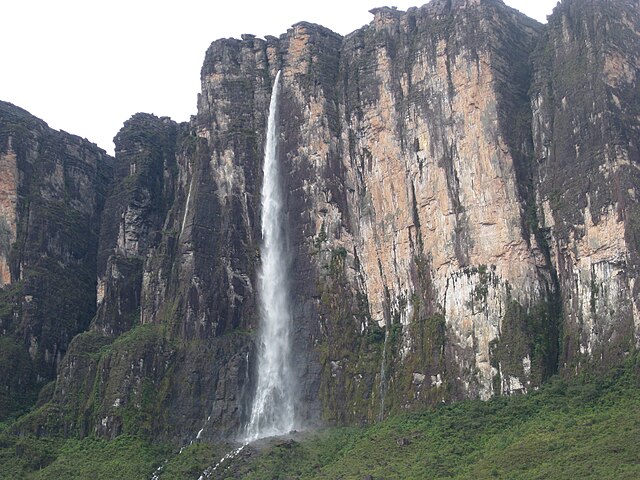
The Potaro River drops 226 metres in one clean plunge off a sandstone plateau in Guyana's rainforest, with no road, no railings and rarely more than a planeload of people at the edge. Most visitors fly in from Georgetown for two hours on the rim.
Full guide Checked September 2026 by David Bussell · 45 sources
Kaieteur is what happens when a big river meets a very tall cliff. The Potaro, dark with tannins from the forest above, runs across the flat top of the Pakaraima escarpment and then goes straight over the edge: 226 metres in a single, unbroken drop, roughly five times the height of Niagara, onto a boulder pile that sends it on down another 25 metres of cascades into a deep, forested gorge. At full flow the curtain is about 113 metres wide and the river averages around 660 cubic metres per second, a combination of height and volume that very few waterfalls anywhere come close to.
There is no road to the top. Nearly everyone arrives on a small plane from Ogle airport on Georgetown's outskirts, lands on an airstrip less than a kilometre from the lip, and spends about two hours on foot with a park guide, walking through low scrub and giant tank bromeliads to a series of named viewpoints: Johnson's View, Boy Scout View and Rainbow View, then the open rock at the top of the falls. There are no barriers anywhere, and the ground at the edge is simply bare sandstone falling away 226 metres. The other way in is a four-to-five-day overland trek up the Potaro from Mahdia, finishing with a steep climb onto the plateau.
What makes a trip here different from most great waterfalls is the emptiness. Kaieteur National Park sees a few thousand visitors a year, not millions, and on a quiet weekday flight you may share the rim with a dozen people. The bromeliads hold the tiny golden rocket frog, found here and nowhere else; Guianan cock-of-the-rock live in the surrounding forest; and swifts roost behind the curtain itself. Pair it with Orinduik Falls on the Brazilian border, or with the Iwokrama rainforest and Rupununi savannah lodges, and it anchors one of the least-crowded wildlife trips in South America.
The United States rates Guyana Level 3, 'Reconsider Travel', reissued on 26 August 2026, for violent crime, including murder and armed robbery, which it says is common, especially at night. The specific warnings are about Georgetown: Stabroek Market, Tiger Bay, Albouystown and Agricola, with the Seawall and National Park area to be avoided after dark. Canada says to exercise a high degree of caution because of high crime, and the UK doesn't advise against travel to any part of the country but flags the same Georgetown neighbourhoods and robberies linked to the airport road. None of the three singles out Kaieteur National Park, and the day trip is a closed loop from a guarded airport to a remote park. In practice that means pre-booked transport between the airport and your hotel, taxis rather than walking after dark, and not carrying valuables openly in town. Canada and the UK also flag tension along the Venezuelan border, far to the west of Kaieteur. Check your own government's page before you book, and make sure your travel insurance covers remote-area evacuation.
Eugene F. Correia International Airport (Ogle), Georgetown → Kaieteur airstrip
A Cessna Caravan or similar small aircraft takes around an hour from Ogle, usually circling the gorge before landing so you see the whole drop from above. On the ground you get roughly two hours with a local park guide, walking a short loop between the viewpoints and the top of the falls, then fly back the same afternoon. Flights only go when enough seats sell and the cloud allows, so dates shift. Some departures add a stop at Orinduik Falls for a swim.
Georgetown → Linden → Mahdia → Pamela Landing → Tukeit → the plateau
The slow way in follows the river the falls belong to. A long day by road reaches the Potaro near Mahdia, then boats and forest trails carry you upstream past Amatuk and Waratuk falls to Tukeit, at the foot of the escarpment. From there it's a steep 2–4 hour climb of roughly 550 metres, nicknamed 'Oh My God' mountain, onto the plateau, with a night at the park guesthouse and a flight back to Georgetown. Nights are in hammocks or basic camps.
Kaieteur National Park guesthouse, near the airstrip
The park runs a simple guesthouse near the airstrip, with beds or hammocks depending on availability, and it's where overland trekkers spend their last night. Staying over is the only way to see Kaieteur empty, in early light and at dusk, when swifts pour back into the gorge to roost behind the curtain. Some Georgetown operators sell a fly-in overnight, but it depends on a later flight having seats, so it takes more planning than the day trip.
Most people should fly in. The day trip gives you the falls, the frogs and the aerial view in an afternoon, at a fraction of the trek's cost. If you have five days and decent fitness, the overland route is the better story, and it ends with the one thing a day trip can't give you: the rim at dawn with nobody else on it.
Late August to October balances a well-fed river with the most reliable flying; May to July puts the most water over the edge but comes with the highest chance of a grounded plane.
The trade-off here is water against weather. The main wet season from about May to August puts the most water over the edge, but it's also when low cloud over the plateau grounds the small planes most often.
Kaieteur at its heaviest: a full, thundering curtain and a gorge filled with spray. The cost is reliability. Rain falls most days, cloud can sit on the escarpment for hours, and flights are delayed or cancelled more often than at any other time of year. Georgetown's streets flood in heavy downpours. Build in at least two spare days if you come now, and expect muddy trails on the overland route.
The most dependable flying of the year, with clearer skies over the plateau and fewer cancelled departures. September and early October still carry plenty of water from the wet season. After that the river falls steadily, and by November the curtain can be noticeably thinner, with more of the dark rock face showing. Heat and humidity stay high throughout.
A shorter, lighter rainy spell around December and January, then a drier stretch from about February to April. Flights generally run well, and flow sits between the wet-season peak and the late-dry low, varying with how much rain the year has brought. It's a reasonable window for combining Kaieteur with the Rupununi, although the savannah is at its driest and hottest by March and April.
Day trips run on small aircraft that fly only when enough seats sell, often a minimum of around nine to twelve passengers, and only when the pilot can see the airstrip. Operators move dates for both reasons, sometimes the evening before. Don't book your Kaieteur flight for your last day in Guyana. Put it early in your trip, with at least one free day behind it.
Prices are 2025/2026 rates published by the airlines, tour operators and lodges themselves, in US dollars or converted from Guyana dollars at about GY$200–210 per US$1. Hotel prices are starting rates seen on booking platforms in September 2026 and move with season, oil-industry demand and occupancy.
The standard visit: check in at Ogle around midday, fly about an hour over unbroken forest, and circle the gorge before landing on the plateau. A park guide then walks you to Johnson's, Boy Scout and Rainbow views and out onto the rock above the drop, pointing out golden rocket frogs in the bromeliads along the way. Air Services Limited sells it direct at the lowest price we found; tour operators add hotel pickup, lunch or smaller groups.
Year-round; most departures Saturday and Sunday, subject to minimum numbers and weather
Adds a short hop to Orinduik Falls on the Ireng River, the Brazilian border, where the water spills over broad terraces of reddish jasper in the open savannah hills of the Pakaraimas. Where Kaieteur is for looking at, Orinduik is for getting into: bring swimwear and sit in the pools beneath the ledges. You get a little less time at Kaieteur, and Evergreen runs it with 4 to 14 passengers.
Year-round, weather and minimum group size permitting
Road from Georgetown through Linden to the Potaro near Mahdia, then boat and forest trail upstream past Amatuk and Waratuk falls to Tukeit. The hard day is the climb up the escarpment, about 550 metres of steep, often muddy trail in 2–4 hours, to arrive on the plateau above the falls. Nights are in hammocks at river camps, then the park guesthouse, and a small plane flies you back to Georgetown.
Year-round; trails are wetter and muddier May – August
Pay on the day — nothing to book in advance.
A fly-in stay at the park guesthouse, using an afternoon flight in and a following-day flight out. The point is the hours day-trippers never see: the gorge in evening light, swifts streaming back to roost behind the falling water at dusk, and the rim in the cool of early morning before the first plane lands. Facilities are basic, and the trip depends on seats being available on two separate flights.
Year-round, subject to flight availability
No booking needed.
The golden rocket frog, a bright yellow frog about the size of a thumbnail, spends its whole life inside the water-filled leaves of one giant bromeliad species. It's found around Kaieteur and nowhere else, and guides know which plants to check. The orange Guianan cock-of-the-rock also lives in the park's forest, though a sighting on a two-hour day trip is luck, not a given. Look, don't touch.
Year-round
No booking needed.
Suspension bridges and four platforms about 30 metres up in the Iwokrama forest canopy, a 15-minute walk from Atta's eight-room lodge. Go at dawn for the birds: this is one of Guyana's best-known birding sites, with Makushi guides who know the calls. Atta sits on the Georgetown–Lethem road about 300 km south of the capital, so it pairs naturally with a Rupununi trip rather than a Kaieteur day.
Year-round
No booking needed.
Riverside cabins at the research centre of the Iwokrama Forest, a protected reserve of nearly a million acres. Days are spent on the Essequibo looking for giant otters and black caiman, on forest trails, or climbing Turtle Mountain for a view over unbroken canopy. Reach it by road from Georgetown in a long day, or by scheduled flight to Fairview (about $440 one way).
Year-round
Pay on the day — nothing to book in advance.
A historic ranch on the Rupununi River, part of the landscape for almost a century and now a lodge known for giant otter rehabilitation and river trips to see them in the wild. Evenings on the savannah bring a good chance of giant anteater, and the ponds hold giant water lilies. Access is by light aircraft or a long overland drive, so most visitors come on a multi-lodge Rupununi itinerary.
Year-round; savannah wildlife easiest to see in the drier months
No booking needed.
A Makushi village in the North Rupununi that owns and runs its own lodge, with village guides leading dawn walks up Surama Mountain, canoe trips on the Burro Burro River and night walks in the forest. Guests sleep in simple rooms or benabs, the traditional thatched round houses. It's one of the longest-running community tourism projects in Guyana, and money goes straight to the village.
Year-round
Pay on the day — nothing to book in advance.
Nearly everyone sleeps in Georgetown and flies out for the day. The only beds at the falls are the park guesthouse, and the rainforest lodges further south belong to a longer trip.
The city's international-brand option: a modern seafront tower with a pool, several restaurants and the most predictable service in town. Popular with oil-industry business travellers, so rates rise and rooms fill midweek.
A long-established Georgetown landmark on the seafront near the Seawall, with a large pool, full business-hotel facilities and a short drive east to Ogle for Kaieteur departures. Prices sit at the top of the city's range.
A pair of 19th-century timber houses turned into a heritage hotel, with verandas, a courtyard mango tree and a well-regarded restaurant. The most characterful place to stay in the city, within reach of St George's Cathedral.
A smaller, well-reviewed three-star with air conditioning, wifi and a bar, and a reliable mid-price base for a Kaieteur flight. Better value than the big seafront hotels if you only need a clean room and a good breakfast.
Georgetown's long-standing traveller favourite: a spotless, family-run timber guesthouse with simple rooms, shared or private bathrooms and inexpensive places to eat nearby. It's small and fills up with independent travellers, so book ahead.
The only place to sleep at the falls: basic beds or hammocks run by the park, used by overland trekkers on their last night and by fly-in overnight trips. Day visitors use it for toilets, drinks and a small menu, paid in cash.
En-suite cabins overlooking the Essequibo at the Iwokrama research centre, with meals from about $77 per person per day and a $15 conservation fee on top. The first rainforest stop on most road trips south.
Eight rooms, home-cooked meals and gardens full of hummingbirds, a 15-minute walk from the Iwokrama canopy walkway. The place birders stay to be up on the platforms at first light.
A community-owned Makushi lodge where the village runs the guiding, the kitchen and the rooms. Simple benabs and cabins at the meeting of forest and savannah. Bring cash, because cards aren't accepted.
A historic ranch-turned-lodge on the Rupununi River, famous for its giant otter work, with river trips at dawn and dusk and savannah drives for giant anteaters. Reached by light aircraft or a long overland drive.
Search all Georgetown, Guyana accommodation
Guyana's main international gateway, about 41 km south of Georgetown. Direct flights from New York JFK (American, JetBlue, Caribbean Airlines), Miami (American), Houston (United), Toronto (Caribbean Airlines, seasonal Air Transat), London Gatwick via St Lucia (British Airways), Amsterdam via St Maarten (KLM), Panama City (Copa) and Bogotá (Avianca).
The small airport on Georgetown's eastern edge, roughly 10 km from the centre, where almost every Kaieteur flight starts. Allow about an hour to get here from Timehri, so don't try to connect straight off an international arrival.
A short strip on the plateau, under a kilometre from the falls. There are no scheduled public flights: it's served by tour charters and operator flights from Ogle, about an hour away.
Every trip to Kaieteur runs through Georgetown: fly internationally into Timehri (GEO), spend at least one night in the city, then take a light aircraft from Ogle (OGL).
International flights land at Timehri, 41 km south of the city; Kaieteur flights leave from Ogle, on the other side of Georgetown. Plan on a night in town in between. Small-plane operators weigh passengers and bags at check-in. On day trips you only need a small daypack, but on multi-day interior trips the checked allowance is often around 20 lb (9 kg), and excess weight is charged or refused depending on the aircraft's payload. Leave your main luggage at your Georgetown hotel.
Guyana's exempt list and the online e-visa system have both changed in the past few years, and third-party sites disagree about several EU countries. If your passport isn't from the US, Canada or the UK, check with a Guyanese embassy or eservices.iss.gov.gy before you book.
 This waterfall
Kaieteur Falls
Guyana
Height251 mWidth113 m
 Most similar
King George VI Falls
Guyana
Height214 mWidth—
Also a plunge waterfall, of similar height and in Guyana too
 Largest curtain
Victoria Falls
Zimbabwe · Zambia
Height108 mWidth1,708 m
Largest single sheet of falling water
 Tallest on earth
Angel Falls
Venezuela
Height979 mWidth—
 Widest on earth
Khone Phapheng Falls
Laos
Height21 mWidth10,783 m
Measured across the whole multi-channel system
Angel Falls is 3.9× taller than Kaieteur Falls. It drops 2.3× further than Victoria Falls (108 m), but Victoria's curtain is 15× wider. Khone Phapheng Falls is 95× wider. Tallest · widest lists.
 3:01
 4:24
 1:58
Chosen from YouTube; videos belong to their creators and play from YouTube's privacy-enhanced player.
History & travel
Charles Barrington Brown · 2018
Reprint of the 1876 account by the geologist who, in 1870, was the first European to record Kaieteur Falls.
Guidebook
Kirk Smock · 2018
The only dedicated Guyana guide, detailing Kaieteur flights from Georgetown and the multi-day overland trek to the falls.

Guidebook
Ben Box · 2017
The one-volume continental handbook, useful for multi-country trips that link falls such as Iguazú, Kaieteur and Angel Falls.
It's often described that way, but the claim is looser than it sounds. At 226 metres high with an average flow commonly given as about 663 m³/s, Kaieteur is among the most powerful single-drop waterfalls anywhere, and Wikipedia calls it among the largest. No authoritative body keeps an official ranking, though, and flow varies a lot between seasons, so 'one of the most powerful' is the safer phrasing.
About $270 per person booked direct with Air Services Limited, including the GY$3,000 park pass, and roughly $335–350 through tour operators such as Wilderness Explorers and Evergreen Adventures, which add pickups, snacks or smaller groups. Adding Orinduik Falls brings it to about $440. The four-day overland trek starts at about $1,195.
About an hour each way from Ogle airport in Georgetown by light aircraft, with roughly two hours on the ground at the falls. From check-in to landing back at Ogle it takes around five to six hours, or about seven if you add Orinduik Falls. Sit on the side the operator suggests for the aerial pass.
Not all the way. You can drive from Georgetown through Linden to the Potaro River near Mahdia, but the last stretch is by boat and on foot, including a steep climb onto the plateau. That's the four-to-five-day overland trek, run by operators with local guides. Nearly every visitor flies.
No. US, Canadian and UK citizens enter visa-free as tourists with a passport valid for at least six months. Length of stay is set on arrival: the US and Canada list up to 90 days, while the UK says 30 days is normal, extendable in Guyana. Some EU nationalities are exempt and others aren't, so check yours.
The US rates Guyana Level 3, 'Reconsider Travel', for violent crime, reissued in August 2026, and Canada advises a high degree of caution. The warnings centre on Georgetown neighbourhoods and night-time street crime, not Kaieteur National Park. Pre-booked transport and ordinary big-city caution in the capital go a long way. Read your own government's current advice before booking.
September and October are the most reliable combination: the river still carries wet-season water and flights are cancelled least. May to August gives the biggest flow but the most weather disruption. By late in the dry season, around November, the falls can look noticeably thinner.
No. There's no safe access to the water at the top or the base on a standard visit, and park guides keep groups back from the edge. If you want to swim, add Orinduik Falls on the Brazilian border, where visitors sit in pools on shallow jasper terraces.
Kaieteur Falls is in Guyana (Guiana Highlands), inside Kaieteur National Park. The nearest base is Georgetown (charter flights from Ogle) and the closest airport is KAI. Its coordinates are 5.1749, -59.4807.
Prices, fees and entry rules change. We re-check full guides regularly; spotted something out of date? Tell us.
Nearby

The Essequibo River is the largest river in Guyana, and the largest river between the Orinoco and Amazon.…

The Orinduik Falls lie on the Ireng River on the Pakaraima Mountains. Orinduik Falls is a wide, multi-tiered…
The Essequibo River is the largest river in Guyana, and the largest river between the Orinoco and Amazon.…
Kukenan Falls is the second tallest major waterfall in Venezuela after Angel Falls. It is also the second…