
About this place
Inventing Niagara: Beauty, Power, and Lies
Ginger Strand · 2009
Explains how much of what you see at Niagara, including the flow over the brink, is engineered and managed.

Canada · United States
Three falls, two countries, one river doing 168,000 cubic metres a minute over the edge. The most visited waterfall system on earth, and the only one with a power station built into the view.
Full guide Checked September 2026 by David Bussell · 23 sources
Niagara Falls is not one waterfall but three, arranged around the tip of Goat Island where the Niagara River splits on its way from Lake Erie to Lake Ontario. Horseshoe Falls, the big curved one everyone pictures, carries about 90% of the flow and sits mostly on the Canadian side of the border — the international line runs right through it, a few metres in from the Ontario bank. American Falls and the much smaller Bridal Veil Falls, separated from each other by Luna Island, are entirely in New York State.
That split geography is why the two sides feel like different trips. Canada, from the town of Niagara Falls, Ontario, gets the view: the whole curved face of Horseshoe Falls head-on, plus Clifton Hill's arcade-and-wax-museum strip a short walk back from the gorge. The US side, inside Niagara Falls State Park, gets proximity: Goat Island puts you on the rock at the lip of the falls, and Cave of the Winds and Maid of the Mist put you in the spray at its base. Most people who do this properly cross the Rainbow Bridge and do both in a day or two.
What makes it a genuine multi-day destination rather than a photo stop is the depth of things actually built here: a boat under the falls on each side, a tunnel drilled behind the curtain, a zipline that fires you at the spray, a whirlpool you ride a cable car over, and helicopters that clear the whole gorge in twelve minutes. Add Niagara-on-the-Lake's wine country twenty minutes downstream, winter ice season, and nightly illuminations with fireworks in summer, and there's a real week here, not just an afternoon.
Stays in Niagara Falls, OntarioFlights to YYZ Where to stay ↓
Niagara Falls, Ontario
Queen Victoria Park runs along the gorge rim directly opposite Horseshoe Falls, so you get the entire curved face in one frame — the single best panorama of the falls that exists. Niagara Parks, the provincial agency, runs almost everything on this side: Journey Behind the Falls, the Power Station tunnel, the Whirlpool Aero Car, White Water Walk and Niagara City Cruises. Clifton Hill, one block back from the rim, is the tourist strip — haunted houses, mini-golf, a wax museum — and worth knowing about mainly so you're not surprised by it.
Niagara Falls, New York
Niagara Falls State Park — the oldest state park in the US, opened 1885 — occupies Goat Island and the riverbank facing Canada. You can't see Horseshoe Falls head-on from here, but you can walk out onto Terrapin Point at the very edge of it, get soaked on Cave of the Winds' Hurricane Deck below American Falls, and board Maid of the Mist from the US side. The town itself is smaller and quieter than its Canadian counterpart, with less neon and fewer restaurants.
Do both if you can — the Rainbow Bridge crossing takes fifteen to thirty minutes on foot including the passport check, and the two sides genuinely complement each other rather than repeating. If you only have one day, Canada gives you more to see and the better photographs; the US side gives you the closer, wetter, more physical experience. Base in Canada for the view from your hotel room, cross for an afternoon on the US side, and come back for dinner.
June through September gets everything running and the best weather; late September and October trade a little warmth for thinner crowds and Niagara-on-the-Lake at harvest.
Water volume barely changes month to month here — this isn't a seasonal river like Victoria Falls or Iguazú — so the variable that actually matters is what's open: the boats, the zipline and most outdoor attractions run roughly late April to early November, and winter turns the gorge and the falls' edges into ice instead.
Everything is open, the illumination runs late into warm evenings, and the weekly fireworks series lights the gorge. Also the busiest and most expensive months on both sides — book Fallsview hotel rooms and the popular boat departures well ahead, especially around Canada Day (July 1) and Independence Day (July 4), when displays are extended.
The season most locals recommend: thinner crowds, cooler air that keeps the mist manageable, and fall colour along the Niagara Parkway and Niagara-on-the-Lake in October. Boats and the zipline typically open in mid-to-late April and close by early-to-mid November — exact dates shift year to year with ice and river conditions, so confirm before you build a trip around them.
The falls do not freeze solid — the volume is too large — but spray freezes onto everything around them, building ice formations along the railings, trees and rock faces that draw photographers from well outside the region. The Winter Festival of Lights runs the Canadian side's illuminated displays from mid-November into January. It is also the cheapest and quietest time to visit, with hotel rates roughly half of summer.
Both falls are lit in changing colours every night of the year by the Niagara Falls Illumination Board, typically from dusk to around 2am in summer and ending earlier in winter — the exact nightly window shifts through the year and is published seasonally by the Board and by Niagara Parks. A weekly fireworks series has run roughly mid-May to mid-October in recent years, with five-minute displays most nights around 10pm and extended shows on July 1 and July 4; confirm the current-year calendar close to your trip, since the schedule is reconfirmed annually and nights are occasionally cancelled for weather.
Prices are 2025/2026 advertised rates from the operators' own sites, converted from CAD to USD at an approximate 0.73 rate and rounded; they move with season, exchange rates and promotions, so treat them as a planning guide rather than a quote.
The original Niagara boat tour, running since 1846 and the reason the phrase 'get soaked at the falls' exists. The boat leaves from below the Observation Tower on the US side, passes the base of American Falls, then pushes into the basin directly beneath Horseshoe Falls where the noise and spray are close to total. Ponchos are provided; bring nothing you mind getting wet.
Late April to early November
The Canadian-side equivalent of Maid of the Mist, departing from the base of the Table Rock gorge and running the same basic route into the mist of Horseshoe Falls, with a pass by American Falls on the way. Slightly more expensive than the US boat and, boosters on both sides will argue, a marginally better vantage on Horseshoe Falls since you approach it from this angle.
April to November
An elevator drops you 38 metres through solid rock to tunnels that open onto portals literally behind the curtain of Horseshoe Falls, plus a lower observation deck at its base that gets you wet. Unlike the boats, this runs all year, which makes it the single best falls-adjacent thing to do in winter.
Year-round
An elevator down the Goat Island gorge wall to a wooden boardwalk that puts you within about six metres of the base of Bridal Veil Falls — the closest legal approach to any part of Niagara Falls, and by most accounts wetter than the boats. Sandals are provided at the entrance because your shoes will not survive dry.
Hurricane Deck open May to mid-October
Four parallel lines run 670 metres down into the gorge from a launch tower in Queen Victoria Park, ending on a platform close enough to Horseshoe Falls to feel the spray. Riders go feet-first, facing the falls the whole way down — a genuinely different angle on the view than any of the boats or walkways offer.
April to November
Doing this one? Check your travel insurance covers adventure activities before you go — SafetyWing is one option.
A jet boat departs from Niagara-on-the-Lake and runs upriver into the Whirlpool Rapids — Class V white water below the falls, at the site of the Great Gorge — turning through standing waves and eddies well away from the falls themselves. The open Wet Jet soaks everyone aboard; the covered Dry Jet keeps you dry and admits children.
May to October
Doing this one? Check your travel insurance covers adventure activities before you go — SafetyWing is one option.
The only helicopter operator flying the falls, based on Victoria Avenue on the Canadian side. Twelve minutes covers all three falls, the Whirlpool Rapids, the Rainbow Bridge and Queen Victoria Park — short, but it's the only vantage from which the whole horseshoe shape of Horseshoe Falls actually reads as a horseshoe.
Year-round, weather permitting
A cable car strung in 1916 across the Niagara Whirlpool, the spot 4.5 km downstream where the river makes a hard right turn and churns in a genuine whirlpool. The car hangs from six cables with no support towers underneath, suspended entirely over the gorge — one of the odder and more overlooked things to do on the Canadian side.
April to November
An elevator and tunnel bring you down to a boardwalk at river level inside the Great Gorge, at the edge of the Class VI Niagara Whirlpool Rapids — the same water the jet boats run, seen from a fixed and much calmer vantage. No falls view here; this is about the rapids themselves.
April to November
Pay on the day — nothing to book in advance.
A decommissioned 1905 hydro station reopened as an attraction in 2021, with the original turbine hall intact and a 671-metre tailrace tunnel — drilled 55 metres below the city, closed for over a century — that now opens onto a viewing platform at river level below the falls. Genuinely different from the other falls-adjacent walks, and it explains where all the diverted water actually goes.
Year-round
Pay on the day — nothing to book in advance.
A 160-metre tower a short walk back from the gorge, with an indoor/outdoor observation deck above both falls and a revolving restaurant. Less immersive than anything at river level, but it's open in weather that grounds the helicopters and gives the clearest single overview of how the three falls actually sit relative to each other.
Year-round
Twenty minutes downriver, Niagara-on-the-Lake anchors Ontario's largest wine region, known especially for icewine — grapes picked frozen, usually in December or January. Dozens of wineries line the Niagara Parkway between the falls and the lake, and it's the standard second day for anyone based on the Canadian side.
Year-round; harvest September–October
The strip of haunted houses, mini-golf, Ripley's and fast food one block back from the Canadian gorge rim is Clifton Hill, and it's worth knowing it exists as a separate thing from Niagara Parks' attractions before you book. It's loud, lit up in neon, and aimed squarely at families killing an evening — fun on its own terms, but if you came for the falls, everything that matters (the boats, Journey Behind the Falls, the Power Station, the viewpoints) is run by Niagara Parks along the actual rim, not on the hill. A second honesty note: the falls' flow is deliberately throttled at night, roughly in half, to free up water for hydroelectric power — an underwhelming late-night viewing is sometimes the treaty working as designed, not bad luck.
Fallsview hotel towers on the Canadian side get the view; the US side and Niagara-on-the-Lake trade that view for quieter streets and, in Niagara-on-the-Lake's case, wine country on the doorstep.
One of the largest falls-facing towers on the Canadian rim, connected by skyway to the Fallsview Casino and a short walk to Table Rock. Book a falls-view room specifically — standard rooms don't have one.
Directly across from Horseshoe Falls with a rooftop pool that looks straight at it. Consistently rated among the better falls-view rooms on the Canadian side.
A 58-storey tower with suite-heavy inventory and a revolving dining room near the top — good for families wanting more space than a standard hotel room.
A converted 1904 flour mill a few minutes' walk from the rim, smaller and quieter than the casino towers, with the stone silo structure still visible in the building.
A 1929 Art Deco office tower converted to a boutique hotel in downtown Niagara Falls, NY — walking distance to Niagara Falls State Park, Cave of the Winds and the US Maid of the Mist dock.
The largest hotel on the US side, attached to the Seneca Nation's casino, a short walk from the state park. Rates swing hard with casino promotions and weekday/weekend demand.
A reliable chain option close to the state park entrance, with some rooms carrying a distant falls view — cheaper than the Canadian Fallsview towers for a comparable standard.
A Victorian grand hotel on Niagara-on-the-Lake's main street, twenty minutes from the falls and inside walking distance of a dozen wineries — the choice for a wine-country base over a falls-view room.
One of the more affordable options still inside walking distance of the gorge, popular with families and bus-tour groups.
A short bus ride from the falls in Niagara Falls, Ontario's downtown, the standard budget base for backpackers and solo travellers on this side.
Search all Niagara Falls, Ontario accommodation
About 130 km / 80 miles from Niagara Falls, roughly 1.5 hours by car or shuttle. The main international gateway for the Canadian side, with direct long-haul routes from Europe, Asia and across North America.
About 30 km / 19 miles from Niagara Falls, NY, roughly 30–40 minutes by car. The closest airport with meaningful route choice, mostly domestic US connections plus some to Toronto.
About 8 km / 5 miles from Niagara Falls, NY. A small airport with limited scheduled commercial service; mainly used for charters and general aviation rather than as a primary gateway.
Toronto Pearson (YYZ) is the dominant hub for reaching the Canadian side and for international connections generally; Buffalo (BUF) is the more convenient US domestic option and often cheaper for a US-based trip, at the cost of a border crossing to reach the Canadian attractions.
The Rainbow Bridge is the pedestrian and vehicle crossing linking the two tourist districts, a walk of roughly 15–30 minutes gate to gate including the passport check on the US side. Tolls: about US$6 / CA$8.50 cash for a passenger vehicle, and US$1 / CA$1.25 per pedestrian, collected on the Canadian side before the walkway. NEXUS cardholders get dedicated fast lanes, but not at Rainbow Bridge — those lanes are at the Lewiston-Queenston and Whirlpool Rapids bridges a few kilometres upstream, so a NEXUS card saves time only if you use one of those crossings instead.
Requirements and fees for both the eTA and ESTA change without much notice and depend on your nationality — confirm against the official Government of Canada and US CBP sites before you travel, especially the ESTA land-crossing rule, which surprises a lot of visitors who assume it's air-only.
 This waterfall
Niagara Falls
Canada · United States
Height51 mWidth1,203 m
 Most similar
Shoshone Falls
United States
Height65 mWidth274 m
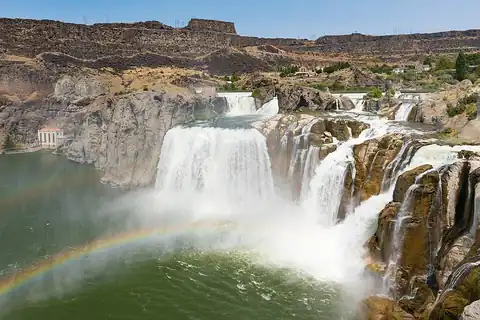
Also a block waterfall, of similar height and in the United States
 Largest curtain
Victoria Falls
Zimbabwe · Zambia
Height108 mWidth1,708 m
Largest single sheet of falling water
 Tallest on earth
Angel Falls
Venezuela
Height979 mWidth—
 Widest on earth
Khone Phapheng Falls
Laos
Height21 mWidth10,783 m
Measured across the whole multi-channel system
Angel Falls is 19× taller than Niagara Falls. Victoria Falls is 2.1× taller and 1.4× wider. Khone Phapheng Falls is 9.0× wider. Tallest · widest lists.
 3:50
 19:09
 1:54
Chosen from YouTube; videos belong to their creators and play from YouTube's privacy-enhanced player.
About this place
Ginger Strand · 2009
Explains how much of what you see at Niagara, including the flow over the brink, is engineered and managed.

About this place
Pierre Berton · 2002
Berton's lively history of the falls: daredevils, tightrope walkers, power barons and the tourist trade on both banks.
Guidebook
Carolyn B. Heller · 2019
Ontario guide with a dedicated Niagara Falls section on lodging, the Canadian-side attractions and wine country nearby.

Guidebook
Lonely Planet · 2024
Country-wide guide for combining Canadian falls, from Quebec and Ontario to the Rockies and the North.
Canada for the view: Queen Victoria Park faces Horseshoe Falls head-on and has the wider range of attractions. The US side gets you closer to the water — Goat Island, Terrapin Point and Cave of the Winds put you at the literal edge. Most visitors cross the Rainbow Bridge and do both; if you only get one, take Canada for the panorama.
Horseshoe Falls is both wider and carries far more water — about 670 metres across and roughly 90% of the Niagara River's flow, mostly on the Canadian side. American Falls is narrower, carries the remaining 10%, and sits entirely in New York, alongside the much smaller Bridal Veil Falls.
Yes. A passport is the standard document for crossing on foot or by car between the US and Canadian sides. US and Canadian citizens can sometimes use an enhanced driver's licence instead of a passport for land crossings specifically, but a passport works for everyone and avoids the question entirely.
It depends on the direction and mode. Canada's eTA applies only to visa-exempt travellers arriving by air, not by land — crossing the Rainbow Bridge into Canada needs only a passport. The US ESTA is different: since 2022 it applies to Visa Waiver Program travellers at land crossings too, not just flights, so apply before you cross into New York if that requirement applies to you.
Roughly late April through early November on both sides — Maid of the Mist in the US and Niagara City Cruises in Canada. Exact opening and closing dates shift year to year with ice and water conditions on the river, so check the current season before building a trip around them.
Yes, and it's a legitimately different experience — spray freezes into ice formations along the railings and rocks, though the falls themselves don't freeze solid given the volume of water. Most boats, the zipline and the jet boat close for the season, but Journey Behind the Falls, the Power Station and Skylon Tower stay open year-round.
If you're only doing the headline viewpoints, one full day covers it. A genuine multi-day trip makes sense once you add Journey Behind the Falls, a boat on each side, the zipline or jet boat, a helicopter flight, and a day in Niagara-on-the-Lake wine country — the attraction list here is deeper than most people expect before arriving.
Toronto Pearson (YYZ) if you're basing on the Canadian side or connecting internationally; Buffalo (BUF) if you're US-based and want the shorter, usually cheaper domestic hop, accepting a short land border crossing to reach the Canadian attractions. Niagara Falls International (IAG) has too little scheduled service to plan around.
Niagara Falls is in Canada / United States (Great Lakes), inside Niagara Falls State Park / Niagara Parks. The nearest base is Niagara Falls and the closest airport is IAG. Its coordinates are 43.0828, -79.0742.
Horseshoe Falls, the largest, mostly in Canada; the American Falls; and the much smaller Bridal Veil Falls, separated from the American Falls by Luna Island. Goat Island divides the Horseshoe Falls from the two American falls.
Prices, fees and entry rules change. We re-check full guides regularly; spotted something out of date? Tell us.
Nearby
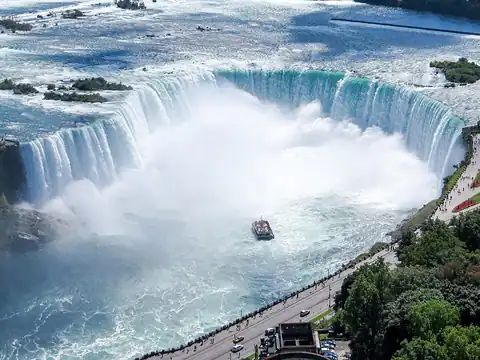
Carries about 90% of the Niagara River's total flow

The Eternal Flame Falls is a small waterfall located in the Shale Creek Preserve, a section of Chestnut Ridge…
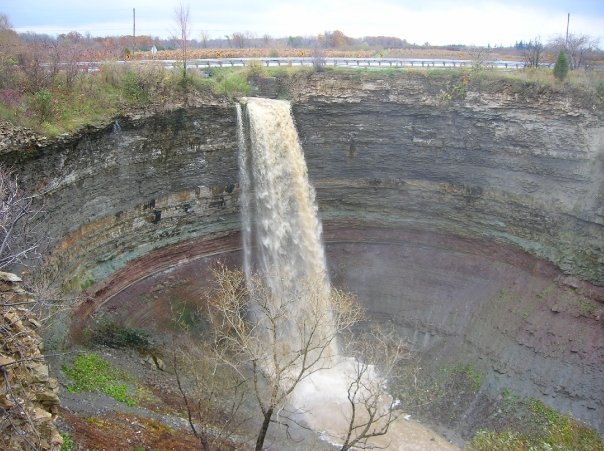
Devil's Punch Bowl is a 37-metre ribbon waterfall on the Niagara Escarpment, in the Stoney Creek community of…

Albion Falls is a 19 m classical/cascade waterfall flowing down the Niagara Escarpment in Red Hill Valley, in…