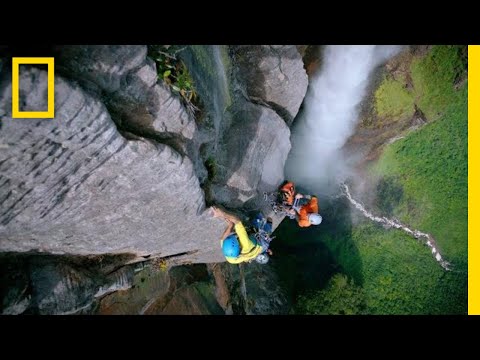
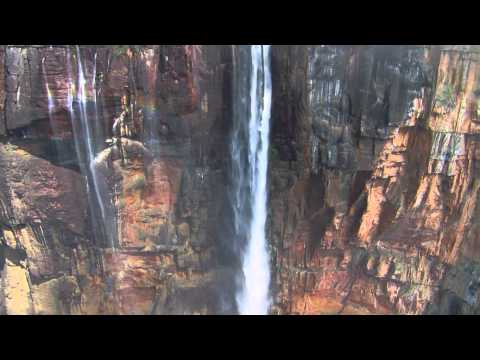
The world's tallest waterfall: water falls 979 metres off the rim of Auyán-tepui, 807 of it in one uninterrupted drop, into a jungle gorge deep inside Canaima National Park. Getting there is most of the trip.
Full guideChecked September 2026 by David Bussell · 18 sourcesUNESCO World Heritage
Angel Falls does not look like other great waterfalls because it isn't shaped like one. There is no wide lip, no river charging over an edge — a thin ribbon of water leaves the flat top of Auyán-tepui, a sandstone table mountain rising sheer out of the rainforest, and falls so far that most of it turns to mist and wind before it reaches the pool at the bottom. The uninterrupted drop is 807 metres, more than fifteen times the height of Niagara, and the total fall including the lower cascades is 979 metres. It is, by a wide margin, the tallest waterfall on Earth.
The falls sit inside Canaima National Park, a UNESCO World Heritage Site of roughly 30,000 square kilometres of tepuis and forest in south-eastern Venezuela, and they are genuinely remote. There is no road. Everyone starts at Canaima, a village on a lagoon reached only by small plane, and from there the trip splits two ways: a river expedition by dugout canoe up the Carrao and Churún rivers to a camp facing the falls, or a light-aircraft flight over the top of them. Which one you get depends almost entirely on the season.
This is not a waterfall you add to a wider Venezuela itinerary lightly in 2026. The place itself — the tepui, the jungle, the lagoon falls at Canaima, the scale of the drop — is as extraordinary as its reputation suggests. But the country around it has been through a US military intervention, the capture of its president, and a major earthquake within the past year, and every government whose advice matters here is currently telling its citizens not to go. We've written this guide in full, and we've written the travel-advisory section first, because you should read that before the rest.
Venezuela has had an extraordinary year. In January 2026, US forces captured President Nicolás Maduro in a military operation and flew him out of the country; Delcy Rodríguez was sworn in as interim president under heavy US oversight, and the country has been in a stabilisation period since. Then, on 24 June 2026, back-to-back earthquakes (magnitude 7.5 and 7.2) struck central Venezuela, killing more than 180 people and badly damaging Caracas's main airport, which only partially reopened to commercial traffic in early September 2026 after a roughly ten-week closure. Neither event was centred on Canaima or Angel Falls, but both affect anyone trying to get there. As of our research (September 2026): the United States rates Venezuela Level 3, 'Reconsider Travel' (with several specific regions, mostly border areas, rural Bolívar and the far south-west, at Level 4 'Do Not Travel'); Canada rates it 'Avoid all travel' — its highest level — and has temporarily suspended its embassy in Caracas, routing consular help through Bogotá; the UK advises against all but essential travel to most of the country and against all travel to a smaller list of border and mining-arc regions. These levels change; verify all three directly before booking anything, not from this page. Practically, this means: your travel insurer may exclude claims for a trip made against your government's advice, and consular assistance if something goes wrong may be limited, slow, or routed through a neighbouring country. International flights into Caracas resumed in stages through 2026 and several carriers (American, Avianca, Copa, LATAM Colombia, GOL) were flying again by September, but capacity is still rebuilding and can change with little notice. Cash — US dollars — is essential; card and ATM access is inconsistent outside Caracas and not something to rely on in Canaima. We are not telling you not to go, and plenty of people are travelling in Venezuela right now, including to Canaima. We are telling you that going means travelling against the explicit advice of your home government, and that this guide exists to describe the place accurately, not to talk you into or out of the trip. That decision, and the responsibility for it, is yours.
By river or by air?
By river — the curiara expedition
Wet season only, roughly June – November/December
Canaima → up the Carrao and Churún rivers → Isla Ratoncito
The full expedition: a motorised dugout canoe (curiara), usually with a Pemón crew, runs several hours up the Carrao and then the narrower Churún into the gorge below Auyán-tepui, stopping at island camps along the way. You sleep in a hammock on or near Isla Ratoncito, directly across the water from the falls, then climb a steep jungle trail to the Mirador Laime viewpoint — and, water levels allowing, wade in the pool at the base. This only runs when the rivers are deep enough to float a loaded canoe, which is a wet-season condition, not a calendar one.
Carrao & Churún river runIsla Ratoncito hammock campMirador Laime viewpointNatural pool at the base (level permitting)Usually combined with the Canaima lagoon falls en route
EntryCanaima National Park entry fee is charged locally, historically around US$30–40; the river trip itself is sold as a 1–3 night package by camps and agencies in Canaima, not as a standalone ticket
Best forGetting genuinely close to the falls, camping under the tepui, travellers with 3+ days and a wet-season trip
By air — the overflight
Possible year-round, cloud permitting
Small plane (avioneta) or occasional helicopter from Canaima
A light aircraft — historically a Cessna Caravan or similar — climbs out of Canaima and banks over Auyán-tepui so you see the entire 979-metre drop in one uninterrupted view from above, something the river trip never gives you since you're looking up at it from the base. It runs whenever the weather cooperates, which makes it the only realistic option in the dry season when the rivers are too shallow for boats, and a good add-on to the river trip in wet season too. Cloud over the tepui is the main risk — flights get cancelled or rerouted, not just delayed.
Full drop visible in one passThe only dry-season optionNo hike, no overnight, no river logisticsCombinable with a lagoon-falls day at Canaima
EntrySold locally by camps and small operators in Canaima, cash only; weather-dependent and not always guaranteed to run same-day
Best forDry-season visitors, short stopovers, anyone who can't or doesn't want to do the multi-day river trip
The short answer
In river season, do both if your schedule allows it — the boat trip gets you close and the flight gives you the scale a ground view can't. Outside river season, the overflight is not a consolation prize, it's the only way to see Angel Falls at all: the boats simply can't run, and the falls themselves are reduced to a trickle.
August to October gives you the best chance of a full-flow river expedition; outside June–November, plan on the overflight and the Canaima lagoon falls instead, not the falls themselves.
The single variable that decides everything here is river depth. It decides whether a boat can physically reach the falls, and it decides how much water is coming over the top when you get there.
Wet season — river season
June – November, sometimes into early December
Angel Falls at real volume, and rivers deep enough for the curiara expedition up the Carrao and Churún to run. This is the only window in which the multi-day river trip to Isla Ratoncito and the Mirador Laime viewpoint operates at all. Rain is frequent and the jungle is exactly as wet as you'd expect; cloud can also affect the overflight on any given day.
Open
River expedition to Isla Ratoncito & Mirador Laime
Overflights, cloud permitting
Salto Sapo and Salto Hacha at strong flow
Camping at the falls
Closed or compromised
Dry season
December/January – May
The Carrao and Churún drop too low for a loaded curiara to make the run, so there is no boat access to Angel Falls itself — this is stated plainly by every operator and travel guide we checked. The falls thin to a trickle, and in the driest months (roughly February–March) can be reduced to almost nothing depending on that year's rains. Canaima lagoon and its own waterfalls, fed differently, keep flowing, and the overflight keeps running weather permitting, so a Canaima-based trip is still possible — a trip to the base of Angel Falls itself is not.
The best month within the window isn't the whole window
Within the wet season, flow builds through the rains — August to October is usually cited as when Angel Falls carries the most water and the rivers are most reliably navigable. June and late November/December are workable but thinner, and the exact cut-off at either end shifts year to year with that season's rainfall, so confirm timing with an operator rather than the calendar alone.
Everything you can do here
This is one of the fastest-changing destinations we cover. Political, seismic and aviation events in 2026 mean prices, routes and entry requirements from even a few months ago may already be out of date; treat every number here as a starting point to verify, not a quote, and treat the advisory section as more important than any price on this page.
River expedition to the base of Angel Falls
sold as a 2–4 day package by Canaima-based camps/agencies; historic all-in rates from roughly US$300–900+ pp depending on nights, season and operator — verify current pricing directly, it moves fast
A motorised dugout canoe runs you up the Carrao and then the Churún river, through gorge scenery between tepuis, to an island camp facing Angel Falls. You sleep in a hammock, then hike up to the Mirador Laime viewpoint the next morning for the closest ground view there is. Only runs when the rivers are deep enough — this is the trip that actually gets you to the falls, not just past them.
River2–4 days typicallyCanaima-based camps and agencies (e.g. Waku Lodge, Campamento Parakaupa) with Pemón boat crews
sold locally in Canaima, cash; unable to verify a current fixed price — expect it to be quoted per flight/per seat on the day
A short flight out of Canaima that banks over Auyán-tepui so the full 979-metre drop is visible in one pass — the one view the river trip can't give you. This is the only way to see Angel Falls at all in the dry season, when the rivers are too low for boats. Flights are weather-dependent and get cancelled outright in heavy cloud rather than merely delayed.
Scenic flight20–40 minutes typicalSmall operators based at Canaima airstrip
historically quoted around US$2,000–3,000 for a shared 4–6 seat helicopter (so roughly US$400–750 per person split among a full load) — unverified and likely to have moved; treat as a charter, not a fixed-rate product
A pricier, less routine alternative to the fixed-wing overflight, usually arranged as a private charter through a Canaima camp rather than booked as a standard tour. Worth asking about if the fixed-wing flight isn't running, but don't plan around it being available on short notice.
Scenic flightAround 30–45 minutesCharter operators, not a standing daily service
Occasional, weather and charter availability permitting
usually bundled into a Canaima lagoon day tour rather than sold separately
A short curiara ride across the Canaima lagoon to Anatoly Island, then a walk that leads in behind the curtain of Salto El Sapo — one of the more genuinely striking short walks in the park, and doable on a day trip even when the rivers to Angel Falls itself are too low to run. Expect to get thoroughly wet.
HikeAbout 2 hours round tripCanaima-based camps and agencies
Year-round
No booking needed.
Salto Hacha
usually bundled with the Salto El Sapo excursion as a combined lagoon tour
The other named waterfall on the Canaima lagoon, reached by boat and a short set of stairs, with a walk behind part of its curtain as well. Less famous than El Sapo but usually run as a pair with it in the same half-day, and a reliable option regardless of season since it's fed by the lagoon, not the Churún.
HikeAbout 2 hours round tripCanaima-based camps and agencies
Year-round
No booking needed.
Pemón community and craft visit
often included free in multi-day camp packages, or a short add-on
Canaima and the surrounding villages are Pemón territory, and most camps run a visit to see craftwork, hear about tepui cosmology and the history of the park, and buy directly from makers. Worth doing on a rest day or a dry-season visit when the river trip isn't an option.
Heritage1–2 hoursCanaima-based camps, coordinated with local Pemón communities
Year-round
No booking needed.
Canaima lagoon boat tour
low-cost, widely offered — ask any camp
A short, calm run across the lagoon past its own line of waterfalls, with the pink-sand beaches and the tepuis behind them. The easiest and most reliable activity in Canaima regardless of season or river conditions, and a good first afternoon while you plan the rest of the trip.
Boat1–2 hoursCanaima-based camps and agencies
Year-round
No booking needed.
Tepui trek add-on (e.g. Kuravaina)
sold as an extra day within a multi-day Canaima package
Some multi-day packages add a half-day climb onto a smaller, more accessible tepui near Canaima for views back across the savanna to Auyán-tepui, rather than the full Angel Falls river route. A reasonable way to fill a spare day, particularly if the main river trip is weathered out.
HikeHalf dayCanaima-based camps and agencies
Year-round, best in drier weather underfoot
No booking needed.
Swim at the base of Angel Falls
included in the river expedition package when conditions allow; not a standalone booking
At the end of the hike to Mirador Laime, if the water level and your guide agree it's safe, you can wade into the natural pool at the base of the falls. It isn't guaranteed on every trip — high flow can make it unsafe, and this is never sold as a separate activity — but it's the single most-mentioned highlight of the river expedition by people who've done it.
SwimmingPart of the river expedition itineraryIncluded with river-expedition operators
Wet season, water level dependent
No booking needed.
Where to stay
Every option here is in or right around Canaima, since there's nowhere else to stay — the falls themselves have no accommodation beyond the hammock camps used on the river expedition.
Waku Lodge
A long-established, family-run operation (advertised as nearly 50 years in Canaima) offering full-day and overnight Angel Falls trips, overflights and the Salto Sapo/Hacha walk from a lagoon-front base. One of the more consistently active operators we found online.
Mid-rangeCanaima lagoonPackage-based, not quoted per room — ask for current rates
An 18-room camp with private bathrooms in the Kanaimö indigenous community's sector of the park, running canoe trips, tepui treks and cultural visits with Pemón guides.
Mid-rangeWestern sector, Canaima National ParkPackages advertised from around US$435 pp
A lagoon-side camp running the standard roster of Canaima excursions (Salto Sapo, Salto Hacha, lagoon tours) alongside multi-day Angel Falls river trips.
Mid-rangeCanaima lagoonPackage-based — ask for current rates
A smaller, longer-running camp mentioned by name in Canaima trip reports for years. We could not confirm its current 2026 operating status from official channels — check directly before relying on it.
Basic hammock-and-mosquito-net camps used specifically for the overnight river expedition, positioned to wake up looking at the falls. This is not a stand-alone booking — it comes bundled with whichever Canaima operator runs your river trip.
BudgetOn the Churún river, facing Angel FallsIncluded in the river-expedition package, not booked separately
Book direct
Indigenous-run budget camps (e.g. Wey Tú Pu)
Simpler, community-run alternatives to the lodge-style camps, generally cheaper and often the option pushed by budget-focused agencies bundling flights, meals and excursions into one price.
BudgetCanaimaAdvertised from around US$480 pp for a multi-day package
Simón Bolívar International Airport, Caracas/Maiquetía
The main international gateway. Badly damaged in the June 2026 earthquakes; reopened to commercial traffic on a partial basis on 1 September 2026, with international carriers (American, Avianca, Copa, LATAM Colombia, GOL and others) resuming in stages through September. Confirm current status before booking.
CBL
Tomás de Heres Airport, Ciudad Bolívar
The traditional departure point for small-plane flights into Canaima, historically running daily services (Cessna Caravan/Cessna 206/similar) in the 8am–2pm window. Reached from Caracas by a domestic flight or a long road journey; confirm current domestic connectivity given the year's disruptions.
PZO
Manuel Carlos Piar Guayana Airport, Puerto Ordaz
The other traditional gateway to Canaima, functionally interchangeable with Ciudad Bolívar for this purpose and often the better-connected of the two domestically.
CAJ
Canaima Airport
A small airstrip with no road link to anywhere — every visitor arrives and leaves by air. All onward travel (river trips, overflights, lagoon tours) is arranged locally once you land.
Caracas is the international hub; Ciudad Bolívar and Puerto Ordaz are the traditional domestic hops onward to Canaima, though given 2026's disruptions to both the airline network and the main international airport, confirm the current routing — including whether a same-day Caracas–Canaima connection is realistic — with an operator before you buy separate tickets.
There is no independent travel here
You cannot show up in Canaima and freelance a trip to Angel Falls. River expeditions run through licensed camps and Pemón boat crews, overflights are booked through small local operators, and most visitors arrive on a pre-arranged multi-day package that bundles the CAJ flight, accommodation and excursions into one booking made in advance, in some cases specifically because Venezuela's newer e-visa process for US citizens (introduced in 2026) requires a confirmed tour-operator booking before it will be issued.
Visas & entry
Canada — tourist visa VariesCanada's official travel advisory page states a tourist visa is required for Canadians visiting Venezuela — this is a change from Venezuela's historic visa-exempt treatment of many Western nationalities, and other sources still describe Canadians as visa-exempt for short stays. We could not fully reconcile this contradiction; confirm directly with Venezuela's nearest diplomatic mission or a specialist visa service before booking flights.
United States — e-visa Not independently confirmedIn April 2026 the US Embassy in Caracas began publishing information on a new electronic visa process for US citizens — reportedly the first formal pathway in years — which appears to require a confirmed booking with a Venezuelan tour operator as part of the application. Given how new and fast-moving this is, verify the current process directly with the embassy before applying.
UK and most other Western nationalities Historically visa-free for short tourist staysVenezuela has historically allowed visa-free entry for up to 90 days for UK, EU and several other nationalities, and some current sources still describe it this way. Given how much else has changed in 2026, confirm your specific nationality's requirement before travelling rather than relying on pre-2026 information.
Venezuela's entry rules have been unusually unstable through 2026, and our sources genuinely disagree with each other on some points, particularly for Canadians. This is one part of the guide where you should verify directly with an embassy or consulate, not trust a summary — ours included.
Day 1 — fly Ciudad Bolívar/Puerto Ordaz (or Caracas, connections permitting) to Canaima; afternoon lagoon boat tour and the Salto El Sapo walk-behind.
Day 2 — Salto Hacha and a Pemón community visit in the morning; overflight of Angel Falls in the afternoon, weather permitting.
Day 3 — spare morning in case yesterday's flight was weathered out, then return flight out.
4–5 days, river season only (roughly June – November)
The river expedition
Day 1 — fly into Canaima; lagoon tour and Salto Sapo/Salto Hacha in the afternoon.
Day 2 — curiara up the Carrao and Churún rivers to an island camp facing Angel Falls; hammock overnight.
Day 3 — early hike to Mirador Laime for the closest ground view, swim at the base if conditions allow, then start the return leg downriver.
Day 4 — back in Canaima; rest day, Pemón craft visit, or a half-day tepui trek if the schedule allows.
Day 5 — return flight out, with a buffer day built in for weather.
1–2 days
Canaima only, no Angel Falls river trip
Day 1 — fly in, lagoon tour, Salto Sapo and Salto Hacha, overflight of Angel Falls in the afternoon if weather allows.
Day 2 — fly out, or add a half-day tepui trek before departure.
Practical notes
MoneyBring US dollars in cash — this is not optional. Card and ATM access is unreliable outside Caracas and essentially not something to plan around in Canaima. Bring more than you think you need, in a mix of denominations, since change for large bills can be hard to find.
BookingThere is no walk-up market for river trips or overflights once you land in Canaima — book through a licensed camp or agency in advance, as part of a package that includes your CAJ flight. This isn't just convenience: given the fluid entry requirements in 2026, a confirmed booking may be a condition of your visa.
HealthThis is a malaria zone; get travel-health advice on prophylaxis before you go. Venezuela's healthcare system is widely described as under severe strain, with shortages of medicines and equipment, and Canaima itself has essentially no medical infrastructure — evacuation in an emergency would be slow.
DocumentsCarry printed copies of your accommodation booking, onward/return flight, and passport photo page — travellers report unusually thorough checks at Venezuelan airports and borders in 2026, and being asked to show all of these.
Weather bufferBoth the river trip and the overflight are weather-dependent, and cloud over Auyán-tepui can cancel a flight outright rather than just delay it. If you have a fixed departure date, don't schedule your Angel Falls activity for your last possible day in Canaima.
ConnectivityExpect little to no reliable mobile data or wifi once you're in Canaima. Tell people your rough plans before you go, and don't count on checking in daily.
What to packRiver trip: dry bag or waterproof phone case, quick-dry clothing, insect repellent, a headtorch for the hammock camp. Lagoon-only trip: swimwear for the walk-behind falls and sun protection — there's very little shade on the lagoon crossings.
Victoria FallsEiffel TowerOloʻupena FallsTugela FallsAngel Falls
Width of the crest, drawn to scale
Khone Phapheng Falls10,783 m
Victoria Falls1,708 m
Angel Falls is 31 m taller than Tugela Falls, the next tallest in our index. It drops 9.1× further than Victoria Falls (108 m). We don't have a reliable crest width for Angel Falls yet, so it is left off the width chart. Tallest · widest lists.
Canaima itself, away from the border regions and mining areas flagged in the advisories, has not historically been named as a specific high-crime zone. But your own government almost certainly advises against travel to Venezuela as a whole right now — verify the current US, Canadian and UK advisories directly, understand what that means for your insurance and consular support, and decide for yourself. This guide won't make that call for you.
Can I see Angel Falls year-round?
You can fly over it year-round, cloud permitting. You can only reach its base by river roughly June to November, sometimes into December, when the Carrao and Churún rivers are deep enough for a curiara. Outside that window the falls also carry much less water — in the driest months they can thin to almost nothing.
How do I actually get to Angel Falls?
Fly into Canaima — there's no road. Most people connect via Ciudad Bolívar or Puerto Ordaz, or via Caracas when routings allow. From Canaima, it's either a multi-day curiara trip up the Carrao and Churún rivers to a camp facing the falls, or a short overflight in a light aircraft.
Do I need a visa to visit Venezuela?
Requirements have shifted significantly in 2026 and our sources conflict, especially for Canadians. The US introduced a new e-visa process for its citizens in April 2026 that appears to require a confirmed tour booking. Check directly with Venezuela's nearest diplomatic mission for your specific nationality before booking flights.
What's the difference between Angel Falls and the Canaima lagoon waterfalls?
Salto Sapo and Salto Hacha are on the Canaima lagoon itself, a short boat ride from the village, reachable and walkable year-round. Angel Falls is a multi-hour river journey further into the park, on Auyán-tepui, and only reachable by boat in the wet season — the two are often confused by first-time visitors planning a trip.
How close can I actually get to Angel Falls?
On the river expedition, you camp on or near Isla Ratoncito facing the falls, then hike about an hour up a steep trail to the Mirador Laime viewpoint, and — water level and your guide permitting — wade into the natural pool at the very base. That's as close as tourism gets; there's no trail to the top.
Are international flights to Venezuela running again?
Yes, in stages. Caracas's main airport was badly damaged in the June 2026 earthquakes and only partially reopened to commercial traffic on 1 September 2026, with several international carriers resuming service through that month. Capacity is still rebuilding, so confirm your specific route close to your travel date rather than assuming normal service.
Can I pay by card in Canaima?
Don't plan on it. Bring US dollars in cash for the whole trip — park fees, tours, meals not already included in a package, and anything else. Card and ATM reliability is inconsistent even in Caracas and effectively absent in Canaima.
Where is Angel Falls?
Angel Falls is in Venezuela (Guiana Highlands), inside Canaima National Park. The nearest base is Canaima and the closest airport is CAJ. Its coordinates are 5.9701, -62.5359.