
Walking guide
Walking in the Drakensberg: 75 Walks
Jeff Williams · 2017
Route descriptions for the Amphitheatre, including the Sentinel chain-ladder route to the top of Tugela Falls and the gorge walk below.

South Africa · Drakensberg
The Thukela River leaps off the Amphitheatre, a five-kilometre basalt wall in the northern Drakensberg, in a chain of free-falling tiers that together drop roughly 948 metres. Reach the lip via two steel chain ladders, or the base through a river gorge.
Full guide Checked September 2026 by David Bussell · 47 sources UNESCO World Heritage
The Thukela River rises on the high basalt plateau of Mont-aux-Sources, a little over 3,000 metres up, runs a few kilometres across a grassy summit bog, and then simply runs out of mountain. It goes over the edge of the Amphitheatre, a cliff wall about 5 km long and up to 1,200 metres high, in a series of free leaps and short cascades totalling a widely quoted 948 metres, the first drop alone about 411 metres. Most sources count five tiers; the World Waterfall Database thinks there may be seven or eight, some hidden in a gorge nobody has properly surveyed.
There is no single viewpoint and no road to the falls. You choose a side. From the Free State, a rough road above the town of Phuthaditjhaba climbs to the Sentinel car park at about 2,540 metres, and a 12 km return hike, including two near-vertical steel chain ladders, puts you on the plateau at the lip, looking straight down the drop. From KwaZulu-Natal, the Tugela Gorge walk in Royal Natal National Park follows the river upstream from below, ending with the Amphitheatre wall and the falls hanging above you.
This is a hiking destination first. The falls are seasonal, strongest after summer rain and reduced to a thread, or a column of ice, in the dry winter, so the trip is as much about the Amphitheatre as the water: sunrise on the escarpment edge, a night camped beside the river on the summit, a via ferrata up Beacon Buttress, San rock paintings in the valley below, and the rest of the uKhahlamba-Drakensberg World Heritage Site within a few hours' drive.
Stays in Northern Drakensberg, BergvilleFlights to JNB Where to stay ↓
Sentinel car park, above Witsieshoek Mountain Lodge, near Phuthaditjhaba (Free State)
The famous one. From the Sentinel car park the path zigzags up under the Sentinel, contours along the base of the Amphitheatre cliffs, then climbs two sets of steel chain ladders, roughly 35–40 metres of vertical rungs in total, onto the plateau. From there it is an easy walk across the bog to where the Thukela tips over the edge. You stand at the top of the drop, with the whole of Royal Natal a kilometre below. Allow 5–7 hours return; set off early.
Thendele / Mahai, Royal Natal National Park (KwaZulu-Natal)
A long, mostly gentle walk from the car park below Thendele camp, following the Thukela upstream through indigenous forest and grassland under the Amphitheatre, with the Policeman's Helmet ridge off to one side. Roughly 7 km in, the gorge narrows. Beyond, it becomes boulder-hopping and wading, with a rock tunnel and a short chain ladder near the end. From the gorge the falls appear high on the wall above, dramatic after rain and invisible in a dry winter.
If you only do one, do the summit from Sentinel: it is the only way to see the falls as falls rather than as a white thread on a distant wall, and it is a genuinely great hike. The gorge is the better second day, the better choice with children, and the only option if you do not want to climb 35 metres of ladder.
March and April for the best balance of water in the falls and settled weather on the summit; December to February for maximum flow if you can start at dawn and accept losing some days to storms.
Rain decides everything. The Drakensberg gets almost all its rain as summer thunderstorms, so the falls run hardest from December to March, exactly when afternoon lightning makes the exposed escarpment most dangerous. By mid-winter the falls can be a trickle or a frozen column.
The falls at full strength, a green Amphitheatre and warm valley days. The catch: storms build almost every afternoon, often with lightning on the exposed plateau and thick cloud that can hide the falls entirely. Start at first light, aim to be down the ladders by early afternoon, and expect some days to be written off. The Tugela Gorge floods quickly after heavy rain, so river crossings can close.
The guidebook favourite, and ours. Storms taper off through March, skies clear, temperatures are comfortable for long days on the plateau, and the falls are still running on summer rain in March and April. By May the flow is dropping noticeably and nights on the summit go below freezing, but visibility is at its best and the ladders are usually dry.
Dry, clear and cold. The falls shrink to a thread or freeze into ice on the cliff, and snow can cover the plateau for days after a cold front. That makes for beautiful photographs, but also icy ladders, bitter wind and nights well below zero on the summit. Snow can make the Sentinel road and trail treacherous and hide the path, so treat winter as a guided trip.
The driest-looking time of year. The grassland is brown or burnt, gusty winds are common, and the falls stay thin until the first proper storms arrive, usually some time in November. Hiking conditions are often good, and the season is quieter, but if the waterfall is the point of the trip, this is the window to avoid.
In a hard winter the spray and seepage on the Amphitheatre freeze into curtains of ice, and the upper falls can hang as a frozen column for days after a cold front. It is not reliable, and it comes with iced-up chain ladders and summit temperatures far below zero, but for experienced winter hikers with a local guide it is one of the stranger sights in southern Africa.
Prices are 2025/2026 published rates in South African rand from Witsieshoek Mountain Lodge, Thaba Adventures, Soul Adventures, Active Escapes, Montusi, Berg Flying and The Northern Horse, plus secondary sources for Royal Natal conservation fees, converted at about R16.4 to US$1 (late September 2026) and rounded. Where an operator does not state a rate year, the note says so; treat all figures as a planning guide rather than a quote.
The classic route, clearly marked and done unguided by most hikers. From the Sentinel car park at about 2,540 m, switchbacks climb under the Sentinel and traverse to the chain ladders, two steel sections that lift you roughly 35–40 metres onto the plateau. Then it is a flat walk to the lip of Tugela Falls. Sign the hiking register in and out, pay in cash, and start early: storms, cloud and wind can all arrive by midday.
Year-round; best March – May
Pay on the day — nothing to book in advance.
The same route with a first-aid-trained local guide, which is the sensible choice in winter, in doubtful weather, or if the ladders are your main worry. Guides decide on the day whether conditions are safe on the escarpment, know the Beacon Buttress gully bypass, and add the plants, birds and local stories you would otherwise miss. Thaba Adventures also runs half-day valley walks from R670 (about $41).
Year-round, weather permitting
Climb the ladders on day one, set up camp beside the Thukela about 100 metres back from the escarpment edge, and get sunset and sunrise over the Amphitheatre, the part that day hikers never see. Soul Adventures carries the tents, cooks, and leads groups of 6–12 from Witsieshoek. Independent hikers can do the same for R145 (~$9) per night in mountain fees, but need full winter-rated gear and a plan for storms.
Best March – May; winter nights well below freezing
Pay on the day — nothing to book in advance.
The bottom-up view, on a well-used path from the car park below Thendele in Royal Natal. Around 14 km return to the main viewpoint, gaining about 450 m, through forest and along the river, with the Amphitheatre growing ahead. Energetic walkers continue into the narrows, boulder-hopping, crossing the river and passing a short rock tunnel with a chain ladder. Fill in the mountain rescue register at the visitor centre first. The river rises fast in storms.
Year-round; avoid after heavy rain
Pay on the day — nothing to book in advance.
A three-pitch via ferrata on Beacon Buttress, about 3 km from the Sentinel car park, clipped into a fixed steel cable the whole way. It is a real high-altitude mountain route, not a theme-park climb: you need decent fitness, a head for exposure, and good boots. No climbing experience is needed, and there is a 40–120 kg weight range. It pairs well with the chain ladders for anyone who found them too easy.
Year-round, weather permitting
Pay on the day — nothing to book in advance.
A guided, bag-carried route of about 40 km that links the Cavern Berg Hotel on the KwaZulu-Natal side, over the mountains to Witsieshoek, up the chain ladders to Tugela Falls, and back down into Royal Natal. Nights are spent in lodges rather than tents. It is the most complete way to see both sides of the Amphitheatre, and it avoids the two-hour drive between the two trailheads, which have no road connecting them.
Year-round
Trail rides on local mountain horses and ponies across the northern Drakensberg foothills, from an hour for beginners to full-day and overnight trails. There is also a village ride visiting nearby Zulu communities and a sunset ride with the Amphitheatre turning dark red across the valley. Riding keeps you off the escarpment, so it is a good use of a stormy afternoon or a rest day between the two big hikes.
Year-round
Pay on the day — nothing to book in advance.
Flies from the Cathedral Peak Hotel north along the escarpment to the Royal Natal Amphitheatre and back, so you see the whole falls, top to bottom, in a way no hiker can. It is expensive, and it takes off from about an hour and a half's drive south of the falls. Weather often cancels flights in the summer storm season. Shorter local flights around Cathedral Peak start from about R2,600 (~$159).
Year-round, weather permitting
Pay on the day — nothing to book in advance.
A short walk up the Sigubudu valley in Royal Natal to a rock shelter with San paintings. They are not as extensive as the sites further south at Kamberg or Giant's Castle, but they are the easiest to reach from the falls, and they are a reminder that people lived in these valleys long before the ladders went in. Look, but do not touch or wet the paintings; ask at the visitor centre about directions.
Year-round
No booking needed.
The other great northern Drakensberg day hike, roughly two hours' drive south of Royal Natal. The route climbs about 1,600 m to a 3,004 m summit, finishing with an exposed scramble on fixed aids. It is a harder day than the chain ladders, and first-timers are strongly advised to take a guide. Nearby Champagne Castle and the central Berg valleys offer many more days of walking if you stay a week.
Best March – May
No booking needed.
The finest San rock art site in the Drakensberg, often called the 'Rosetta Stone' of San art for the painted eland and figures that helped researchers read its meaning. Community guides lead groups of up to ten at set times. It is a day trip at least three hours south of the falls. Note that the Didima Rock Art Centre at Cathedral Peak, listed in older guides, has been closed for years.
Year-round
No booking needed.
Tugela Falls is usually listed at 948 metres, second only to Angel Falls in Venezuela at 979 metres. In 2016 an amateur Czech team measured Tugela at 983 metres, and South African media have since called it 'unofficially' the world's tallest. That measurement was taken from more than a kilometre away from the base, and it has not been accepted by the World Waterfall Database or any survey body. Angel Falls' own 1949 figure has its critics too, but it has the longer single uninterrupted drop, about 807 metres against Tugela's roughly 411. Fairest summary: both are about 950 metres tall, neither has been properly re-surveyed, and Tugela is the tallest in Africa.
The two sides of the Amphitheatre are about two hours apart by road, so choose a base by route: Witsieshoek or the Namahadi Hut for the summit, and Royal Natal or the R74 lodges for the gorge.
A mountain lodge high above Phuthaditjhaba, with the Sentinel and the Amphitheatre behind it. It is the obvious summit base: it runs the Sentinel trail permits, the 4x4 shuttle and the Thaba Adventures desk. Backpacker rooms from R925 (~$56) per person sharing.
A research hut on the plateau with solar lighting, basic bathrooms and floor space for 15. It is primarily an alpine research station, and the first three days of each month go to researchers. Book up to 11 months ahead through Witsieshoek; a R145 access fee applies.
Ezemvelo's self-catering chalets on a slope facing the Amphitheatre, with a short walk to the Tugela Gorge trailhead. No restaurant, so bring food. Recent reviews praise the view but complain about maintenance and the access road.
Around 88 sites, about half with power, spread across three wide grassy fields with the Amphitheatre on the skyline. Hot water is limited, and school holidays get busy. It is the base for Tugela Gorge, the Cascades and the Sigubudu rock art walk. Book through Ezemvelo KZN Wildlife.
A family resort, recently renovated and new to the Orion Hotels collection, with unobstructed views of the Amphitheatre. It offers hotel rooms and self-catering chalets, a pool with water slide, wood-fired hot tubs, and the Amphitheatre Restaurant. It is a short drive to the park gate.
The upmarket KZN-side choice: Mountain, Garden and Family suites facing the mountains, dinner and breakfast included. A R40 per adult conservation levy is added. The roads are tarred all the way, but the lodge warns of potholes on the last 10 km.
A 50-year-old riverside resort with self-catering chalets, about 50 powered campsites, a restaurant and a golf course, all looking up at the Amphitheatre. It is a practical and unfussy base between Bergville and Royal Natal for families and campers.
A big, sociable backpackers with dorms, en-suite rooms, tents, a bar, pool and sauna, and views of the Amphitheatre face. Micro-Adventure Tours uses it as the base for its weekend Tugela Falls and Tugela Gorge trips from Johannesburg (R3,300–4,150, about $201–253).
Search all Northern Drakensberg, Bergville accommodation
About 206 km / 2.5 hours to Royal Natal. Airlink flies from Johannesburg only, daily, so it is useful only if you are connecting through JNB and want to cut the drive.
About 315 km / 3.5 hours to Royal Natal via the N3 and Bergville; about 4 hours to Witsieshoek. Domestic flights from Johannesburg and Cape Town, plus limited long-haul connections via Middle East hubs.
About 335 km / 4–4.5 hours to Royal Natal, and about 345 km / 4 hours to Witsieshoek via the N3 and Harrismith. This is the main long-haul gateway, and for the summit route it is effectively as close as Durban.
Johannesburg O.R. Tambo is the practical hub for almost all long-haul arrivals; Durban works if you are combining the trip with the KwaZulu-Natal coast.
Royal Natal (KwaZulu-Natal) and the Sentinel car park (Free State) sit on either side of the same cliff, but no road links them. Some GPS apps route you through Royal Natal to Witsieshoek; that road does not exist. Drive via the R74 over Oliviershoek Pass and through Phuthaditjhaba, allowing about 2 hours. The last 7 km from Witsieshoek to the Sentinel car park is a badly broken road, and the lodge advises a 4x4. Otherwise take its shuttle, R160 (~$10) each way. Pay the R90 per adult toll-gate conservation fee in cash on the way up.
South Africa's ETA is rolling out country by country through 2026; check the Department of Home Affairs site (eta.dha.gov.za) before you book, and don't pay third-party sites.
 This waterfall
Tugela Falls
South Africa
Height948 mWidth—
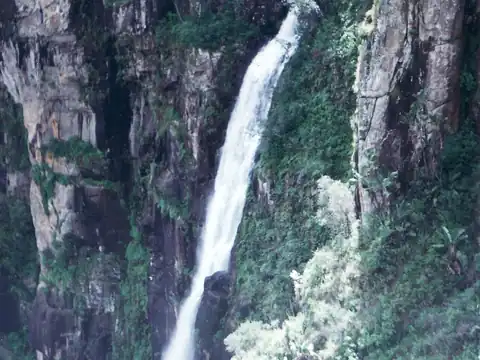 Most similar
Mutarazi Falls
Zimbabwe
Height772 mWidth—
Also a tiered waterfall, of similar height and in Zimbabwe
 Largest curtain
Victoria Falls
Zimbabwe · Zambia
Height108 mWidth1,708 m
Largest single sheet of falling water
 Tallest on earth
Angel Falls
Venezuela
Height979 mWidth—
 Widest on earth
Khone Phapheng Falls
Laos
Height21 mWidth10,783 m
Measured across the whole multi-channel system
Angel Falls is 31 m taller than Tugela Falls. It drops 8.8× further than Victoria Falls (108 m). We don't have a reliable crest width for Tugela Falls yet, so it is left off the width chart. Tallest · widest lists.
 10:17
 3:37
 3:47
Chosen from YouTube; videos belong to their creators and play from YouTube's privacy-enhanced player.
Walking guide
Jeff Williams · 2017
Route descriptions for the Amphitheatre, including the Sentinel chain-ladder route to the top of Tugela Falls and the gorge walk below.

Guidebook
James Bainbridge et al. · 2022
Covers the Drakensberg, Augrabies, KZN Midlands, Panorama Route falls and Lesotho's Semonkong for Maletsunyane in one book.
Not by any accepted measurement. The standard figure is 948 m, second to Angel Falls at 979 m. A 2016 amateur Czech team measured 983 m, but from over a kilometre from the base, and the result has not been accepted. Angel Falls also has the far longer single drop, about 807 m to Tugela's 411 m. Tugela is the tallest in Africa.
Yes, two ways. The Tugela Gorge walk in Royal Natal National Park shows the falls from below, about 14 km return on mostly easy ground. On the summit route, the Beacon Buttress gully avoids the ladders, but it is a steep, loose scramble that should not be tried when wet, so it is not an easy option.
From the Sentinel side between March 2026 and February 2027, fees are R90 conservation plus R145 day hiking, about R235 ($14) per adult, paid at Witsieshoek. The optional shuttle to the car park costs R320 ($20) return. For the Tugela Gorge in Royal Natal, expect an Ezemvelo conservation fee of about R160 ($10) per foreign adult.
March and April. The falls are still running on summer rain but the afternoon thunderstorms have mostly eased. December to February brings the strongest flow but daily lightning risk on the escarpment. In June to August the falls often shrink to a trickle or freeze, and September to November is usually dry until the rains return.
About 12 km return, climbing roughly 480–550 m from a start at about 2,540 m, and most hikers take 5 to 7 hours. The path is well marked and not technical, but the ladders are near-vertical and exposed and the altitude slows people down. Reasonably fit walkers who are comfortable with heights manage it without a guide in good weather.
Not in clear weather for experienced hikers; the route is well used and signposted. A guide is worth it in winter, in poor visibility, for summit overnights, or if the ladders worry you. Thaba Adventures at Witsieshoek charged R1,350 ($82) per person in 2025, minimum two people. Soul Adventures runs fully equipped overnight trips.
Not directly. There is no road across the mountain, despite what some GPS apps suggest. You drive around via Oliviershoek Pass and Phuthaditjhaba, about 2 hours, and the last 7 km to the car park is rough enough that Witsieshoek advises a 4x4 or its R160 ($10) each-way shuttle.
Yes. You can wild-camp on the plateau, R145 ($9) per person per night in Sentinel mountain fees, with full cold-weather gear, or book a guided overnight that supplies tents and meals. The Namahadi Hut at 3,069 m sleeps 15 on the floor for R625 ($38) per person, bookable through Witsieshoek, but it is primarily a research hut.
Tugela Falls is in South Africa (Drakensberg, KwaZulu-Natal / Free State), inside Royal Natal National Park. The nearest base is Bergville and the closest airport is PZB. Its coordinates are -28.7523, 28.8946.
Prices, fees and entry rules change. We re-check full guides regularly; spotted something out of date? Tell us.
Nearby

Ncandu Falls is a waterfall in the Ncandu River in Northern KwaZulu-Natal, in South Africa close to the town…
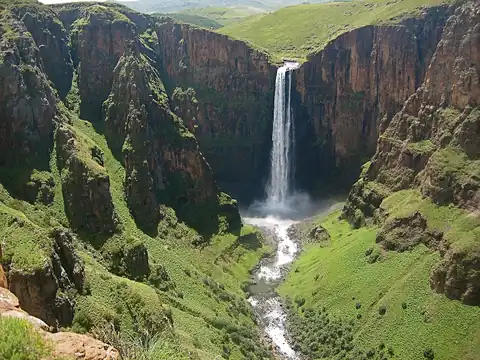
Longest single-drop abseil (204m) in the world

KwaZulu-Natal's most accessible major waterfall

Magwa Falls is a waterfall in Eastern Cape province in South Africa. The main water drop is 142 metres .