
Natural history
Iguazú: Fauna
Marcelo Beccaceci · 2015
Photographic guide by an Argentine naturalist to the coatis, toucans, swifts and butterflies you'll see around the falls.

Argentina · Brazil
Not one waterfall but roughly 275, spread across two and a half kilometres of basalt cliff on a U-shaped bend in the Iguazú River, split between two national parks and two countries that see it from entirely different angles.
Full guide Checked September 2026 by David Bussell · 21 sources UNESCO World Heritage
Iguazú is a system, not a single drop. The river fans out across a wide plateau and then falls off the edge of it unevenly, in a broken, horseshoe-shaped wall of roughly 275 separate cascades strung along about 2.7 km of cliff — the exact count shifts with the water level, fewer in drought, more when the river floods. At the centre of the horseshoe sits the Devil's Throat, Garganta del Diablo: a semicircular chasm around 150 m across where fourteen of the river's channels converge and fall together, throwing up a spray column visible for kilometres and a sound loud enough to make conversation pointless on the catwalk above it — when there is a catwalk to stand on.
Argentina and Brazil each hold a national park here, and they show you almost opposite things. Argentina's side puts you inside the falls system: elevated steel catwalks thread out over and between the individual drops on the Upper and Lower Circuits, an open-sided Ecological Train carries you to the Devil's Throat trailhead, and a short boat crossing (when running) reaches Isla San Martín in the middle of the river. Brazil's side does the opposite — a single trail along the far bank gives you the wide, photographable, one-frame view of the whole horseshoe at once, finishing at a walkway and elevator that puts you almost underneath the Devil's Throat from below.
Between the two sides there is a genuine industry: zodiac boats that drive straight into the spray at the base of the falls, a jungle-truck-and-boat combination on the Argentine side, a helicopter that only flies from Brazil, a bird park, a hydroelectric dam that is one of the largest power stations on earth, and — a handful of nights a month — a walk out to the Throat by the light of the full moon. Two full days covers the essentials; three to five lets you add the boats, the dam and the birds without rushing.
As of September 2026 the Argentine walkway out to Garganta del Diablo is dismantled and closed. Park authorities removed the catwalk and railings in August 2026 as a preventive measure against El Niño-driven flooding — the Iguazú River hit roughly five times its historic average flow in early September — and reconstruction is expected to take about 60 days once levels return to normal, with no fixed reopening date at time of writing. This is not a one-off: the walkway has closed for extended stretches in previous high-water years and will again. While it's shut, Argentina's Upper and Lower Circuits stay open and Brazil's walkway still delivers a full, close-range view of the Devil's Throat from below and opposite — but if walking out onto the catwalk itself is the reason you're going, confirm current status on iguazuargentina.com before you travel.
Iguazú National Park, via Puerto Iguazú
This side puts you in among the falls rather than opposite them. The Upper Circuit walks along the cliff top above the drops; the Lower Circuit descends to their base and to the boat dock; an open-air Ecological Train and a further walkway lead out to the edge of the Devil's Throat itself, when that catwalk is open — it is currently dismantled for flood safety and its reopening is not yet dated. Isla San Martín and the Gran Aventura boat add river-level and mid-stream perspectives most of the year.
Iguaçu National Park, via Foz do Iguaçu
A single well-paved trail (Trilha das Cataratas) runs along the Brazilian bank with the entire Argentine horseshoe unfolding across the gorge in front of you — the view most Iguazú photographs are actually taken from. It ends at a walkway and elevator that put you close to and almost underneath the Devil's Throat. The Brazilian park is also the only side with helicopter flights, and it borders Parque das Aves directly, making a Brazil day easy to combine with a bird park visit.
Do both if you have the time — Brazil for the wide-angle view in half a day, Argentina for the close-up, catwalk-and-boats experience that takes a full day on its own. If you only get one side, most repeat visitors take Argentina for the depth of the visit; take Brazil instead if your time is genuinely short or if the Devil's Throat catwalk is closed, since Brazil's walkway keeps working regardless.
April to June and September to November combine strong, reliable flow with lower flood risk and thinner crowds; avoid the July school-holiday weeks on both sides if you want the trails to yourselves.
The single biggest variable is the Iguazú River's flow, which is driven by rain far upstream in Brazil and swings between a dramatic, spray-heavy flood and a quieter, clearer low-water period — with occasional drought years that reduce whole sections to a trickle and occasional floods that shut the Devil's Throat catwalk outright.
The fullest, loudest version of the falls, with more of the roughly 275 channels running at once and the spray column at its most visible. It is also the Southern Hemisphere summer, so expect 35°C+ heat, high humidity, school-holiday crowds on both sides, and a real risk — most years, not every year — that sustained flooding forces the Argentine catwalk to close.
Strong, reliable flow without the worst of the summer flood risk, milder temperatures, and — outside local school holidays — the thinnest crowds of the year. This is the window most guides quietly recommend, and it is the safest bet for having every circuit and boat running.
Cooler, drier Southern Hemisphere winter with less spray and more exposed basalt — good for photographing the rock structure of the falls rather than the volume of water. July is peak local holiday season on both sides of the border, so book ahead. In genuine drought years (2019–2021 and 2023–2024 both produced widely photographed low-water events), several channels run dry entirely and the falls look markedly diminished; it is worth checking recent water-level reports before you travel in this window.
On several nights around each full moon, Argentina's park opens after dark for a guided walk by the Ecological Train out toward the Devil's Throat area, run only by the official park operator and sold roughly a month ahead because it sells out. It is the one time you can be in the park after the day-visitor crowds have gone. When the Devil's Throat catwalk itself is closed for flood works, as in the second half of 2026, the route is adjusted to the circuits that remain open — check the current route when you book.
Prices are advertised 2025/2026 rates from official park operators and listed tour providers, converted to USD at approximate September 2026 exchange rates (~1,540 ARS/USD, ~5.19 BRL/USD) and treated as a planning guide, not a quote — both the Argentine peso and, to a lesser extent, the Brazilian real move quickly enough that the local-currency figure is the more reliable one to check before booking.
An open 4WD truck runs 5–6 km through the rainforest to a dock on the upper river, then a twin-engine zodiac drives straight into the spray at the base of the San Martín and Three Musketeers falls. Complete soaking is standard — dry bags are provided, dry clothes are not. Book directly through Iguazú Jungle to skip the third-party markup.
Year-round, wetter and rougher in high water
A silent electric buggy runs through the Atlantic rainforest to the river, followed by an optional short jungle walk and then a twin-engine Zodiac that pushes in close to the base of the falls from the Brazilian side. The Brazilian equivalent of Gran Aventura, and just as wet.
Year-round
The only helicopter operator here, and it flies exclusively from a heliport on the Brazilian side, next to Parque das Aves — Argentina does not permit commercial helicopter tourism over its national park, a long-standing restriction that remains a point of friction, since the noise from Brazilian flights carries across the border regardless. Argentina-based visitors need to cross into Brazil to take it.
Year-round, weather permitting
The Ecological Train runs after dark to the Devil's Throat trailhead for a bilingual guided walk under moonlight, one of the only ways to be in the park once the day crowds have left. On clear, high-water nights near the peak of the lunar cycle a faint lunar rainbow sometimes shows in the spray.
Several nights around each full moon; sells out roughly a month ahead
Pay on the day — nothing to book in advance.
A private stretch of rainforest outside Puerto Iguazú strung with ziplines, a rappel descent and connecting trekking, run as a half-day combo with hotel pickup. The closest thing to Victoria Falls-style adrenaline that Iguazú has, and it is well away from the falls themselves rather than over them.
Year-round
Doing this one? Check your travel insurance covers adventure activities before you go — SafetyWing is one option.
A walk-through aviary complex immediately outside the Brazilian park's entrance, with macaws, toucans and hummingbirds at close range in large planted enclosures rather than cages. The standard add-on to a Brazil-side day, since it sits between the falls entrance and the town.
Year-round
A rescue and rehabilitation centre for injured and trafficked native wildlife on the road between Puerto Iguazú and the Argentine park, with guided walks past toucans, raptors and other Misiones species recovering before release. Quieter and less commercial than Parque das Aves.
Year-round
No booking needed.
A binational Brazil–Paraguay hydroelectric plant on the Paraná River, among the largest power stations on earth by annual output, with a viewpoint over the spillway and dam face. The standard non-falls day trip from Foz do Iguaçu; a longer, ticketed technical tour goes inside the structure.
Year-round
A short free ferry from the Lower Circuit to an island in the middle of the river, with a stairway up to viewpoints inside the falls system rather than looking at it from outside. Severe flooding has repeatedly damaged the landing infrastructure, so access is intermittent — check the day's status at the Lower Circuit dock.
Water-level dependent; closed for extended periods after major floods
No booking needed.
Simple obelisk viewpoints in both Puerto Iguazú and Foz do Iguaçu, looking across the confluence of the Iguazú and Paraná rivers to where Argentina, Brazil and Paraguay meet — Ciudad del Este is visible on the Paraguayan bank. A short, free add-on rather than a destination in itself.
Year-round
No booking needed.
Both towns run from falls-view luxury inside the actual national parks down to simple hostels a few blocks from the bus terminal.
The only hotel inside the Argentine park, with falls-facing rooms, an infinity pool and direct trail access that skips the daily entry queue. Book a falls-view room specifically — standard rooms face the forest.
A colonial-style 1958 hotel that is the only accommodation inside the Brazilian park, right beside the panoramic trail entrance — guests can walk the trail before and after the day-visitor crowds arrive.
A large resort a short drive from town and the park gate, with pools, a casino and a spa — the mid-tier choice for travellers who want resort facilities without the in-park premium.
A small, plant-filled boutique bed-and-breakfast in a residential street, consistently rated among the best-run small properties in town for service and breakfast.
A family-oriented resort with multiple pools and its own water park area, on the main avenue between the town centre and the Brazilian park.
A straightforward, well-reviewed city-centre tower hotel, walkable to restaurants and close to the bus routes out to both the falls and Parque das Aves.
A long-running backpacker fixture a few blocks from the bus terminal, with a pool, communal kitchen and easy transport bookings for the falls and the border crossing.
A garden hostel with a pool a short walk from the bus terminal, popular with travellers stopping between the Argentine and Brazilian sides.
Search all Puerto Iguazú accommodation
About 25 km from Puerto Iguazú town, Argentina. Several daily flights from Buenos Aires — mostly Aeroparque (AEP), around 1 hr 50 min — on Aerolíneas Argentinas, Flybondi and JetSmart; few or no direct international routes.
About 18 km from Foz do Iguaçu, Brazil. Multiple daily flights from São Paulo (GRU/CGH, ~1 hr 40 min) and Rio de Janeiro (GIG/SDU, ~2 hrs) on LATAM, GOL and Azul; the busier of the two airports for connections.
Buenos Aires (mainly Aeroparque) is the dominant connection on the Argentine side; São Paulo (Guarulhos) is the dominant connection on the Brazilian side, with Rio de Janeiro as the main secondary hub.
Puerto Iguazú and Foz do Iguaçu are linked by the Tancredo Neves Bridge over the Iguazú River, with immigration posts on each end roughly 15 km apart. A day crossing requires two stamps — an Argentine exit stamp and a Brazilian entry stamp, then the reverse on the way back — and skipping either one can cause problems when you eventually leave the country. A taxi will wait through both checkpoints for roughly $25–40 USD one-way; the Crucero del Norte / Rio Uruguay bus does the same route for a few dollars but requires getting off and back on at each post; organised falls tours handle the paperwork for you. Budget at least 45–60 minutes for the crossing itself, on top of the drive.
The Brazil e-visa applies to any entry, including a same-day land crossing over the Tancredo Neves Bridge for a few hours at the falls or Parque das Aves — it is not waived for short visits, and travellers based in Puerto Iguazú sometimes assume otherwise. Confirm current fees and eligibility against the official portal for your nationality before you travel; both countries' fee and visa rules have changed more than once in the last two years.
 This waterfall
Iguazú Falls
Argentina · Brazil
Height82 mWidth2,700 m
 Most similar · Largest curtain
Victoria Falls
Zimbabwe · Zambia
Height108 mWidth1,708 m
Similar width and with helicopter flights and zip lines
 Tallest on earth
Angel Falls
Venezuela
Height979 mWidth—
 Widest on earth
Khone Phapheng Falls
Laos
Height21 mWidth10,783 m
Measured across the whole multi-channel system
Angel Falls is 12× taller than Iguazú Falls. Victoria Falls is 1.3× taller, but Iguazú Falls is 1.6× wider. Khone Phapheng Falls is 4.0× wider. Tallest · widest lists.
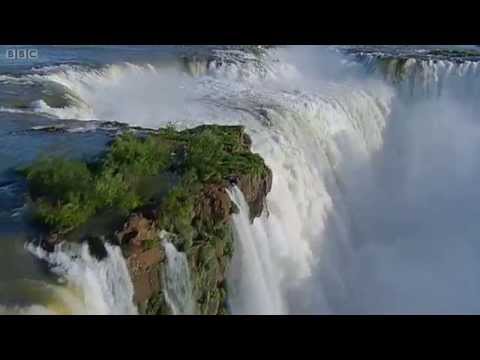 1:59
 3:16
 26:46
Chosen from YouTube; videos belong to their creators and play from YouTube's privacy-enhanced player.
Natural history
Marcelo Beccaceci · 2015
Photographic guide by an Argentine naturalist to the coatis, toucans, swifts and butterflies you'll see around the falls.
Guidebook
Trent Holden et al. · 2025
Covers Foz do Iguaçu's panoramic side, Chapada Diamantina for Fumaça, and the Serra Gaúcha around Canela for Caracol.
Guidebook
Isabel Albiston et al. · 2024
Covers Puerto Iguazú and the Argentine side's catwalks to the Devil's Throat, plus Misiones' Saltos del Moconá.

Guidebook
Ben Box · 2017
The one-volume continental handbook, useful for multi-country trips that link falls such as Iguazú, Kaieteur and Angel Falls.
Brazil gives you the wide, photographable view of the entire horseshoe from one trail in about half a day. Argentina puts you in among the falls on elevated catwalks and adds boat rides and an island crossing, but takes a full day on its own. Do both if you can; if you can only manage one, take Argentina for depth or Brazil if your time — or the Devil's Throat catwalk — is limited.
Two full days covers the essentials, one per side. Four to five lets you add the boat rides, Itaipu Dam, Parque das Aves and a zipline or wildlife refuge without rushing any of them.
As of September 2026, no — the Argentine walkway was dismantled in August 2026 as a preventive measure against extreme El Niño-driven flooding, with reconstruction expected to take about 60 days once river levels normalize and no fixed reopening date announced. It has closed for extended periods in past flood years too. Brazil's walkway still delivers a full view of the Devil's Throat from the opposite bank regardless.
Argentina is visa-free for US, Canadian and Australian citizens. Brazil requires an e-visa for the same nationalities, reinstated in April 2025, costing US$80.90 and applied for online in advance — this applies even to a same-day land crossing for the falls, not only to flying in.
Only from Brazil. Helisul flies from a heliport beside Parque das Aves; Argentina does not permit commercial helicopter tourism over its national park, a long-standing restriction, so Argentina-based visitors need to cross the border to take the flight.
April to June and September to November combine strong flow with lower flood risk. December to March is the most dramatic but carries real risk of catwalk closures and intense heat; July and August are cooler and clearer with less spray, though periodic drought years (2019–2021, 2023–2024) have reduced several channels to a trickle.
No — they are separate parks in separate countries with separate currencies and no joint ticket. Argentina does offer a 50% discount on a second consecutive day if you keep your ticket stub, which is worth using if you want to split the two circuits over two mornings.
Over the Tancredo Neves Bridge, with mandatory immigration stops on each end about 15 km apart — an Argentine exit stamp and a Brazilian entry stamp, reversed on the way back. A taxi waits through both posts for roughly $25–40 one-way; buses and organised tours also run the route. Budget an hour for the crossing.
Iguazú Falls is in Argentina / Brazil (Paraná Plateau), inside Iguazú National Park / Iguaçu National Park. The nearest base is Puerto Iguazú and the closest airport is IGR. Its coordinates are -25.6953, -54.4367.
Both. The Iguazú River forms the border for its final stretch, and about 80% of the individual falls are on the Argentine side, while the Brazilian side gives the panoramic view. Each side has its own national park, ticket and visitor centre.
Prices, fees and entry rules change. We re-check full guides regularly; spotted something out of date? Tell us.
Nearby
UNESCO The single most powerful segment of Iguazu Falls

The Municipal Park Monday and its main attraction – approximately 45 m tall and 120 m wide waterfall named…
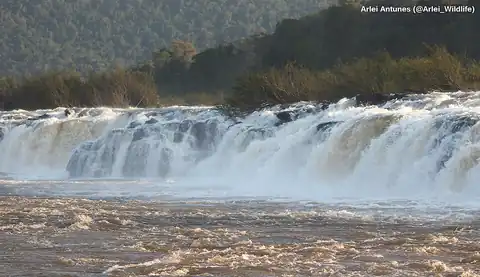
One of the world's longest longitudinal waterfalls

The Guairá Falls or Guaíra Falls were a series of immense waterfalls on the Paraná River along the border…