Classic Hikes in the Canadian RockiesGraeme Pole
Walking guide
Classic Hikes in the Canadian Rockies
Graeme Pole · 2011
Well-regarded guide to the Rockies' best day hikes and backpacks, including Johnston Canyon and Yoho Valley routes.

Canada · Alberta
Steel catwalks bolted to a limestone canyon wall, a wet tunnel to the Lower Falls, a 30-metre Upper Falls and a meadow of cold, blue-green springs beyond. Banff's busiest trail, and the natural base for the Rockies' other big waterfalls.
Full guide Checked September 2026 by David Bussell · 40 sources UNESCO World Heritage
Johnston Creek does not fall off a cliff so much as saw its way down through one. Over a few kilometres above the Bow Valley it has cut a canyon in the limestone so narrow and sheer in places that there is no floor to walk on, so the trail is bolted to the wall instead. You walk on steel catwalks hung over the water, with the creek churning a few metres below your boots and the rock close enough to touch. Parks Canada gives the Upper Falls as 30 metres; the Lower Falls is smaller but more intimate, reached through a short, dripping tunnel in the rock.
The trail is an out-and-back that gets steadily quieter the further you go. The Lower Falls sits 1.2 km in, with about 50 metres of climb, and that is where most people turn round. The Upper Falls is 2.5 km from the trailhead and 120 metres up, with one platform at its base and another above it. Past that the canyon opens out, the trail climbs through forest and, 3.2 km further on, drops into the Ink Pots, a cluster of cold spring pools in shades of turquoise and green in a wide meadow under the peaks.
It is the obvious anchor for a Rockies waterfall trip because everything else is within a day's drive: Takakkaw Falls in Yoho, one of the tallest in Canada, is roughly an hour and a quarter west; Athabasca and Sunwapta Falls sit on the Icefields Parkway towards Jasper. Johnston itself works in every season — high water in June, clear light in September, and a frozen canyon walked on guided icewalks in winter — though autumn 2026 comes with a scheduled closure you need to plan around.
Parks Canada has said it will close the Lower Falls area and the Johnston Canyon car park after the Thanksgiving long weekend (Monday 12 October 2026) for two to three months, to scale loose rock and stabilise the canyon walls — routine work it does roughly every decade, timed for the quietest part of the year, with more planned for autumn 2027. Exact dates had not been finalised when this guide was written, and that window overlaps the start of icewalk season. Separately, until 6 October 2026 the Bow Valley Parkway's 17 km eastern section is closed to private vehicles: you can still drive to the canyon, but via the Trans-Canada and Castle Junction, approaching from the west. Check the Banff trail-conditions and bulletins pages the week you go.
1.2 km from the Johnston Canyon day-use area on the Bow Valley Parkway
The short walk that most of those 700,000 annual visitors actually do. The trail is wide and gentle, then turns into catwalks clamped to the canyon wall with the creek close below. At the falls, a bridge crosses the creek to a short tunnel through the rock: squeeze through and you come out on a ledge facing the plunge pool, close enough to get wet. On summer afternoons there is a queue for the tunnel, sometimes a long one.
2.5 km from the trailhead, continuing past the Lower Falls
The crowd thins by half after the Lower Falls, and the trail gets steeper, with more catwalk and more forest. The Upper Falls is the taller and more dramatic of the two, a 30-metre drop down a sheer wall, seen from a lower platform on the creek and from a higher one near the lip. In winter the whole fall freezes into columns of blue ice, and ice climbers are sometimes working the face. Allow two to three hours return from the car park.
5.7 km from the Johnston Canyon trailhead, or from Moose Meadows
Beyond the Upper Falls the canyon ends and the trail climbs through forest before dropping to an open meadow on Johnston Creek, where a cluster of cold springs well up through the gravel in pools of turquoise, jade and deep green. It is a half-day round trip, and the reward is space: a small fraction of canyon visitors come this far. The Moose Meadows trailhead, a little west on the parkway, is an alternative start that skips the canyon crowds entirely.
If you have an hour, do the Lower Falls, but get there before 9am or after 5pm so the tunnel is yours. If you have half a day, the Upper Falls is the better waterfall and the better walk. If you have a full day and decent legs, go all the way to the Ink Pots — or start from Moose Meadows and come down through the canyon, when it is quiet.
June for the fullest falls, September for clear light and thinner crowds, and January to March for the frozen canyon — but in 2026 the canyon closes after 12 October for two to three months.
The biggest variable at Johnston Canyon is not water but access: the Bow Valley Parkway runs cycling-only and overnight restrictions in spring and autumn, the canyon ices over from November to April, and in 2026 Parks Canada is closing it for maintenance after Thanksgiving.
Snowmelt pushes the creek to its loudest and the falls to their fullest, and the summer crowds have not yet arrived. The trade-off is access: between 1 March and 25 June no one may travel the parkway's eastern 17 km between 8pm and 8am, and from 30 April to 25 June that stretch is cycling-only from 8am to 8pm. Roam Route 9 started its daily summer schedule on 13 May in 2026.
Everything is open, the Yoho Valley Road to Takakkaw Falls is running, and the Icefields Parkway's lodges are all trading. It is also Johnston Canyon at its most crowded: the car parks fill on fine days, cars back up along the parkway, and the Lower Falls tunnel can have a long queue from late morning until early evening. In 2026 the Canada Strong Pass made Parks Canada admission free from 19 June to 7 September.
Clear air, larches turning gold on the high slopes, thinner crowds after Labour Day — and the parkway's eastern section car-free for cycling from 1 September to 6 October, so drivers approach via the Trans-Canada and Castle Junction. Johnston Canyon Lodge closes in early October and the Yoho Valley Road in mid-October. In 2026 the canyon itself is scheduled to close after the Thanksgiving weekend.
The falls freeze into curtains and pillars of blue ice, snow settles on the catwalks, and the canyon becomes one of Banff's classic guided icewalks, with cleats and hot chocolate. Parks Canada calls the trail usually very icy and strongly recommends ice cleats. Crowds drop sharply outside weekends. For winter 2026–27, the maintenance closure may keep the canyon shut into December or later — confirm before booking.
From roughly November to April the Lower and Upper Falls freeze into walls of blue and white ice, and the catwalks turn into a winter walk that needs no technical skill — only cleats, warm layers and some patience on the slick sections. Several Banff operators run guided icewalks with hotel pick-up and cleats included; Discover Banff Tours lists morning and afternoon departures and an evening version. Winter 2026–27 is the exception to plan around: Parks Canada is closing the Lower Falls area and car park after the 12 October Thanksgiving weekend for two to three months of rock stabilisation, so icewalks may start late. Operators have said they will run alternative canyon tours during the shutdown — ask what you are actually booking.
Prices are 2026 advertised rates from Parks Canada, Roam Transit and operator sites, converted from CAD to USD at about 0.71 (the late-September 2026 rate) and rounded; hotel and shuttle figures marked as third-party are listing prices, not quotes, and move sharply with season.
The short, famous part: 1.2 km of wide trail and steel catwalk clamped above the creek to the Lower Falls, where a bridge and a short tunnel through the rock bring you out on a ledge right beside the plunge pool. Expect spray, a queue for the tunnel from late morning in summer, and a wet camera lens. Go at 8am or after 5pm and you may have the ledge to yourself for a minute or two.
Year-round when open; icy November–April; closed after 12 Oct 2026 for 2–3 months
No booking needed.
Keep going past the Lower Falls and the canyon gets deeper, the crowd thinner and the trail steeper. The 30-metre Upper Falls is seen from a platform at its base, looking up at the drop and the stained rock around it, and from a higher viewpoint near the lip. In winter it freezes into columns of blue ice and draws ice climbers. The better of the two waterfalls, and worth the extra hour.
Year-round when open; cleats strongly recommended in winter
No booking needed.
The full walk: through the canyon, past both falls, then 3.2 km on through forest to a meadow where cold springs bubble up into small pools of turquoise and green beneath the peaks. It is a moderate climb and a quieter world — most canyon visitors never get this far. Pack lunch; there is nothing to buy beyond the trailhead. As of September 2026 the bridge beyond the Ink Pots towards Jo9 campground is washed out, so treat the springs as your turnaround.
Late spring to autumn; snowy and icy in winter
No booking needed.
The local's answer to the canyon queues. The Moose Meadows trailhead, a short drive west of Johnston Canyon on the Bow Valley Parkway, climbs through forest and joins the main trail just above the Upper Falls, so you reach the Ink Pots without the catwalk crush. A good loop for strong walkers is up from Moose Meadows, over to the Ink Pots, and down through the canyon late in the day when it has emptied — if you can arrange a car at each end.
Late spring to autumn
No booking needed.
A guided walk through the frozen canyon with Banff hotel pick-up, ice cleats strapped to your boots, poles on request, and hot chocolate and a maple cookie at the end. Groups are capped at 12 per guide. The route follows the catwalks to the frozen Lower Falls and on to the Upper Falls' ice curtain, about 135 m of climb in all. Departures at 8:30am and 1:30pm. Confirm the 2026–27 start date: the canyon closes after mid-October for up to three months.
November – April (normally); winter 2026–27 start depends on the maintenance closure
A second established Banff guiding company running the Johnston Canyon icewalk on the catwalks and trails, with round-trip transport from Banff, ice cleats and trekking poles, hot chocolate and cookies. It also sells a Marble Canyon and Johnston Canyon combination, pairing Johnston with the narrow slot canyon just over the Continental Divide in Kootenay National Park — a useful fallback if Johnston's winter reopening slips.
Winter
Parks Canada closes the parkway's eastern 17 km to private cars in spring and early autumn, and it becomes one of the best road rides in the Rockies, rolling through montane forest with the Bow River and Castle Mountain alongside. It is prime habitat for bears, wolves and cougars, and Parks Canada warns cyclists are particularly vulnerable to sudden encounters: carry bear spray and make noise. Leave the car at the Banff Train Station car park, and lock up at the bike racks at the Johnston Canyon trailhead.
30 Apr – 25 Jun (8am–8pm) and 1 Sept – 6 Oct in 2026
No booking needed.
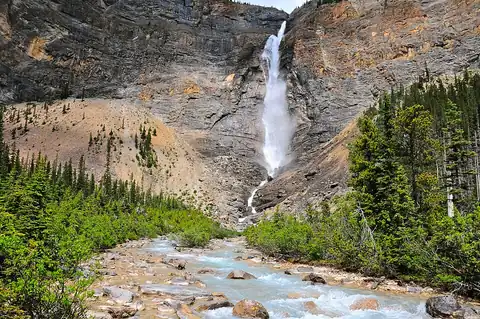
The Rockies' big one: meltwater from the Daly Glacier leaping off a cliff in Yoho National Park, usually given as 373 m in total. From Johnston Canyon take the Trans-Canada over Kicking Horse Pass towards Field, then the Yoho Valley Road, whose tight switchbacks force vehicles over 7 m to reverse; trailers are banned. A short, level path leads from the car park to the spray at the base. The road is open only from mid-June to mid-October.
Mid-June to mid-October only (Yoho Valley Road)
No booking needed.
Two short-walk waterfalls near the Jasper end of the Icefields Parkway. Athabasca Falls is only 23 m high but carries the whole Athabasca River through a quartzite slot, carving potholes and a short canyon — one of the most powerful falls in the mountain parks. Sunwapta Falls, further south, drops into a narrow gorge and is the trailhead for a backcountry trail along the Athabasca River. Mist leaves the rocks slick; stay behind the railings. There is no cell coverage on the parkway.
Year-round road; best May – October, when services are open
Sleeping at the canyon or along the Bow Valley Parkway puts you on the trail before the day-trippers; Banff town, 25–35 km away, has the widest choice and the Roam bus, and Lake Louise is the better base for Yoho and the Icefields Parkway.
Forty-two heritage cabins and bungalows at the trailhead, with gas fireplaces in many, the BlackSwift Bistro, a market café, e-bike rental and pet-friendly units. Seasonal, open May to early October; reachable via Castle Junction when the parkway is restricted.
Log chalets about midway between Banff and Lake Louise, a few minutes' drive from Johnston Canyon, with full kitchens, jet tubs and wood or gas fireplaces. An old family property with more than 80 years of history and strong guest reviews.
Stand-alone log cabins and alpine suites on the creek, sleeping two to six, with a grab-and-go Creekside Café, fire pits, sauna, free bikes and dog-friendly rooms. Closer to Lake Louise than to Banff, so handy for Yoho and the Icefields Parkway too.
The castle above the Bow River, welcoming guests since 1888, with 724 rooms, a Stanley Thompson golf course, a large spa and many restaurants. A short walk from Bow Falls; about 35 minutes' drive from Johnston Canyon.
A modern hotel a minute's walk from downtown Banff, with two rooftop hot pools looking at the mountains, a spa and suites with more room for families. Walkable to the Roam transit hub for the Route 9 bus to Johnston Canyon.
Hostelling International's Banff hostel, with dorms and private rooms a little uphill from downtown. The cheapest reliable bed near the canyon, and on the local transit network for getting to the Route 9 hub.
539 rooms on the shore of Lake Louise, with lakeview categories facing the Victoria Glacier and the BASIN glacial-waters thermal experience. The natural base for Takakkaw Falls and the Icefields Parkway; about 30 minutes from Johnston Canyon.
Search all Banff accommodation
About 144 km / 90 miles to Banff, roughly 1.5 hours on the Trans-Canada, then another 25–35 km to Johnston Canyon. WestJet's hub, with nonstops across Canada and the US and long-haul routes to Europe. Banff Airporter (door to door, one stop in Canmore; C$88.90 / ~US$63 one way per third-party listing) and Brewster Express (from C$66.75 / ~US$47 one way on a round trip) run to Banff hotels.
The Jasper-end gateway, about four hours' drive from Jasper. Only worth it if you are doing the Icefields Parkway north to south, finishing at Johnston Canyon; Brewster Express also runs Calgary–Jasper in summer (to 17 October in 2026).
Calgary (YYC) is the only realistic gateway for Johnston Canyon; most international travellers connect through Toronto, Vancouver or a US hub if there is no nonstop from home.
Johnston Canyon sits on the Bow Valley Parkway (Highway 1A), about 25 km from Banff. The parkway's eastern 17 km is closed to private vehicles from 30 April to 25 June (8am–8pm) and from 1 September to 6 October in 2026, and closed to all travel from 8pm to 8am between 1 March and 25 June. During those windows, drive the Trans-Canada to Castle Junction and approach from the west. Without a car, Roam Transit Route 9 runs from the Banff High School Transit Hub via the Trans-Canada and Castle Junction, about 35 minutes, C$5 adult, C$2.50 youth and senior, under-12s free, no reservations; in 2026 it ran daily from 13 May with seven departures a day, and third-party guides report weekend and holiday service in winter. The Parks Canada shuttle does not go to Johnston Canyon — it serves only Lake Louise and Moraine Lake.
Requirements and fees for the eTA and visitor visa change without much notice and depend on your nationality — confirm against the official Government of Canada site before you travel, and never pay a third-party agent for an eTA.
 This waterfall
Johnston Canyon Falls
Canada
Height30 mWidth—
 Most similar
Nugget Falls
United States
Height30 mWidth—
Also a tiered waterfall, of similar height and in the United States
 Largest curtain
Victoria Falls
Zimbabwe · Zambia
Height108 mWidth1,708 m
Largest single sheet of falling water
 Tallest on earth
Angel Falls
Venezuela
Height979 mWidth—
 Widest on earth
Khone Phapheng Falls
Laos
Height21 mWidth10,783 m
Measured across the whole multi-channel system
Angel Falls is 33× taller than Johnston Canyon Falls. Victoria Falls is 3.6× taller. We don't have a reliable crest width for Johnston Canyon Falls yet, so it is left off the width chart. Tallest · widest lists.
 11:42
 7:40
 4:23
Chosen from YouTube; videos belong to their creators and play from YouTube's privacy-enhanced player.
Walking guide
Graeme Pole · 2011
Well-regarded guide to the Rockies' best day hikes and backpacks, including Johnston Canyon and Yoho Valley routes.

Walking guide
Kathy and Craig Copeland · 2009
Opinionated hiking guide rating Rockies trails, handy for picking day hikes beyond the busy falls boardwalks.
Guidebook
Lonely Planet · 2024
Latest Lonely Planet Rockies guide covering the Icefields Parkway, Johnston Canyon and Yoho's Takakkaw Falls.

Guidebook
Andrew Hempstead · 2022
Banff-based author's Rockies guide with Yoho, the Icefields Parkway and Johnston Canyon, plus lodging and road-trip plans.
Yes. Johnston Canyon is inside Banff National Park, so every adult needs a Parks Canada pass: C$12.25 per day, or C$24.50 for a family or group of up to seven in one vehicle. Youth 17 and under are free. The Discovery Pass (C$83.50 adult, C$167.50 family) covers a year. The free Canada Strong Pass period in 2026 ended on 7 September.
The Lower Falls is 1.2 km each way with about 50 m of climb — allow an hour to 90 minutes return, including a queue for the tunnel. The Upper Falls is 2.5 km each way and about 120 m up, so two to three hours return. Continuing to the Ink Pots adds 3.2 km each way; budget 3.5 to 5 hours in total.
It will be. Parks Canada plans to close the Lower Falls area and the car park after the Thanksgiving long weekend (12 October 2026) for two to three months of rock scaling and wall stabilisation, with exact dates still being finalised. As of 19 September 2026 the trail was open and in good condition. Check the Banff bulletins before you go.
Yes. Only the parkway's eastern 17 km, between Banff and Johnston Canyon, closes to private vehicles — from 1 September to 6 October in 2026, and 8am to 8pm from 30 April to 25 June. Drive west on the Trans-Canada to Castle Junction and double back east on the 1A. Between 1 March and 25 June, no one may use that section from 8pm to 8am.
Take Roam Transit Route 9 from the Banff High School Transit Hub. It runs via the Trans-Canada and Castle Junction, takes about 35 minutes and costs C$5 per adult, C$2.50 for youth and seniors, free for under-12s. Seats cannot be reserved. The summer schedule starts in mid-May with seven daily departures. The Parks Canada shuttle does not go there.
No — the trail is open to independent walkers in winter when it isn't closed, and Parks Canada simply strongly recommends ice cleats. A guided icewalk (from about C$104 / US$74 with Discover Banff Tours) adds hotel transport, cleats, a guide who knows the ice, and hot chocolate. It's the easier choice if you have no car or cleats.
If you have half a day, yes. The canyon crowd mostly turns back at the falls, so the 3.2 km beyond the Upper Falls feels like a different park: forest, then an open meadow with cold springs welling up into turquoise and green pools under the peaks. It's a moderate climb, 11–12 km return in total. Start from Moose Meadows to avoid the canyon entirely.
Roughly 75 km, or about an hour and a quarter by car: west on the Trans-Canada past Lake Louise and over Kicking Horse Pass towards Field, then up the Yoho Valley Road. That road is open only from mid-June to mid-October, has switchbacks that vehicles over 7 m must reverse around, and bans trailers. Your Banff park pass covers Yoho.
Johnston Canyon Falls is in Canada (Canadian Rockies, Alberta), inside Banff National Park. The nearest base is Banff and the closest airport is YYC. Its coordinates are 51.2489, -115.8386.
Prices, fees and entry rules change. We re-check full guides regularly; spotted something out of date? Tell us.
Nearby

Bow Falls is a major waterfall on the Bow River, Alberta just before the junction of it and the Spray River.…

Wapta Falls is a waterfall of the Kicking Horse River located in Yoho National Park in British Columbia…
 UNESCO
One of Canada's tallest waterfalls

Bow Glacier Falls is located near Banff, AB. The falls originates from meltwater from the Bow Glacier and…