Walking in Southern NorwayUte Koninx
Walking guide
Walking in Southern Norway
Ute Koninx · 2021
Ten multi-day treks incl. Jotunheimen and Hardangervidda, the high country above Vettisfossen and Vøringsfossen.

Norway · Eidfjord & Hardanger
The Bjoreio drops 182 metres off the rim of Hardangervidda into the Måbødalen gorge, and a 99-step bridge now carries you across the top of it. The anchor of a Hardanger waterfall circuit that runs from Steinsdalsfossen to Låtefossen and Trolltunga.
Full guide Checked September 2026 by David Bussell · 40 sources
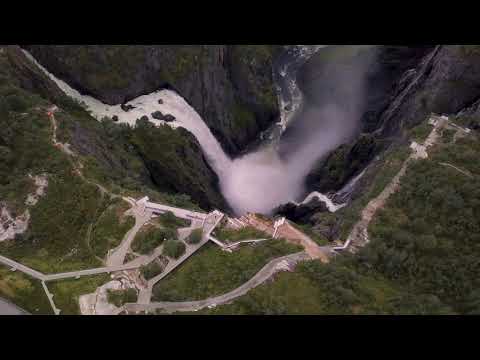
Vøringsfossen is what happens when a mountain plateau simply stops. The Bjoreio river runs across the western edge of Hardangervidda, Europe's largest mountain plateau, reaches the head of the Måbødalen valley at roughly 700 metres above sea level and falls 182 metres into a sheer-sided gorge, with a single main plunge of about 145 metres. The walls are close together and almost vertical, so the spray has nowhere to go but up, and on a bright morning it hangs in the gorge as a white column. It has been called Norway's most famous waterfall for more than a century: Hansteen estimated its height with stones and a pocket watch in 1821, J.C. Dahl painted the valley, and Edvard Grieg worked at the Fossli Hotel on the rim. What the postcards leave out is that the Bjoreio is harnessed for hydropower, and the flow you see is partly a matter of regulation.
You see the falls from above, from two sides of the gorge. On the Fossli side, beside the 1891 Fossli Hotel, a short, wheelchair-friendly path leads from the bus stop to the main viewpoint, and a rockier trail continues to the step bridge. That bridge, opened in 2020 and designed by Carl-Viggo Hølmebakk for the Norwegian Scenic Routes, is 47 metres long with 99 steps and a 16-metre difference in height between its ends, and crosses the Bjoreio just above the drop. On the far side is Fossatromma, the lower plateau beside Route 7, where a third stage of platforms, a large car park, toilets and EV charging opened in September 2024. More than a kilometre of railed paths links the two, and the full loop takes one to two hours.
Vøringsfossen is the headline, but it works best as the centre of a Hardanger waterfall trip. Near Norheimsund, Steinsdalsfossen lets you walk dry-shod behind a 50-metre curtain of water. South of Odda on Route 13, Låtefossen's twin streams meet mid-fall and thunder under a six-arched stone road bridge. North of Voss, Tvindefossen pours down a stepped cliff beside the E16. Above them all lies Hardangervidda itself, and a couple of hours south of Eidfjord is Trolltunga, the long, serious day hike most visitors pair with the falls. Add a fjord boat from Norheimsund, a RIB or kayak out of Eidfjord, and summer orchards along the fjord, and Hardanger rewards three or four days.
Fosslivegen, Vøringsfoss — the Book Hardanger bus stop and Fossli Hotel
The classic view, and the easiest one. From the bus stop and toilets it is about 200 metres, step-free, to the main viewpoint looking straight down the gorge. A rockier 200-metre trail, busy on cruise days, leads on to the step bridge. The Fossli Hotel, open since 1891 and still run by the founding family, sits on the rim with a café serving waffles and cake; Grieg worked on his Opus 66 folk-song arrangements here.
Lower plateau beside Route 7, above the Måbødalen tunnels
The third and final stage of the Scenic Routes project: a large car park with EV chargers, a modern toilet building and new viewing platforms on the lower plateau, linked to Fossli by the old pack road and the step bridge. Coming up Route 7 from Eidfjord it is the first stop, and the platforms look back across the gorge at the falls. It is also where you start the round walk if you'd rather cross the bridge from below.
From the lower Måbødalen valley, below the Route 7 tunnels
Very few visitors see Vøringsfossen from the bottom, where the gorge funnels the noise and spray. The route follows old roads and rough terrain into the gorge, and the easiest way to do it is Book Hardanger's guided top-to-bottom hike, about four and a half hours with transport from Eidfjord. Independent hikers should check locally first: one recent third-party trail guide reports that the old suspension bridge at the valley bottom is closed indefinitely.
Do the loop: park at one end, cross the step bridge, and walk back, which takes one to two hours and shows you the falls from both rims. If you have only half an hour, stop at Fossli for the main viewpoint. Go to the valley floor only with a guide or clear local advice on the path.
June to mid-September is the dependable window, when the hydropower release keeps Vøringsfossen at 12 m³/s or more; May brings the snowmelt peak at the other falls, and from late September Vøringsfossen itself can run thin.
At Vøringsfossen the calendar matters more than the weather: a hydropower concession guarantees at least 12 m³/s only from 1 June to 15 September, and outside that window the flow can drop sharply.
The falls run at their regulated minimum or above, the Fossli Hotel and café are open, Book Hardanger's buses run from Eidfjord, and the fjord boats and buses from Bergen are on their full timetables. Trolltunga is in its main season, with shuttle buses and pre-booked P3 parking. It is also cruise season in Eidfjord, so the paths get crowded on ship days; come early or late.
Natural flow peaks with the May–June snowmelt, and Steinsdalsfossen and Låtefossen are at their loudest. The toilets at Vøringsfossen are open from 1 April, and the Fossli Hotel opens around mid-May. Snow can linger on Hardangervidda and on the Trolltunga plateau, which is guided-only until 31 May. Mid-May also brings the start of the fruit blossom along the fjord.
After 15 September the guaranteed release ends, and Vøringsfossen can shrink noticeably, although autumn rain can still bring the natural flow up. The toilets and car parks stay open until 31 October and the Nature Centre until October, but the Fossli Hotel closes in mid-September. Steinsdalsfossen and Låtefossen are unregulated and often lively after rain. Trolltunga becomes guided-only from 1 October.
The flow can be reduced to a trickle or freeze, and snow can bury the railings, so the viewpoints, the step bridge and parts of the trail are closed. Route 7 over Hardangervidda may close or run in convoy in bad weather. Steinsdalsfossen and Låtefossen stay reachable from the road, but paths are slippery and the kiosks and toilets are shut.
Hardanger is Norway's main fruit-growing district, and from roughly mid-May to mid-June the orchards along the fjord around Lofthus and Ullensvang flower in white and pink below the snow-streaked mountains. It lines up with the snowmelt, so the unregulated falls such as Steinsdalsfossen and Låtefossen are running hard, although Vøringsfossen's guaranteed summer release does not start until 1 June.
Tour, activity, entry and parking prices are the operators' published 2026 rates in Norwegian kroner, converted at about 1 NOK = $0.105 (late September 2026); hotel figures are Booking.com listing prices and hotel rack rates for unspecified dates, so treat all of them as a planning guide rather than a quote.
A green-marked loop of more than a kilometre links Fossli and Fossatromma. Start at Fossli, walk the step-free 200 metres to the main viewpoint, then take the rocky trail to the step bridge: 47 metres, 99 steps, with the Bjoreio sliding towards the edge beneath you. Cross, work along the new Fossatromma platforms and return by the old pack road. The steps get slick when wet, so wear shoes with grip and keep children close.
Spring to autumn; facilities 1 April – 31 October, bridge and some viewpoints closed in winter
No booking needed.
The only straightforward way to reach the foot of the falls. You leave Eidfjord at 10:20 on the waterfall bus, hike with a local guide into the Måbødalen gorge along old roads and rough terrain to the valley floor, feel the spray and the noise, then climb to the rim for the viewpoints and step bridge before the bus back at 14:15. Graded moderate: bring boots with grip, waterproofs and food.
Spring, summer and autumn
A shuttle-style bus tour from the cruise pier by Eidfjord's tourist office up Måbødalen's tunnels to Fossli, with a digital audio guide and about an hour at the falls, enough for the main viewpoint, the step bridge and a waffle at the Fossli Hotel. Extra departures run on busy cruise days. It is the practical answer if you arrive by fjord boat or ship without a car.
Spring to autumn; Nature Centre combo May – September
An independent-but-packaged day: Skyss bus 925 from Bergen at 07:25, a boat from Norheimsund at 09:00 calling at Herand, Utne, Lofthus, Kinsarvik and Ulvik before Eidfjord, then the Nature Centre and Vøringsfossen by bus. The boat returns at 15:20, and you can take a taxi to Steinsdalsfossen and catch the 930 bus home from its stop at 19:03. It is long but covers the fjord and two waterfalls without a car.
May – September
Seven kilometres from Eidfjord on the way up to the falls, the renamed nature centre opens with a panoramic drone film of Hardanger through four seasons, then three floors of hands-on exhibits on geology, climate and wildlife across 2.9 billion years. It explains the plateau, the reindeer and the hydropower scheme that feeds on Vøringsfossen, and it is a good wet-weather fallback. Café and restaurant on site; free parking.
April – October, daily 10:00–18:00; groups by appointment in winter
Pay on the day — nothing to book in advance.
A fast inflatable boat out of Eidfjord, heading either up the Simadalsfjord, where the Sima power station inside the mountain takes the water diverted from above Vøringsfossen and Kjeåsen farm clings to the cliff 600 metres up, or out towards the Hardanger Bridge. Expect seals, seabirds and the goats at Hotle. The route depends on the weather, and warm layers under the suit help in April and October.
April – October
A guided three-hour paddle on the inner Hardangerfjord for beginners and experienced paddlers alike, starting with instruction and a safety briefing. You sit low under the steep walls around Eidfjord, and with luck see seals, porpoises or sea eagles. Tours run in rain but are cancelled in strong wind, with a full refund or a place on another tour. Bring water, a snack and windproof, waterproof layers; over-15s pay the adult price.
May – September
The rock ledge jutting out over Ringedalsvatnet above Odda is Hardanger's other icon, and a serious day out: 27 km and about 800 metres of climb from P2 Skjeggedal, or 20 km and 320 metres from P3 Mågelitopp, reached by the Trolltunga-Road Bus (NOK 150 up, NOK 100 down). Start before 8:00 to avoid long queues at the tongue itself and to be down before dark. Weather changes fast, so carry proper layers, food and water.
Independent hiking 1 June – 30 September; guided only 1 October – 31 May
No booking needed.
The official Trolltunga site names two guide companies, and from 1 October to 31 May it recommends hiking only with one of them, when snow, short days and whiteouts make the plateau dangerous. Trolltunga Active also sells a Trolltunga via ferrata, a zipline and sunset-to-sunrise summer hikes, for anyone who wants more than the standard trail. Trolltunga Active cites 20 years of experience and offers 10% off for young travellers and students.
Year-round; the only way to hike Trolltunga from October to May
Doing this one? Check your travel insurance covers adventure activities before you go — SafetyWing is one option.
About 2 km west of Norheimsund on Route 7, a 50-metre fall that formed in 1699 drops over an overhang wide enough for a path to run behind it on a broad rock ledge, so you can stand dry behind the curtain of water. It is two minutes from the car park, and a Skyss bus stop sits beside it. It is at its most powerful in May and June with the snowmelt; the path gets slippery in winter.
Year-round; café and toilets roughly May/June – late September/October
No booking needed.
Fifteen minutes' drive south of Odda on Route 13 towards Røldal, two streams from Lotevatnet fall about 165 metres, join partway down and roar beneath a six-arched 19th-century stone bridge that carries the old road. Driving across it is a wet experience in full flow. The car park is small and fills in summer, so be patient or come early; an old path leads to the ruins of a 19th-century viewing café.
Year-round; strongest in spring snowmelt
No booking needed.
A short trip up Route 7, a National Scenic Route, past Vøringsfossen onto the open plateau to Dyranut Fjellstove at 1,245 metres, where a short walk up a nearby hill gives a 360-degree view over treeless moorland, lakes and streams. It skirts rather than enters the national park, but gives non-drivers a taste of the plateau. Book by email; spare seats are sold at the Eidfjord tourist office.
Spring to autumn, on listed dates
The Bjoreio is regulated, and water from above the falls is diverted to the Sima power station inside the mountain. Under concession terms dating from 1973, at least 12 m³/s must go over the falls from 1 June to 15 September, the tourist season. Outside that window there is no such guarantee, and the falls can run much thinner, especially in dry spells, or freeze in winter. If you visit in late September or October, as many autumn travellers do, expect a smaller waterfall than the photographs, and let Steinsdalsfossen and Låtefossen, which are not regulated, carry the trip.
Eidfjord, 20–25 minutes below the falls, has the most beds; the Fossli Hotel sits on the rim itself, and Lofthus, Odda and Norheimsund put you closer to Trolltunga, Låtefossen and Steinsdalsfossen.
The only place to sleep beside the falls: a 21-room wooden hotel from 1891, run by the founding Garen family for four generations. Grieg arranged his Opus 66 folk songs here and his 1896 piano survives. Seasonal, roughly mid-May to mid-September.
A traditional fjordside hotel in the village centre, next to the tourist office and the Troll Train stop, with fjord views, a breakfast buffet, a sports bar and a summer restaurant. Handy for the waterfall buses, which leave from the quay a few steps away.
Reviewers rate its comfortable rooms, fjord views and generous breakfast. It has a garden, terrace, restaurant and bar, plus free parking and bike rental for the flat valley road towards Øvre Eidfjord.
A small family guesthouse with cabins that tops Tripadvisor's Eidfjord rankings, praised for its views and for the coffee and pastries in its café. It has a garden, terrace and free parking, and sits in the village centre.
A traditional wooden guesthouse overlooking the lake, the cheapest listed option near the falls and within 12 km of them, so ideal for being at Fossli before the buses arrive.
A small guesthouse and cabin site rated 4.9 on Tripadvisor, where reviewers single out freshly renovated cabins, home-cooked meals and the quiet. Suits walkers who want the plateau on the doorstep rather than the fjord.
Founded as a boathouse by Hans Utne in 1846 and still run by the fifth generation of his family: 170 rooms among the orchards, a spa with indoor and outdoor pools and a fjordside sauna, and Grieg's composer's hut in the garden. A good base for Trolltunga.
A historic 104-room hotel on the quay in Norheimsund, an hour from Bergen, with breakfast included, EV charging and free parking. The natural first or last night on a Hardanger loop, beside the fjord-boat pier.
Search all Eidfjord accommodation
The closest international airport. Vøringsfossen is about 173 km / 3 hours by car from Bergen via Voss, and Norheimsund about 75 km / 1 hour 15 minutes. Direct flights from across Europe and frequent domestic links to Oslo.
Norway's main long-haul hub. The drive to Vøringsfossen over Hardangervidda on Route 7 takes about 5–6 hours; alternatively take the Bergen Line train to Geilo, 73 km / about an hour from the falls.
Bergen is the practical gateway for Hardanger, with Oslo as the long-haul hub; the Bergen Line railway links the two via Geilo and Voss.
Public transport to the falls themselves is limited. The best-tested chain in summer is Skyss bus 925 from Bergen bus station to Norheimsund (07:25), the Hardangerfjord boat from Norheimsund at 09:00 to Eidfjord (arriving 11:45), and Book Hardanger's waterfall bus from the Eidfjord quay, returning on the 15:20 boat and the 930 bus from Norheimsund. Seasonal buses have also run between Eidfjord, Fossli and Geilo, connecting with the Bergen Line trains, but the timetable we found dates from 2023, so check skyss.no before relying on it. Drivers should note that Route 7 across Hardangervidda can close or run in convoy in winter weather.
The EU's ETIAS pre-travel authorisation has been repeatedly delayed and was not in operation at the time of writing (September 2026), so check before you travel.
 This waterfall
Vøringsfossen
Norway
Height182 mWidth—
 Most similar
Kvinnefossen
Norway
Height200 mWidth—
Also a plunge waterfall, of similar height and in Norway too
 Largest curtain
Victoria Falls
Zimbabwe · Zambia
Height108 mWidth1,708 m
Largest single sheet of falling water
 Tallest on earth
Angel Falls
Venezuela
Height979 mWidth—
 Widest on earth
Khone Phapheng Falls
Laos
Height21 mWidth10,783 m
Measured across the whole multi-channel system
Angel Falls is 5.4× taller than Vøringsfossen. It drops 1.7× further than Victoria Falls (108 m). We don't have a reliable crest width for Vøringsfossen yet, so it is left off the width chart. Tallest · widest lists.
 1:44
 1:59
 5:32
Chosen from YouTube; videos belong to their creators and play from YouTube's privacy-enhanced player.
Walking guide
Ute Koninx · 2021
Ten multi-day treks incl. Jotunheimen and Hardangervidda, the high country above Vettisfossen and Vøringsfossen.

Guidebook
Lonely Planet · 2024
Current Lonely Planet covering the western fjords, Hardanger, Geiranger and Telemark roads past Norway's big falls.

Guidebook
DK Eyewitness · 2024
Illustrated Norway guide, good for planning fjord drives such as Geiranger and Hardanger.
Yes. There is no entrance fee, and parking at both Fossli and Fossatromma is free. The toilets are open from 1 April to 31 October. You only pay if you take a tour: Book Hardanger's bus from Eidfjord costs NOK 475 (about $50) per adult, or NOK 665 (about $70) including the Norwegian Nature Centre.
182 metres in total, falling from the edge of Hardangervidda into the Måbødalen gorge. The main free fall is usually given as about 145 metres, although Wikipedia gives the longest single drop as 163 metres. Wikipedia also lists it as only the 83rd-highest waterfall in Norway by total fall, but it is the one most Norwegians would name first.
It opened in August 2020 as the second stage of the Norwegian Scenic Routes development designed by architect Carl-Viggo Hølmebakk. It is 47 metres long, has 99 steps and climbs 16 metres from one end to the other as it crosses the Bjoreio just above the drop. The third stage, at Fossatromma, opened in September 2024.
Because it is regulated for hydropower. Water from the Bjoreio is diverted to the Sima power station, and the concession only guarantees at least 12 m³/s over the falls from 1 June to 15 September. Outside that window, and in dry spells, the flow can be much lower, and in winter it can freeze.
Yes, in summer. Take Skyss bus 925 from Bergen to Norheimsund, the Hardangerfjord boat to Eidfjord and Book Hardanger's waterfall bus from the Eidfjord quay. Book Hardanger sells the whole chain as a 13-hour day trip for NOK 2,230 (about $234). From the east, seasonal buses have linked Geilo and Fossli, but check current timetables.
Yes, but it is not the casual walk the rim loop is. Book Hardanger runs a guided top-to-bottom hike from Eidfjord, about four and a half hours, for NOK 2,050 (about $215), which descends into the Måbødalen gorge and then climbs to the viewpoints. Going alone, check locally first, as a bridge on the valley-floor route has been reported closed.
On the same trip, yes; on the same day, not realistically. Trolltunga's trailheads above Odda are a couple of hours' drive from Vøringsfossen, and the hike itself takes 7–12 hours. Do Vøringsfossen on the way into Hardanger, sleep in Odda or Lofthus, and give Trolltunga a full day of its own with an early start.
Steinsdalsfossen, about 2 km west of Norheimsund on Route 7. A path climbs to a wide rock ledge behind the 50-metre fall, and you stay dry while the water pours past in front of you. It is free, with free parking two minutes away, and has a summer café. It is at its most powerful in May and June.
Vøringsfossen is in Norway (Hardanger), inside Hardangervidda National Park. The nearest base is Eidfjord and the closest airport is BGO. Its coordinates are 60.4271, 7.2509.
Prices, fees and entry rules change. We re-check full guides regularly; spotted something out of date? Tell us.
Nearby

Valursfossen is a waterfall in Eidfjord Municipality in Vestland county, Norway. It is part of the river…

Espeland Falls or Espelandsfossen is a 135-metre tall waterfall located in the Espeland Valley in Voss…

Skrikjofossen is a waterfall in Ullensvang Municipality in Vestland county, Norway. The falls are located…

Kjosfossen is a waterfall located in Aurland Municipality in Vestland county, Norway. The waterfall is one of…