
History & travel
Blue Nile: Ethiopia's River of Magic and Mystery
Virginia Morell · 2001
Morell's account of following the Blue Nile from Lake Tana down through its gorge, with the river's history, legends and people.

Ethiopia
The Blue Nile drops about 42 metres into a basalt gorge 30-odd kilometres below Lake Tana, but hydro plants now take most of its water outside the rains. It runs full only in the wet season, and Amhara currently carries do-not-travel advisories.
Full guide Checked September 2026 by David Bussell · 28 sources
Tis Abay, 'great smoke', is the first big drop on the Blue Nile: the river leaves Lake Tana at Bahir Dar, runs roughly 30 kilometres south-east across farmland, then breaks over a line of dark basalt cliffs in several separate channels and falls around 42 metres into a narrow gorge. The local name Tis Issat, 'smoking water', describes the spray that hangs over it in the rains. At full flood the falls can spread to about 400 metres across. In the dry months, and on days when the power stations upstream are running hard, they can shrink to a few thin strands, or almost disappear.
That flow is managed. A weir at Chara Chara, on Lake Tana's outlet, has regulated the lake since 1996. Two Tis Abay hydro stations take water from the river just above the falls, and since 2010 the Tana Beles scheme has sent up to 160 cubic metres a second out of the lake by tunnel into another river basin. As a result, the waterfall you see depends on the month and on the grid. You walk in from Tis Abay village, cross a 17th-century stone bridge and climb through fields to a viewpoint facing the main curtain. Then you loop back across a suspension bridge, or take a short boat crossing above the falls.
The Blue Nile Falls were one of northern Ethiopia's standard day trips, usually paired with a boat ride to the painted round churches of Lake Tana's Zege Peninsula. We have written this guide in full, but the travel advisory comes first here, and you should read it before anything else. The United States, the United Kingdom and Canada all currently advise their citizens against all travel to the Amhara region, which includes Bahir Dar, the lake and the falls. Fighting between Fano militias and federal forces has continued since 2023, including in areas close to the city.
Bahir Dar, Lake Tana and the Blue Nile Falls are all in Ethiopia's Amhara region, and all three governments we checked advise against going there. The United States rates Ethiopia as a whole at Level 3, 'Reconsider travel', and Amhara at Level 4, 'Do not travel', citing armed conflict, unrest, kidnapping and crime, and saying do not travel there 'for any reason'; US government staff need special authorisation to go (advisory issued 27 August 2026). The UK Foreign Office advises against all travel to Amhara region (updated 25 September 2026), noting significant conflict since spring 2023 between Fano militias and the Ethiopian authorities, plus crime, banditry and recent kidnappings. Canada says 'Avoid all travel' to Amhara (updated 24 September 2026). It reports regular clashes 'including in and around cities, towns and airports', a state of emergency that lets police and the military restrict movement, search property and detain people, a kidnapping risk, past roadblocks and attacks on vehicles, and mobile and internet shutdowns during unrest. This is not only a rural problem. In 2026, analysts reported Fano contesting towns on main roads into Bahir Dar and a claimed Fano attack on Densa, about 10 km from the city, in April. Elections could not be held in several Amhara constituencies in June for security reasons. Ethiopian Airlines still flies Addis Ababa to Bahir Dar several times a day, and some tour operators still sell trips. In practice, travelling against your government's advice may invalidate standard travel insurance, and consular help will be limited if something goes wrong. We are not telling you whether to go. This guide describes the place accurately. Check all three advisories directly before booking, because they change, and the decision is yours.
Tis Abay village, about 30 km south-east of Bahir Dar
You reach the falls on foot, not from a car park. From the ticket office in Tis Abay village the main path crosses the old stone bridge over a narrow channel below the falls. It then climbs through fields and a hamlet to the lookout facing the main curtain, taking 30–60 minutes each way. A longer loop continues to the base, crosses a suspension bridge over the Alata river and comes back by motorboat above the falls. The whole circuit takes 2–3 hours. The boat stops in heavy rain.
Boats from Bahir Dar's lakeshore to the Zege Peninsula and islands
Lake Tana, about 3,200 square kilometres at 1,788 metres, has islands that and shores hold dozens of Orthodox churches and monasteries, some founded in the 14th century. The standard half-day boat trip crosses to the Zege Peninsula. There, Ura Kidane Mehret, a round church rebuilt in the 16th century, is painted floor to ceiling with murals 100–250 years old. Azwa Maryam is often paired with it. Longer trips reach Kebran Gabriel, Debre Maryam, Narga Selassie and Daga Estifanos. Most boats return past the Blue Nile outlet, where hippos are often seen.
In normal times, do both: the lake in the morning and the falls in the afternoon make one long day from Bahir Dar. The falls are worth the trip only from about July to October; outside that window, the monasteries are the stronger reason to go. None of this changes the advisory, which covers both.
August and September give the most reliable full flow and October is usually still good; from January to May the power stations can leave the falls almost dry.
Two things set the flow at Tis Abay: the rains, and how much water the power stations take. In the wet season there is enough water for both, but in the dry season the turbines get priority and the falls get what is left.
This is when the Blue Nile Falls look like the photographs. The river fills after the main rains, the falls spread across the cliff in several wide channels, and spray drifts over the viewpoint. Before regulation, September had the highest average flow. The paths are muddy, the countryside is green, and the boat crossing above the falls can close after heavy rain.
The rains have started but the river is still rising, so flow varies from year to year and from day to day. Some operators count June as part of the good season, and in a wet year it is. Expect less water than in August and September, and afternoon storms.
Flow falls steadily after October. From about January to May the power stations can take nearly everything, and the falls may be reduced to a thin strand or switched off entirely on some days. One study reports water being diverted mainly on weekdays. The walk, the bridge and the birdlife are still there, and the dry season is the best time for the monasteries, but do not come for the waterfall alone.
Hydropower cut the Blue Nile Falls long before the current conflict did. Before regulation, average monthly outflow from Lake Tana ranged from about 15 cubic metres a second in May to about 378 in September. Water now goes first to Tis Abay II beside the falls and to the Tana Beles tunnel from the lake. Researchers have proposed a fixed release of 17 cubic metres a second as an environmental flow, but we found no confirmation that any release is guaranteed for the falls. If you are visiting outside the wet season, ask a Bahir Dar guide how the falls look that week before you go.
Tour prices are September 2026 per-person 'from' rates on Pelago and GetYourGuide. Birr amounts are converted at about 161 ETB to US$1, the National Bank of Ethiopia indicative rate for August–September 2026. The falls and monastery entry fees could not be confirmed for 2026 and are marked as such.
Start at the ticket office in Tis Abay village and follow the main path across the 17th-century stone bridge. The path climbs through smallholdings to the main viewpoint facing the falls. The full loop continues down towards the base, crosses a suspension bridge over the Alata river and returns by a short motorboat ride above the lip. About 5 km in total, uneven and slippery in the rains. The western path is the gentler option for less steady walkers.
Year-round walk; worth it for the water roughly July – October
No booking needed.
This is how most visitors used to see Bahir Dar: a morning boat across Lake Tana to Ura Kidane Mehret on the Zege Peninsula, back past the Blue Nile outlet to look for hippos, then a drive of about 40 minutes to Tis Abay and the walk to the falls. The listings we checked include monastery and falls entry, the boat, a guide and hotel or airport transfers. One includes lunch. Moderate fitness is enough.
Year-round; falls at full flow roughly July – October
This version spreads the same sights over two days. Day one is the lake: Ura Kidane Mehret, then Kebran Gabriel, which admits men only, and the Blue Nile outlet, followed by sunset from Bezawit Hill and an evening in town. Day two is the falls walk across the Alata bridge, with time for birds along the gorge. Pick-up from Bahir Dar airport is included, so there are no road transfers beyond the drive to the falls.
Year-round; falls at full flow roughly July – October
This is the shortest lake trip and the one most tours use. The boat crosses from Bahir Dar's lakeshore to the forested Zege Peninsula, then it's a short walk up to Ura Kidane Mehret. The circular church, founded in the 14th century and rebuilt in the 16th, is covered inside with painted biblical scenes and portraits of rulers. Its treasury holds emperors' crowns and royal robes. Azwa Maryam, nearby, is often added, and both are open to women.
Year-round
Beyond Zege, the lake's island monasteries need a longer boat ride and more time. Debre Maryam dates to the 14th century and Narga Selassie to the 18th. Kebran Gabriel and Daga Estifanos admit men only, a restriction the monks keep and guides will confirm, so mixed groups often choose Narga Selassie or stay on Zege instead. Daga Estifanos is the farthest of these and needs a full day on the water.
Year-round; calmer water in the dry months
Where Lake Tana empties into the Blue Nile, just outside Bahir Dar, hippos are often seen surfacing in the shallows. Boats keep their distance, as they should, so bring a long lens rather than expecting close-ups. Visitors also come to see where the Nile's longest tributary by volume leaves the lake. Most Zege boat trips add the detour on the way back, so ask if it isn't on your itinerary.
Year-round
No booking needed.
The gorge, fields and riverside trees around the falls hold Ethiopian endemics and near-endemics. Tour listings name the Blue-breasted Bee-eater and White-cheeked Turaco among the birds seen on the path to the Alata bridge. Walk the loop slowly in the early morning, before the heat and the tour groups arrive, and the falls walk becomes a birding outing. Bring binoculars; the path is quiet early.
Year-round
No booking needed.
This is the shorter, easier way in: a motorboat crosses the river above the falls, then a walk of about 20 minutes leads to the base. It is useful for anyone who wants to avoid the climb on the main trail, and it is how most people finish the loop. It stops when the river is running high after heavy rain, which is also the best time to see the falls.
Not during heavy rain
No booking needed.
Bezawit Hill, on the edge of Bahir Dar and topped by a former imperial palace, looks over the city, the lake and the start of the Blue Nile. Guided tours use it as the sunset stop at the end of a lake day. Access to the palace grounds themselves has varied, so ask your guide what is open before counting on it.
Year-round
No booking needed.
Stay in Bahir Dar, the nearest town with a real hotel choice. Tis Abay village is a day trip, and we found no accommodation there worth recommending.
The Bahir Dar resort of Ethiopia's Kuriftu group, its second property after the original, set on the lake with spa facilities. It is among the higher-rated hotels in town on TripAdvisor and one of the two lakeside hotels picked by international tour operators.
A 135-room lakefront hotel with air-conditioned rooms and views across Lake Tana, still listed under its former Avanti name by several tour operators. It is a long-running choice for organised Ethiopia itineraries passing through Bahir Dar.
One of the more-reviewed established hotels in Bahir Dar, rated around 3.9/5 on TripAdvisor and a common town base for lake and falls trips. We could not confirm current rates or 2026 operating details, so contact it directly.
A long-listed Bahir Dar hotel, around 3.7/5 on TripAdvisor, and a practical town base for a lake-and-falls day. We could not verify current prices, facilities or 2026 operating status, so check directly before booking.
A town hotel with a spa, rated around 3.8/5 on TripAdvisor. We list it as a mid-range alternative to the lakefront resorts, but could not confirm 2026 rates or current operating status, so check directly before booking.
A backpacker lodge rated around 4.6/5 on TripAdvisor, one of the better-reviewed budget options in town. It is a good place to find other travellers to share boat hire, but confirm it is open before relying on it.
A camping option in Bahir Dar, rated around 4.6/5 on TripAdvisor and the cheapest way to stay near the lake. Given the security situation, check its current status and exactly where it sits before booking, and weigh a hotel instead.
Search all Bahir Dar accommodation
The practical way in. Ethiopian Airlines flies Addis Ababa to Bahir Dar about seven times a day on Dash 8 turboprops, about 1 hour 10 minutes, according to its September 2026 schedule. The falls are about an hour's drive beyond the town. Canada's advisory notes clashes near airports in Amhara, so confirm the flight status close to travel.
The international gateway and Ethiopian Airlines' hub, with connections across Africa, Europe, the Middle East and North America. Connect here to the domestic flight to Bahir Dar.
Addis Ababa Bole (ADD) is the only realistic international hub; connect to Bahir Dar (BJR) on Ethiopian Airlines rather than by road.
The main road from Addis Ababa to Bahir Dar runs through areas where Fano and government forces have been fighting. Ethiopia's human rights commission reported the Bahir Dar–Debre Markos highway blocked by armed groups for several days in August 2025 and other Amhara routes closed for months. Canada's advisory warns of roadblocks and attacks on vehicles. In 2026, the domestic flight is the sensible way to reach Bahir Dar, and the one road trip worth making is the roughly 30 km to Tis Abay, preferably with a local operator who knows that day's conditions. Public buses to Tis Abay historically ran about hourly from Bahir Dar, but check locally before relying on them.
Ethiopia's tourist visa fees have changed several times since 2023, and some sources say 90-day tourist e-visas were suspended for a period. Check the fee and validity on evisa.gov.et when you apply. Canada lists yellow fever vaccination as recommended depending on your itinerary, so check with a travel clinic.
 This waterfall
Blue Nile Falls
Ethiopia
Height42 mWidth400 m
 Most similar
Chitrakoot Falls
India
Height29 mWidth300 m
Also a block waterfall and similar width
 Largest curtain
Victoria Falls
Zimbabwe · Zambia
Height108 mWidth1,708 m
Largest single sheet of falling water
 Tallest on earth
Angel Falls
Venezuela
Height979 mWidth—
 Widest on earth
Khone Phapheng Falls
Laos
Height21 mWidth10,783 m
Measured across the whole multi-channel system
Angel Falls is 23× taller than Blue Nile Falls. Victoria Falls is 2.6× taller and 4.3× wider. Khone Phapheng Falls is 27× wider. Tallest · widest lists.
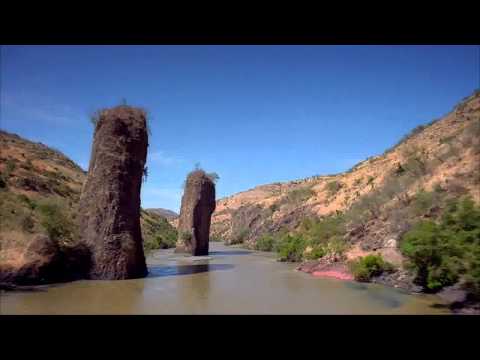 7:32
 1:47
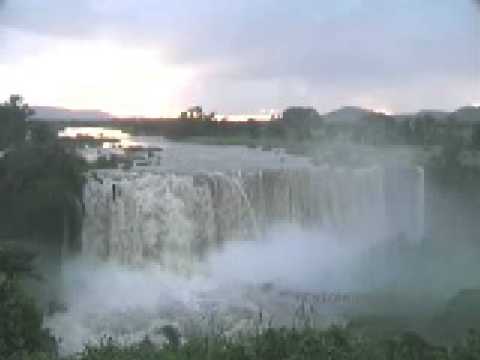 1:41
Chosen from YouTube; videos belong to their creators and play from YouTube's privacy-enhanced player.
History & travel
Virginia Morell · 2001
Morell's account of following the Blue Nile from Lake Tana down through its gorge, with the river's history, legends and people.

History & travel
Alan Moorehead · 2000
Moorehead's history of the Blue Nile from Lake Tana, where James Bruce and later travellers described the Tis Abay falls.
Guidebook
Philip Briggs · 2019
Thorough on Bahir Dar and Lake Tana, with directions for the Tis Abay walk to the Blue Nile Falls and the Portuguese bridge.
The falls, Bahir Dar and Lake Tana are all in Amhara region, where the US (Level 4, 'Do not travel'), the UK ('against all travel') and Canada ('Avoid all travel') all advise against going as of September 2026, citing armed conflict, kidnapping risk and a state of emergency. Some operators still run trips. Read the advisories yourself, check your insurance, and decide.
Yes, but it depends when you go. Hydro plants upstream, and a transfer tunnel from Lake Tana, take much of the flow outside the rainy season, so from about January to May the falls can shrink to thin strands or almost stop. From roughly July to October, peaking in August and September, the river still covers much of the cliff.
August and September, when the main rains have filled the river and there is more water than the power stations can use. October is usually still good, and June and July are variable. Avoid January to May if the waterfall itself is the point.
Drive about 30 km south-east to Tis Abay village, around an hour by car, then walk. Buses historically ran roughly hourly from Bahir Dar, but most visitors go with a guide or driver, and given the security situation that is the better choice. From the village ticket office, the viewpoint is 30–60 minutes on foot.
The stone bridge below the falls was built in 1626 for Emperor Susenyos, when Portuguese Jesuits were influential at his court. Accounts credit an Indian mason who arrived with the Catholic Patriarch Afonso Mendes, so 'Portuguese' reflects the period rather than who built it. It is often called Ethiopia's first stone bridge.
Some of them. Ura Kidane Mehret and Azwa Maryam on the Zege Peninsula, the most-visited pair, welcome everyone. Kebran Gabriel and Daga Estifanos admit men only. Tell your boat operator in advance so they can plan a route that works for the whole group.
Yes, for US, UK, Canadian and EU citizens. Apply for the tourist e-visa at evisa.gov.et before you fly. Fees reported in July 2026 were US$62 for 30 days and US$152 for 90 days, both single entry, with processing in about three days. Don't count on a visa on arrival.
About 42 metres is the most widely cited figure, though operators quote anywhere from 37 to 45 metres. The drop varies across the cliff's separate channels. At full flood the falls can be around 400 metres wide. Height matters less here than timing: the same cliff can be a wide curtain in September and a trickle in April.
Blue Nile Falls is in Ethiopia (East Africa). The nearest base is Bahir Dar and the closest airport is BJR. Its coordinates are 11.4933, 37.5833.
Prices, fees and entry rules change. We re-check full guides regularly; spotted something out of date? Tell us.
Nearby

Lamadaya are waterfalls that are located in the Cal Madow mountain range in the Sanaag region of Somaliland.…

ruu Falls, also known as Aruu Falls Camspite, are natural waterfalls located in Northern Uganda along the…

Miriadua Falls is a Ugandan tourist site found in Maracha on River Oluffe, over 20 kilometres north of Arua…

Uganda's most scenic coffee-country waterfall trio