Lonely Planet MoroccoLonely Planet
Guidebook
Lonely Planet Morocco
Lonely Planet · 2025
Current Morocco guide covering the Middle Atlas and day trips from Marrakesh or Azilal to the Cascades d'Ouzoud.
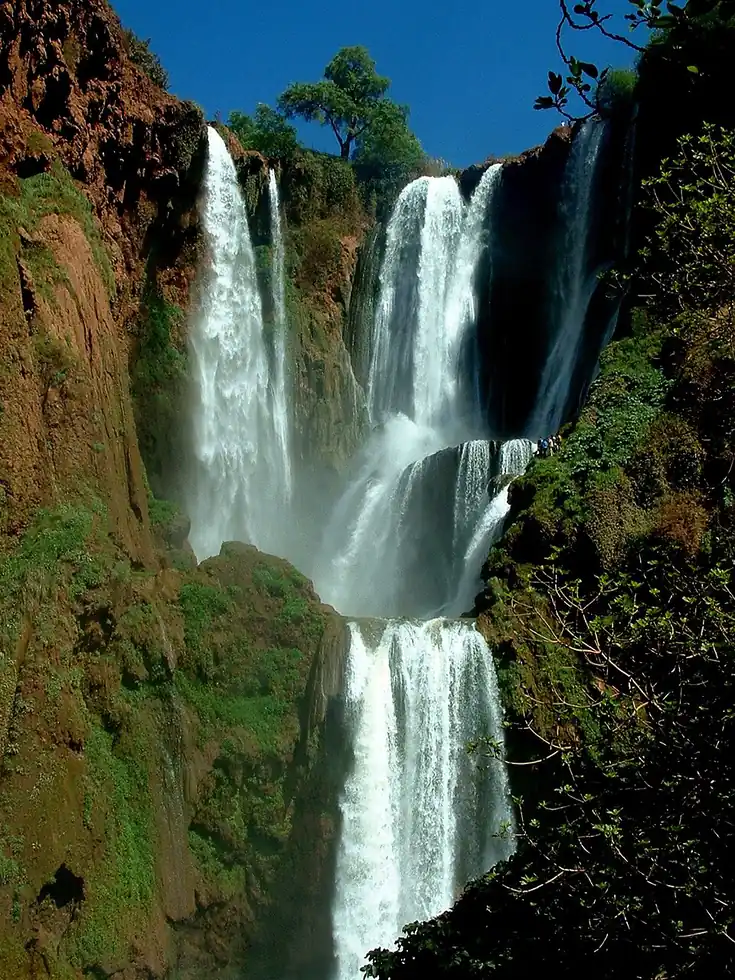
Morocco · Azilal Province
A tiered, roughly 110-metre drop over red rock in the Middle Atlas foothills, about 150 km from Marrakech. Walk down past olive groves, cafés and working mills, take a rowing boat to the spray, and watch wild Barbary macaques without feeding them.
Full guide Checked September 2026 by David Bussell · 34 sources
Ouzoud is a waterfall built in steps. The river pours off the lip of a red and ochre cliff at the edge of the village of Tanaghmeilt, splits into several separate ribbons, catches on ledges of travertine and moss, and lands about 110 metres lower in a green, churning pool. Sources agree on roughly that height but not on the exact figure. The name is usually explained as the Amazigh (Berber) word for olives or for the watermill, and both fit: olive groves cover the slopes and small mills still turn in the channels beside the path.
You experience it from the top down. From the car parks and hotels on the rim, a path of steps and packed earth drops through the olive trees past a string of terrace cafés, reaching the plunge pool in 20 to 30 minutes, or closer to an hour at a relaxed pace. At the bottom, local boatmen row small boats out towards the spray, and calmer pools downstream are where people swim in summer. A second route climbs the opposite bank, and longer paths follow the river down into the gorge of the Oued el-Abid.
Most visitors come as a long day trip from Marrakech, about 2.5 to 3 hours each way, which gives you two to four hours on site in the busiest part of the day. Stay a night instead and the rhythm changes: the tour vans leave, the macaque troops come down to the falls in the evening, and you can walk the gorge in the cool of the next morning before continuing to Bin el Ouidane lake or the natural bridge at Imi n'Ifri.
Tanaghmeilt / Ouzoud village, above the falls
The car parks, guesthouses and first viewpoints sit on the plateau above the drop, a few minutes' walk from the lip. From here you look straight across the amphitheatre at the upper tiers, and hotel terraces such as Riad Cascades d'Ouzoud and Borj des Cascades face the falls directly. This is also where unofficial guides and children selling food for the monkeys tend to meet arriving cars, so decide before you park whether you want a guide.
Stepped path through the olive groves to the plunge pool
The main path drops through olive terraces past a run of cafés and traditional mills still worked by the stream, then opens onto the plunge pool, where boatmen row visitors towards the spray under the main curtain. Terrace restaurants serve tagine and mint tea with the falls in view. Calmer pools downstream are the swimming spots in summer; the main basin is rough and cold. Allow 20 to 30 minutes down and longer back up.
River paths below the falls
Below the falls the river cuts on through red rock towards the gorge of the Oued el-Abid. Longer walks follow it down, and one 2026 guide puts the gorge walk at about two hours one way, with local guides charging around 150–200 MAD. The crowds thin within minutes of leaving the base. Paths are unmarked in places, hot in summer and prone to high water after rain, and Canada advises against hiking alone in remote Moroccan mountains, so go with a guide.
Walk down to the base: that is where the mills, the boats and the full height of the falls are. If you stay overnight, add the gorge walk the next morning with a guide. If you only have a few hours and bad knees, the rim viewpoints alone still show you most of the cascade.
March to May brings the strongest flow; June to September is best for swimming but busiest; October and November are calm and quiet; winter has water but cold nights.
Water volume is the variable. Winter rain and Atlas snowmelt make spring the fullest season, while by August the falls run thinner and the site is at its most crowded.
The strongest flow of the year, green olive terraces and wildflowers in the surrounding fields, with walking weather comfortable enough for the gorge path. One guide also names February as high-flow. The water is still cold for swimming, but the paths are at their most pleasant, and early mornings are quiet before the tour vans arrive. This is also the best time to see Bin el Ouidane lake full and turquoise.
Hot, busy and the best time to swim. The pools and cafés are at their liveliest, and guides single out Sundays and August as the most crowded times of the year. Flow drops noticeably by late summer, though the falls keep running. Start early: the path back up is exposed in the midday heat, and the day-trip vans from Marrakech arrive from late morning.
Stable weather, cooler walking and far fewer visitors than summer. Flow depends on when the first autumn rains arrive: early in the season it can still look like late summer, while a wet November brings the falls back up. A good compromise if you want to walk the gorge and linger at the base without the August crowds.
Few visitors and often more water than in summer, but cold, especially at night. Several recent hotel reviews in Ouzoud mention cold rooms and weak heating in winter, so ask before booking. Paths can be muddy and slippery after rain, and the drive from Marrakech is best done entirely in daylight.
Day tours from Marrakech leave around breakfast time, arrive late in the morning and are gone by mid-afternoon. Stay overnight and you get the base almost to yourself early and late, with softer light on the red rock. Macaque troops tend to gather around the falls towards dusk, when you can watch them behave like wild monkeys rather than like beggars working a crowd.
Fees at the falls are 2025/2026 rates in Moroccan dirhams reported by travel guides and visitors, converted at about 9.6 MAD to $1 (Wise, 27 September 2026); tour and hotel prices are 2026 advertised listings or review-site averages that change with season and demand. Treat all figures as a planning guide, not a quote.
The classic Ouzoud walk drops from the village through olive terraces to the plunge pool on a path of rough steps and packed earth, reported at roughly 300 steps. On the way you pass small stone mills still driven by the stream, and a chain of terrace cafés serving tagine, couscous and mint tea with the falls in front of you. There are two ways down, stairs and a looser natural path, so you can make a loop. Wear shoes with grip.
Year-round; muddy after rain, hot at midday in summer
No booking needed.
Local boatmen row small shared boats across the plunge pool towards the spray under the main curtain. It is short and genuinely wet, and it gives you the only view of the falls from water level. Queues build when tour groups arrive: one reviewer waited 40 minutes. Agree the price and what it covers before stepping in, and keep phones in a dry bag.
Year-round, weather and water levels permitting
Pay on the day — nothing to book in advance.
Swimming is allowed, but the main basin under the falls is rough and not for casual swimmers. The calmer natural pools a little way downstream are where people actually swim, and in summer they get busy. The water stays cold even in August. There are no lifeguards. Rural Morocco is conservative: cover up away from the water, and a T-shirt over swimwear is the respectful choice.
Best June – September; cold the rest of the year
No booking needed.
Troops of Barbary macaques, an endangered species and the only wild primate in Africa north of the Sahara, live in the olive groves around the falls. Years of tourist handouts have made them bold: they grab bags, sunglasses and food. A study in Ifrane National Park found that provisioned macaques suffered more stress, weight gain, hair loss and gut disease than wild-feeding ones. Watch from a few metres, keep food sealed, and do not buy peanuts from the children selling them.
Year-round
No booking needed.
Below the falls, paths follow the river down through red-walled terrain towards the gorge of the Oued el-Abid, the larger river it feeds. Within minutes of the boats the crowds are gone, and the walk passes quieter pools and terraced fields. Trails are informal and route details vary between sources, so hire a guide through your guesthouse rather than on the path, agree the price and turnaround point beforehand, and carry plenty of water.
Spring and autumn; avoid after heavy rain and in midday summer heat
No booking needed.
The easy way to do it: hotel pickup in Marrakech, an air-conditioned minibus, a local guide on the walk down and a boat ride, with free time at the base. It is cheap and, on 1,938 reviews averaging 4.6, broadly well run. Recurring complaints are being steered to one restaurant for lunch, rushed guiding, 40-minute boat queues and late returns. Choose the self-guided option if you would rather walk at your own pace.
Daily, year-round
You do not need a guide for the main path, which is obvious and busy. A guide earns the fee on the loop that crosses to the opposite bank and climbs back through the olive groves, and on the longer walks downstream, where they know the paths and the families along them. Ask your riad to arrange one. Canada's travel advice is to hire only guides recommended by hotels, agencies or tourist authorities, not those who approach you at the car park.
Year-round
Pay on the day — nothing to book in advance.
A large reservoir behind a 133-metre dam completed in 1953, its turquoise water set among bare red Atlas ridges roughly an hour to an hour and a half from Ouzoud. Lakeside hotels such as Widiane Resort and Hotel Bin el Ouidane arrange boating, canoeing and lake excursions, and people swim and fish here in summer. Water levels fall in drought years, so the colour and shoreline in photographs are not guaranteed. A natural second stop on an overnight trip.
Swimming and paddling roughly May – October; fullest water in spring
No booking needed.
About 6 km from the town of Demnate, a stream has hollowed a collapsed cave into a huge limestone arch spanning a gorge, streaked in white and red and busy with nesting crows. About 300 steps lead down, then the path turns into a rougher scramble over rocks that is steep and exposed to the sun. Dinosaur footprints in the rock nearby can be visited with local help. It pairs well with Ouzoud on a loop from Marrakech.
Year-round; spring for wildflowers, avoid midday in summer
No booking needed.
Children and vendors on the path sell peanuts and snacks for the macaques, and some ask for money after a monkey climbs on you for a photo. Barbary macaques are listed as Endangered by the IUCN, and research in Morocco's Ifrane National Park found that tourist-fed groups had higher stress hormones, more hair loss, heavier bodies and around eight times more gastrointestinal illness than troops that were not fed, plus deaths and disappearances in the fed group. Feeding also makes them grab bags and occasionally bite. Watch from a few metres, keep food zipped away and let them be wild.
Day-trippers sleep in Marrakech, but a night in Ouzoud is the better plan: a cluster of guesthouses and hotels sits on the rim within a few minutes' walk of the falls, and the lake resorts at Bin el Ouidane are an hour or so away.
A nine-room traditional house with a courtyard orange tree and a roof terrace, a few minutes' walk from the upper viewpoints. Reviewers through mid-2026 praise the home cooking and the welcome; rooms are simply furnished and can be cold in January.
The largest hotel on the rim, with about 50 rooms, a spa and two pools including a rooftop infinity pool looking at the cascade. The location is unbeatable, but 2026 reviews are mixed on maintenance, cleanliness and winter heating.
A 12-room boutique property with a large pool among olive trees and flower gardens. Top-rated in Ouzoud, with 2026 reviews singling out the breakfasts, the owner's care and dinners adapted for vegetarians. Quiet, and a short walk from the village.
A kasbah-style hotel outside the village with an outdoor pool, rooms and cottages sleeping two to five, and dinners cooked to order. Guests rate it highly for cleanliness and staff; it is a 20-minute walk down to the falls, longer back up.
A 45-room two-star hotel under ten minutes' walk from the falls, with a large pool, garden terraces and live music some evenings. Cheap and friendly, but reviews are uneven on cleanliness and upkeep, so ask to see the room.
A campsite and small auberge with rooms, a pool and a restaurant, well reviewed for hot showers, clean bathrooms and mountain views. Popular with overlanders and campervans, though pitches are small and dinner must be ordered ahead.
Four rooms plus Berber tents and camping, run by a welcoming family, with home-cooked tagines and vegetables grown on site. Right beside the falls and quieter than the main strip; the most recent review found dates from January 2025.
A 128-room lakeside resort with several pools, a spa, and boating and canoeing on the reservoir. Reviews to September 2026 praise the setting and views but report uneven service and maintenance for the price.
Open since 2006, with 29 suites in Moroccan style, terraces, gardens and a pool looking over the lake. It organises lake excursions, mountain walks and trips to Ouzoud and the Ait Chribou eco-village.
Search all Ouzoud accommodation
About 150 km and 2.5–3 hours from the falls by road. The main airport for southern Morocco, with direct flights from across Europe, including London, Paris and Madrid, and connections via Casablanca.
Royal Air Maroc's hub and the main gateway from North America, with non-stop flights from Montreal and New York. From Casablanca, continue to Marrakech by train or connecting flight, or drive towards Ouzoud via Beni Mellal.
Marrakech is the base for almost every visit; long-haul travellers usually connect through Casablanca or a European hub such as Paris, Madrid or London.
By car, follow the N8 north-east from Marrakech and turn onto the R208 towards Azilal; one guide times the drive at 2 hours 40 minutes on paved roads. Drive in daylight: Canada advises avoiding night driving in Morocco because of road conditions and accident rates. A private grand taxi from Marrakech for the round trip costs about 1,500–1,700 MAD (~$156–177) per vehicle. By public transport, CTM buses reportedly run from Marrakech to Azilal in about three hours for around 60 MAD, then shared grand taxis cover the last 22 km for 30–40 MAD; confirm current times locally.
Morocco's entry rules for these passports have been stable for years, but check your own government's travel advice before you fly, particularly on passport validity, where official sources differ.
 This waterfall
Ouzoud Falls
Morocco
Height110 mWidth—
 Most similar
Sipi Falls
Uganda
Height95 mWidth—
Also a tiered waterfall, of similar height and in Uganda
 Largest curtain
Victoria Falls
Zimbabwe · Zambia
Height108 mWidth1,708 m
Largest single sheet of falling water
 Tallest on earth
Angel Falls
Venezuela
Height979 mWidth—
 Widest on earth
Khone Phapheng Falls
Laos
Height21 mWidth10,783 m
Measured across the whole multi-channel system
Angel Falls is 8.9× taller than Ouzoud Falls. It is about the same height as Victoria Falls (108 m). We don't have a reliable crest width for Ouzoud Falls yet, so it is left off the width chart. Tallest · widest lists.
 7:14
 18:02
 13:33
Chosen from YouTube; videos belong to their creators and play from YouTube's privacy-enhanced player.
Guidebook
Lonely Planet · 2025
Current Morocco guide covering the Middle Atlas and day trips from Marrakesh or Azilal to the Cascades d'Ouzoud.
No. Most 2025–2026 sources confirm the falls are free to visit and open around the clock. You pay for parking (about 10–20 MAD), the boat ride (usually 20 MAD per person), food and any guide. One travel site quotes a 20 MAD entrance fee, but no other source mentions it. Carry cash, as there are no reliable ATMs at the falls.
About 150 km north-east, or 2.5 to 3 hours each way on paved roads via the N8 and R208. Shared minibus tours leave Marrakech around 8am and return in the early evening, from about $22 per person. A private grand taxi for the round trip costs roughly 1,500–1,700 MAD (~$156–177) per vehicle.
A day trip works if you are short of time, but it means six hours in a vehicle for two to four hours at the falls, in the busiest part of the day. Staying one night gives you the base early and late without crowds, macaques in the evening, and time for the gorge walk. Rooms on the rim start around $40.
Yes. The main basin under the falls is rough, so people swim in the calmer natural pools a little way downstream. The water stays cold all year, and summer, from June to September, is the realistic swimming season. There are no lifeguards. Wear something modest over your swimwear.
No. Barbary macaques are endangered, and research in Morocco found that tourist-fed groups suffer more stress, obesity, hair loss and gut disease than wild-feeding ones. Feeding also makes them grab bags and bite. Ignore the children and vendors selling peanuts, keep food sealed and watch from a few metres away.
About 20 MAD (roughly $2) per person is the fare most sources report for the short row towards the spray. One 2026 guide quotes 40–60 MAD for a 20-minute trip, so confirm the price with the boatman before you get in. Queues of up to 40 minutes build at midday when tour groups arrive.
March to May, when winter rain and Atlas snowmelt give the fullest flow, the terraces are green and walking weather is comfortable. June to September is best for swimming but crowded, especially on Sundays and in August, and the falls run thinner. October and November are quiet; winter has water but cold nights.
Not for tourism if you hold a US, Canadian, UK or EU passport: you can stay visa-free for up to 90 days. Canada and the US require six months' passport validity, while UK guidance asks for three months after arrival, so travel with six months to be safe. Morocco's electronic travel authorisation does not currently apply to these passports.
Ouzoud Falls is in Morocco (North Africa). The nearest base is Tanaghmeilt and the closest airport is RAK. Its coordinates are 32.0152, -6.7193.
Prices, fees and entry rules change. We re-check full guides regularly; spotted something out of date? Tell us.
Nearby

El-Ourit Waterfalls are located seven kilometers from the city of Tlemcen, near the National Road of Algeria…

Kefrida Waterfall is a waterfall in Algeria.

The Félou Falls are located on the Sénégal River 15 kilometres upstream of Kayes in western Mali. The river…

The Gouina Falls or Chutes de Gouina are on the Sénégal River in Mali between the towns of Bafoulabé and…