Walks and Treks in CroatiaRudolf Abraham
Walking guide
Walks and Treks in Croatia
Rudolf Abraham · 2019
Cicerone walking guide to Croatia's karst mountains and national parks, for walks beyond the boardwalks.

Croatia · Šibenik-Knin County
Seven travertine waterfalls on one Dalmatian river, from Skradinski buk's seventeen-step, 800-metre staircase to the braided 'Necklaces' of Roški slap. You reach them by boat from Skradin, and an island monastery sits halfway between the two.
Full guide Checked September 2026 by David Bussell · 51 sources
The Krka runs 72 km from the Dinaric foothills to the Adriatic at Šibenik, and along the way it has built seven barriers of travertine, the porous limestone locals call sedra (tufa). Moss and algae trap calcium carbonate from the water and slowly turn into rock. The last and longest barrier, Skradinski buk, is 800 metres of seventeen stepped falls, between 200 and 400 metres wide, that drop 45.7 metres in total through islets, pools and curtains of moss. The park describes it as the longest tufa barrier in Europe. Thirteen kilometres upstream, Roški slap opens with a chain of tiny cascades called the Necklaces, then fans out and crashes into Visovac Lake. Manojlovac, further north, is the tallest of the seven at 59.6 metres.
Most visitors see Krka in stages because the river itself is staged: the travertine dams make it impossible to sail straight through. Park boats carry you from the riverside town of Skradin up to Skradinski buk, or a park bus drops you there from the main Lozovac car park. A one-way, 1.9 km boardwalk loop then crosses the falls on wooden bridges and passes restored watermills and the ruins of an 1895 hydroelectric plant. From the foot of the falls, excursion boats continue up the lake to the Franciscan island monastery of Visovac and on through the Među gredama canyon to Roški slap. The upper river, with Manojlovac, the Roman camp at Burnum and the Orthodox Krka Monastery, is reached by road and gets a fraction of the crowds.
Krka became a national park in 1985. It is easier than Plitvice to fold into a Dalmatian coast trip: Split and Zadar airports are each about an hour away, and Šibenik is closer still. The trade-off is that almost everyone uses the same two entrances to reach the same waterfall, so a July midday at Skradinski buk is a slow queue along the boardwalks. There is also the swimming question. The famous swimming pool below Skradinski buk closed for good on 1 January 2021, and a lot of tour listings still haven't caught up.
Lozovac entrance (bus) or Skradin entrance (boat)
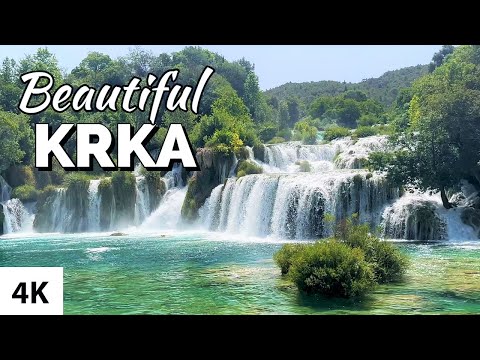
This is the Krka waterfall in nearly every photograph: the Krka and Čikola rivers pour together over seventeen travertine steps into a broad green pool. A one-way, 1.9 km boardwalk loop takes about an hour at a walk, and closer to two with photo stops. It crosses the upper cascades on wooden bridges, passes an ethno village of working watermills, and reaches the ruins of the 1895 Krka hydroelectric plant. Excursion boats to Visovac and Roški slap leave from here.
Roški slap / Laškovica entrance, off the Drniš and Miljevci roads
Roški slap starts with the Necklaces, a braid of tiny travertine cascades spread over reed beds and islets. It ends in a 22.5-metre funnel of white water that drops into Visovac Lake. A 1,360 m circular trail crosses the Necklaces past restored watermills and wool-washing posts, and 517 wooden steps climb to Oziđana pećina, a cave with traces of people from thousands of years ago. It gets far fewer visitors than Skradinski buk, and there is a marked swimming area in summer.
Kistanje and Puljane, on the Knin–Kistanje road
Upstream, the Krka runs through a deep limestone canyon, and Manojlovac drops 59.6 metres over a series of barriers, the last of them 32.2 metres high. You look at it from a viewpoint above, where an inscription cut into the rock records Emperor Franz Joseph's visit in 1875. A few hundred metres away are the arches and military amphitheatre of Burnum, a Roman legionary camp. Krka Monastery, a Serbian Orthodox house dedicated to the Archangel Michael, stands about 3 km east of Kistanje.
If you only have one day, go to Skradinski buk. Arrive by boat from Skradin if you can, and add the 4-hour boat excursion to Visovac and Roški slap if the timing works. With a car and a second day, drive to Roški slap for the Necklaces (and a swim in summer), then continue north to Manojlovac and Burnum. That's where most repeat visitors spend their time.
May, June and the first half of October balance strong flow, open boats and bearable crowds. September is still peak price, but it's the last month of the swimming season. Buy online and pick an arrival time whenever you go.
Two things change most: the price, which doubles from shoulder season to summer, and the boats, which run only from 1 April to 31 October. Out of season, you walk or drive to Skradinski buk and cannot reach Visovac.
Long days (8:00–20:00 at the main sites in July and August) and hot boardwalks. Tour coaches from Split and Zadar arrive by late morning, and the all-sites ticket is at its highest, €40 (~$46), or €30 after 15:00. This is the only time you can swim in Krka, and only at the marked areas at Roški slap, Stinice and Pisak. Manojlovac runs thin because its water is diverted to a hydro plant.
Often the strongest flow of the year, including at Manojlovac, where the water has not yet been diverted for summer. The ticket costs half the summer price (€20, ~$23), and the boats and Lozovac bus start on 1 April. It is warm enough for the 517 steps at Roški slap without the July heat. The Skradinski buk boardwalks still fill up at weekends and on school-trip days.
The €20 shoulder price returns and the crowds thin out quickly after the first week. Rain usually brings the flow back after the summer low, and the willows and ash along the river turn yellow. Boats and the Lozovac bus run until 31 October. Hours shorten from 16 October to 9:00–17:00, so start early if you want the 4-hour Roški slap boat.
The cheapest Krka: €7 (~$8) for the whole park and near-empty boardwalks, often with high water after winter rain. The trade-off is transport. No boats run, so you walk the 3.4 km trail from Skradin bridge or drive down from Lozovac to the falls. Visovac and the boat excursions are off, and Manojlovac and Burnum close. Hours are 9:00–16:00, and the park shuts on 25 and 26 December.
From June to September, the all-sites adult ticket drops from €40 to €30 (~$34) for entry after 15:00, and children's and students' tickets drop to €11.25. With the 20:00 summer closing in July and August, that still leaves time for the whole Skradinski buk loop. Coach groups are leaving by then and the light is softer. Arriving at opening is the other quiet window. Late morning to early afternoon is the bottleneck to avoid.
Park prices are Krka National Park's published 2026 rates in euros (unchanged in the 2027 list), converted at the ECB rate of about $1.14 per euro (25 Sept 2026) and rounded. Tour prices are 2026 third-party listings that change with demand, season and operator. Treat all figures as a planning guide, not a quote.
The one-way, 1.9 km circuit goes over and around the seventeen steps of Skradinski buk. It runs on wooden bridges across the upper cascades, past mossy travertine and small lakes, then down to the big pool at the bottom, with information panels along the way. It passes the ethno village, where restored mills still grind and full cloth, and the remains of the 1895 power plant. Expect stairs and a steady one-way flow of people. Railings are there on the busiest sections.
Year-round
Pay on the day — nothing to book in advance.
Park boats leave the Skradin waterfront and head up the Krka's river canyon, past moored yachts and reed beds, to the foot of the falls. It's the most scenic way in and it costs nothing beyond your ticket. With an online ticket you skip the Skradin ticket office and go straight to the dock. Parking in Skradin is private and paid. Out of season, or if you'd rather walk, a 3.4 km trail runs from Skradin bridge to the falls.
1 April – 31 October
No booking needed.
An excursion boat crosses Visovac Lake to a small wooded island. Franciscans have lived there since 1445, at the monastery of Our Lady of Mercy, and its church, museum and library hold incunabula and archaeological finds. Staff show you round during a 30-minute stop. Dress modestly and leave dogs behind, since they aren't allowed on the island. Departures are set day by day, not on a fixed timetable, and can't be booked online. Buy tickets at the dock. The island closes to visitors on 2 and 15 August.
1 April – 31 October (occasionally March and November in good weather)
Pay on the day — nothing to book in advance.
The longest river trip in the park, and the best way to see Roški slap without a car. After the Visovac stop, the boat continues up the lake and through the Među gredama canyon, where limestone walls close in on both sides, to the foot of Roški slap. You get 90 minutes to walk the Necklaces trail and see the mills before the same boat takes you back. You have to return on the boat you came on.
1 April – 31 October
Pay on the day — nothing to book in advance.
A 1,360 m circular trail crosses the Necklaces, the chain of small travertine cascades at the top of Roški slap, past restored watermills and wool-washing posts. Fit walkers then climb 517 wooden steps to Oziđana pećina, a cave with evidence of people living there thousands of years ago, and look back down over the falls. You can also reach the cave by a shorter flight of steps from Bogatići. The full Stinice–Roški slap–cave trail runs about 8.5 km one way.
Year-round; cave visits April–October
Pay on the day — nothing to book in advance.
Since Skradinski buk closed to swimmers in 2021, these three marked areas are the only places in the park where you can legally get in the water. There's one at Roški slap and two on Visovac Lake: Stinice, on the Miljevci side, and Pisak near Remetić. You swim at your own risk, only inside the marked zones, and only in season. Jumping off falls or bridges is banned, and rangers enforce it. Stinice has free parking and a toilet, as well as the short boat to Visovac.
1 June – 30 September only, weather and water levels permitting
No booking needed.
Manojlovac is the park's tallest waterfall, 59.6 metres in all. You see it from the canyon rim, where an inscription cut into the rock marks Emperor Franz Joseph's visit in 1875. Go in spring or after autumn rain: in the warm months most of its water goes to the Miljacka hydro plant. A few hundred metres away, Burnum has the arches of a Roman legionary command building and Croatia's only surviving military amphitheatre. The finds are displayed at the Krka Eco Campus in Puljane.
April – October (closed November – March)
Pay on the day — nothing to book in advance.
On 28 August 1895, a plant at Skradinski buk started sending two-phase alternating current 11 km to Šibenik's street lights. It was Croatia's first complete AC system and one of the first in the world, and the IEEE now marks it as a Milestone. The park notes that it started up two days after the first Niagara plant. That original plant, HPP Krka (Jaruga I), shut in 1913 and survives as excavated ruins beside the loop. Its successor downstream, Jaruga, opened in 1904 and still generates power.
Year-round
No booking needed.
From the upper dock at Roški slap, a boat heads upstream into a quieter stretch of canyon, where two medieval fortresses face each other across the river. You see Trošenj and Nečven from the boat and don't land. Older guides describe a boat stop at Krka Monastery on this route. The park's 2026 boat price list doesn't include one, so plan to reach the monastery by road from Kistanje instead.
April – October; last departures around 15:00
Pay on the day — nothing to book in advance.
The shortest of the park boat trips turns off the Krka into the Čikola, the tributary that joins it just above Skradinski buk. The Čikola has been backed up into a 3 km lake-like canyon by the same travertine dam. It's a quick loop between towering limestone walls with no landing, so it works well if the 2-hour Visovac trip won't fit. It leaves from the dock at the foot of Skradinski buk.
April – October
Pay on the day — nothing to book in advance.
The park has marked 388 km of cycling routes: twelve loops split between mountain-bike, road and easy family 'track' rides. They start from Skradin, the Laškovica visitor centre and the Krka Eco Campus in Puljane. The park hires pedal-assist e-bikes at Puljane with prior notice and hands out GPS tracks. The Puljane loops take in Burnum and Manojlovac. Canoes and kayaks, by contrast, are not allowed anywhere in the park.
During Krka Eco Campus opening hours; book ahead
Pay on the day — nothing to book in advance.
Coach from Split or Trogir, about 1.5 hours each way, and usually the Skradin boat in, with about two hours on the Skradinski buk loop. Some add wine tasting in Skradin or a stop in Šibenik. Read the fine print: the cheapest listings often leave out the entrance ticket. Many still say 'swimming', which now means the river at Skradin or a coastal stop, not the pool below the falls.
Mostly April – October
Krka banned swimming at its main waterfall, Skradinski buk, from 1 January 2021 to protect the travertine and to stop drownings, and the ban holds. The pool that filled old photographs is closed. Plenty of Split and Zadar day tours still carry 'boat ride & swimming' in their titles. That usually means a dip in the river at Skradin or a stop at a coastal town on the way back, not the falls. Inside the park you can swim only at the marked areas at Roški slap, Stinice and Pisak, from 1 June to 30 September, at your own risk. Canoeing, kayaking, drones and jumping from falls or bridges are all banned. Plitvice, the other famous option, allows no swimming at all.
Skradin puts you on the first boat to the falls, while Šibenik, 20–30 minutes away, has the old town, the better hotels and the sea. The only beds inside the park are at a hostel in the far north.
A 3-star, 25-room hotel in Skradin's small centre, a few minutes' walk from the Krka ticket office and boat. It has a restaurant with Dalmatian and grilled fish dishes and a large terrace. Staying here lets you be on the first boat before day-trippers arrive.
Skradin is a small stone town at the head of the Krka estuary, and most beds are family-run apartments and rooms rather than hotels. You can walk to the boat, eat at the waterfront konobas, and have the town to yourself once the tour coaches leave.
A family-run campsite under pine shade, midway between the two main entrances, with room for about 120 guests. The owners sell their own cheese, wine, olive oil, prosciutto and fresh bread. It's the cheapest base within easy reach of Lozovac.
The only accommodation inside the national park. It's a park-run, hostel-style volunteer and research centre in a converted military complex, beside the Burnum archaeological collection and the e-bike hire. It's quiet and remote, and suits the upper-river sites much better than Skradinski buk.
Seventeen rooms in the restored 15th-century Marenci Palace on a small square in Šibenik's pedestrian centre, with original stone walls, a hot tub and Finnish sauna, and a café terrace. The Michelin Guide lists it as a recommended stay.
Stone heritage rooms and apartment-style residences below the old city walls, looking over the channel where the Krka meets the Adriatic. Some residences have private hot tubs or saunas, and the two restaurants are Bronzin (grill) and Buta. It's listed by the Michelin Guide.
A contemporary concrete-and-timber hotel in the Small Luxury Hotels of the World collection, with pools, a spa, and a shuttle boat across to the old town. The hotel also runs its own boat for Kornati trips. It closes from November to February.
A 4-star-plus beach hotel in Šibenik's big resort complex, which has several hotels, a 4 km coastline, a large indoor spa and a water park. Lozovac is about 18 km away. It suits people splitting their time between beach days and Krka.
Search all Skradin accommodation
About 58 km to Lozovac and 65 km to Skradin, roughly an hour on the A1 motorway. It's the busiest Dalmatian airport, with the widest choice of seasonal European routes, and where most Krka day tours start.
Roughly 65–75 km to Skradin and Lozovac, about 1 hour to 1 hour 10 minutes via the A1. It's a strong seasonal and low-cost European gateway, and the natural choice if you're pairing Krka with Plitvice.
Split is the main gateway. Both Dalmatian airports are mostly served by European (and often seasonal) flights, so long-haul travellers usually connect through a European hub or Zagreb. Šibenik, 15–20 km from the park, is the nearest city and bus hub.
The park runs in stages because the travertine dams block the river. The Skradin boat goes only as far as Skradinski buk. From there, excursion boats continue to Visovac and Roški slap, and from Roški slap to the fortresses. An all-sites ticket covers every land site on the same day, but you can use each site only once, so you can't go in by the Lozovac bus and come back through by the Skradin boat. To see Roški slap, Manojlovac or Burnum on your own, you'll need a car: each has its own parking. From June to September, park at Laškovica or Bogatići for the free Roški slap shuttle. By bus, Split to Skradin takes from about 1 hour 20 minutes, with more frequent local buses from Šibenik.
ETIAS, the EU's planned pre-travel authorisation for visa-exempt visitors, has been delayed repeatedly and had no confirmed launch date as of late September 2026, with several reports pointing to a slip into 2027. It is not yet required for entry via Croatia. This is one of the fastest-moving areas of European travel policy, so check the official EU ETIAS site close to your travel date rather than relying on any date quoted here.
 This waterfall
Krka Falls
Croatia
Height25 mWidth—
 Most similar
Boyana Waterfall
Bulgaria
Height25 mWidth—
Also a cascade waterfall, of similar height and in Bulgaria
 Largest curtain
Victoria Falls
Zimbabwe · Zambia
Height108 mWidth1,708 m
Largest single sheet of falling water
 Tallest on earth
Angel Falls
Venezuela
Height979 mWidth—
 Widest on earth
Khone Phapheng Falls
Laos
Height21 mWidth10,783 m
Measured across the whole multi-channel system
Angel Falls is 39× taller than Krka Falls. Victoria Falls is 4.3× taller. We don't have a reliable crest width for Krka Falls yet, so it is left off the width chart. Tallest · widest lists.
 3:59
 13:23
 13:13
Chosen from YouTube; videos belong to their creators and play from YouTube's privacy-enhanced player.
Walking guide
Rudolf Abraham · 2019
Cicerone walking guide to Croatia's karst mountains and national parks, for walks beyond the boardwalks.

Guidebook
Lonely Planet · 2024
12th edition with detailed sections on Plitvice Lakes and Krka National Park, incl. access, boats and entry tips.

Guidebook
DK Eyewitness · 2023
Illustrated guide with cutaway-style maps of Plitvice and Krka national parks.
Guidebook
Rough Guides · 2022
Rough Guide coverage of Lika and Dalmatia, useful for pairing Plitvice with Krka and Skradin.
Not at Skradinski buk, where swimming has been banned since 1 January 2021. It's allowed only in marked areas at Roški slap, Stinice and Pisak, from 1 June to 30 September, at your own risk and depending on water levels. Tours that advertise 'swimming' usually mean the river at Skradin or a coastal stop. Plitvice doesn't allow swimming at all.
For the all-sites adult ticket, €40 (~$46) from June to September (€30/~$34 after 15:00), €20 (~$23) in April, May and October, and €7 (~$8) from November to March. Children 7–18 pay up to €15, and under-7s are free. It includes the Skradin boat and Lozovac bus from April to October. The park's published 2027 prices are the same.
Skradin if you want the scenic 25-minute boat ride and a town for lunch, though parking there is paid. Lozovac if you're driving and want free parking, a quick park bus or the 875 m forest path down to the falls. Both lead to the same Skradinski buk loop, and one ticket covers either. You just can't mix them on the same visit.
No. Your entrance ticket covers only the Skradin boat and the Lozovac bus. The 2-hour Visovac excursion costs €15 (~$17) extra, and the 4-hour trip to Visovac and Roški slap €20 (~$23). Both run April to October, are sold only at the park, not online, and leave on times set each day.
Yes, if you mainly want the waterfall. It costs €7, the boardwalks are nearly empty, and flow is often high after winter rain. But no boats run from November to March, so you walk from Skradin bridge or drive down from Lozovac. Visovac, Manojlovac and Burnum are also off the table, and the park closes at 16:00.
Plitvice is bigger: sixteen lakes, Croatia's tallest waterfall and a full day of walking, but no swimming anywhere. Krka is easier from the coast, about an hour from Split, adds a river boat trip and an island monastery, and allows a summer swim at Roški slap. If you have a car and four or five days, do both. Zadar is the natural airport between them.
Take a day tour, which usually runs 7.5–10 hours and often leaves out the park ticket, or a public bus from Split to Skradin, from about 1 hour 20 minutes. From Skradin, the included park boat reaches the falls. Roški slap and the upper river are hard to reach by public transport, so book the 4-hour boat excursion from Skradinski buk instead.
Croatia is a full Schengen member, so visa-exempt nationalities (US, Canada, UK, Australia, New Zealand and others) can stay up to 90 days in any 180-day period without a visa. Expect EES fingerprint registration if you enter Schengen at Split or Zadar. ETIAS has been repeatedly delayed and has no confirmed launch date, so check the official EU site before you travel.
Krka Falls is in Croatia (Dalmatia), inside Krka National Park. The nearest base is Šibenik and the closest airport is SPU. Its coordinates are 43.9037, 15.9751.
Prices, fees and entry rules change. We re-check full guides regularly; spotted something out of date? Tell us.
Nearby

Croatia's most-visited named waterfall

The Topoljski Buk, also Krčić Waterfall and Veliki Buk, is a 22-meter-high waterfall in the north of the…

Štrbački buk waterfall is a 25m high waterfall on the Una River . It is situated on the border of Croatia and…

The Bliha Falls , called by locals Blihin Skok , is a waterfall on the Bliha river located near Fajtovci, 14…