Lonely Planet ChinaLonely Planet
Guidebook
Lonely Planet China
Lonely Planet · 2024
Covers Guizhou (Huangguoshu), Jiuzhaigou in Sichuan and the Yellow River loess country around Hukou in one volume.

Vietnam · China
A 300-metre-wide staircase of limestone ledges on the Quây Sơn River, split down the middle by the Vietnam–China border and seen from two separate countries, two ticket gates and two fleets of bamboo rafts that never quite meet mid-river.
Full guide Checked September 2026 by David Bussell · 31 sources
Ban Gioc–Detian is a wide fall rather than a tall one. The Quây Sơn River (the Guichun to the Chinese) spills across a broad rim of travertine and limestone about 300 m wide and drops roughly 30 m in stepped tiers, broken by rock outcrops and clumps of trees into several separate curtains that merge into one white wall in high water. Karst towers ring the basin, and in late summer the valley floor is paddy right up to the plunge pool. It is usually ranked the fourth-largest waterfall on an international border, after Iguazú, Victoria and Niagara.
The border runs along the river and through the falls, so you pick a bank. On the Vietnamese side, in Đàm Thủy commune of Cao Bằng province, a short path leads from the gate to the riverside, where bamboo rafts pole out towards the main curtain and a pagoda looks down from the hill above. On the Chinese side, in Daxin County, Guangxi, a shuttle bus runs from a car park well outside the scenic area to boardwalks, a stone boundary marker and rafts of its own. The rafts from each side work the same pool but turn back before the invisible line.
Go for the scale of the water in the wet season, the rice terraces turning gold around it in September, and the long, winding road north from Hanoi that takes in some of Vietnam's least-visited limestone country on the way. Combine it with Nguom Ngao cave next door, the Cao Bằng loop, or the Ha Giang loop to the west. If you want both sides, budget days rather than hours: for most foreign passports there is no crossing at the falls themselves.
The Ban Gioc–Detian cross-border scenic area, trialled from September 2023 and in full operation since 15 October 2024, lets escorted groups of up to 20 visit the other bank for the day. Every official and press account we found, up to reports in May 2026, describes it as open only to Vietnamese and Chinese citizens, with third-country nationals excluded. No change had been announced by late September 2026. The rafts do not cross either. To see both sides, go round by the formal international crossings, which takes days rather than hours.
Đàm Thủy commune, Cao Bằng province, via Cao Bằng city
The Vietnamese bank faces the widest, most layered section of the falls head-on, and it is where most Western travellers end up, usually after a long road trip from Hanoi. Entry costs pocket change, bamboo rafts run to the spray for a couple of dollars more, and the Phật Tích Trúc Lâm pagoda on the hill above gives the elevated view. Facilities are simple, the crowds are mostly Vietnamese, and a homestay night in the village lets you see the falls before the day-trip vans arrive.
Shuolong town, Daxin County, Guangxi, via Nanning
The Chinese side is the more developed, more crowded operation: a ticketed scenic area with a compulsory shuttle bus from the outer car park, paved walkways and viewing platforms along the upper falls, a Qing-era boundary stele from 1896 and the modern Marker 836, rafts of its own and, on some nights, an illuminated evening session. It is a straightforward day trip from Nanning by bus or car and fits naturally into a southern China itinerary.
Pick the side that matches the rest of your trip, because for US, Canadian, UK and EU passport holders you cannot hop between them at the falls. Coming from Hanoi or doing the northern loops, go Vietnam: cheaper, quieter and with the more complete frontal view. Already in Guangxi, go Detian for the boardwalks and night visit.
August to October pairs full flow with ripening rice and steadier weather; June and July bring bigger but muddier water and more rain, and winter shrinks the falls to strands.
Everything turns on the monsoon: from roughly May to September the river runs high and the falls merge into one wide curtain, while from November to April the flow shrinks to separate strands above clear green pools under cold, often grey skies.
The falls at or near full width, the rice in the valley ripening and harvested from mid-September into early October, and the rains easing into drier, clearer days as October goes on. This is the window both Vietnamese and Chinese guides point to, so expect busy weekends and Vietnam's 2 September holiday and China's first-week-of-October Golden Week to fill rafts, hotels and roads on their respective sides.
Big, loud, often brown water from the first heavy rains, green rice seedlings in the paddies and hot, humid afternoons with thunderstorms. Crowds are lighter than in autumn outside Vietnamese school holidays. The trade-off is weather: downpours can wipe out views for hours, the river turns muddy, and long road journeys through Cao Bằng's passes are slower and riskier after heavy rain.
The falls break into separate white ribbons over exposed ledges, and the pools below turn the jade-green colour in many photographs. November can still be pleasant; December to February brings temperatures that can drop to single digits, drizzle and fog. Lunar New Year (late January or February) sends a surge of Chinese and Vietnamese holiday traffic to both sides despite the thin flow.
The paddies that run right up to the Vietnamese viewing area turn yellow and are cut by hand across the second half of September and into early October, the timing shifting a week or two with each year's planting. It is the one stretch when high water, harvest colour and improving weather reliably overlap, and it is the season of the classic Ban Gioc photograph. Book homestays near the falls ahead for weekends in this window.
Prices are 2025/2026 rates from the Cao Bằng ticket schedule, the Detian scenic area as reported by 2026 travel guides and booking platforms, and advertised tour and hotel listings, converted at roughly 26,300 VND and 7.1 CNY to US$1 (September 2026). Treat them as a planning guide rather than a quote.
Flat bamboo rafts with life jackets pole out from the landing below the viewing terraces into the pool at the foot of the main curtain, close enough for spray in high water. The rafts work the Vietnamese half of the pool and turn back before the mid-river border line, often within shouting distance of the Chinese rafts doing the same thing. Buy tickets at the landing, and expect a wait at midday when tour groups arrive.
Year-round, suspended during flood surges
Pay on the day — nothing to book in advance.
The Chinese scenic area runs its own raft fleet from a landing inside the park, bought separately from the entry ticket. The route mirrors the Vietnamese one: out across the pool to the edge of the spray, a pause for photographs of the full width of the falls, then back before the border. Queues build during Chinese holiday periods, so go early in the day or on a weekday.
Year-round, suspended in high water
No booking needed.
A Zen pagoda about 500 m from the falls, begun in 2013 and inaugurated in December 2014 as the first Buddhist temple on this stretch of the northern frontier. A stepped path climbs to the main hall, bell and drum towers and a 1.5-tonne bronze bell, with a view over the full width of the falls and the paddies from above. Dress for a temple, with shoulders and knees covered.
Year-round
No booking needed.
A limestone cave system a few kilometres from the falls on the same road, with a lit, paved route through large chambers of stalactites and flowstone formations. It is the standard pairing with Ban Gioc on every tour itinerary and the obvious place to go when a downpour rolls through. The path is uneven and damp in places, so wear shoes with grip.
Year-round; can close after heavy flooding
Pay on the day — nothing to book in advance.
On scheduled evenings the Chinese scenic area reopens from about 19:30 to 22:00 with the falls and walkways lit up, a quite different experience from the daytime visit and only possible if you are staying in Shuolong or at the gate. Prices and nights vary by season and are published by the scenic area, so confirm on the day rather than relying on a tour listing.
Seasonal; check the scenic area's schedule before you go
No booking needed.
The easiest way to see the Vietnamese side without planning the road trip: Old Quarter pick-up, a long first-day drive via Dong Khe and a stop at Mắt Thần (Angel Eye) mountain, a night near the falls, then Ban Gioc and Nguom Ngao cave on day two before the drive back. The listing includes meals and an English-speaking guide; raft tickets are extra.
Year-round
A longer loop that adds Ba Bể, Vietnam's largest natural lake, to the falls. The listed itinerary runs Hanoi to Cao Bằng via Quy Môn Quan gate and Dong Khe, a full day at Ban Gioc and Nguom Ngao, then a boat trip across Ba Bể lake and through Puong cave on the way back. Nights are in homestays, groups are capped at 15, and frontier documents and entries are included.
Year-round
The classic northern motorbike combo: the Ha Giang loop over the Mã Pí Lèng pass and through Đồng Văn and Mèo Vạc, then east via Bảo Lạc and the Mẻ Pia switchbacks to Cao Bằng and the falls. Most people ride pillion with an easy rider rather than drive themselves; the route is steep, narrow and shared with trucks. Large luggage stays in Hanoi.
Best September – November; riskier in peak monsoon
A circuit out of Cao Bằng city linking the falls with the region's other sights: Mắt Thần (Angel Eye) mountain with its hole through the summit, Khuổi Ky stone-house village about 10 km from Ban Gioc, the Pác Bó cave and stream associated with Hồ Chí Minh's return in 1941, and quiet passes between karst towers. Several Cao Bằng guesthouses rent bikes and arrange easy riders.
Year-round; best August – November
Inside the Chinese scenic area, a path upstream of the falls leads to Marker 836 on the modern border and to the older No. 53 stele set up jointly by the Qing dynasty and French Indochina in 1896. It is a reminder that this border was fought over as recently as 1979 and only fixed by treaty in 1999. Stay on the Chinese side of any marker.
Year-round
No booking needed.
Stay by the falls for early-morning light and a quiet evening, or in Cao Bằng city, 2–2.5 hours away, for more choice; on the Chinese side, guesthouses cluster at the gate and in Shuolong.
The state-owned Saigontourist property right by the falls: 53 rooms on a large hillside site, a restaurant, vehicle rentals and waterfall-view rooms. Location is its selling point; recent traveller ratings are mixed, so read up-to-date reviews before booking.
A simple, backpacker-friendly guesthouse near the falls with mountain and river views, handy for being at the gate when it opens and for a quiet evening after the day groups have driven back to Cao Bằng.
A family homestay a short walk from Ban Gioc with breakfast included, well rated by recent guests for home cooking and for being close enough to see the falls before the tour vans arrive.
A highly rated village homestay near Nguom Ngao cave, recommended by guests for its hosts and meals; a good base if you want the cave and the falls on the same morning.
A popular homestay in the Ban Gioc area with private rooms and a restaurant set into a cave, well placed for walking to the falls and the pagoda early, before the day-trip vans arrive.
The largest and most comfortable hotel in Cao Bằng city, from the national Mường Thanh chain, with an indoor pool, spa, gym and rooftop views. The standard stop for tour groups and a good reset after the bus from Hanoi.
A dependable 40-room mid-priced hotel in the city with an on-site restaurant and motorbike rental, useful if you plan to ride the Cao Bằng loop out to the falls and back over two or three days.
A guesthouse about 100 m from the Detian scenic area entrance, rated 8.8/10 on Trip.com with reviews into 2025. Owners help with entry tickets; rooms are clean and plain, and there are no falls views.
Search all Cao Bang stays on Agoda or compare on Booking.com
About 350 km from the falls, 7–8 hours by road via Cao Bằng city. Vietnam's main northern gateway, with long-haul links via Asian and Gulf hubs and plenty of regional flights.
The closest airport to the Chinese side, roughly 3–4 hours' drive from Detian. Domestic flights across China and regional routes around Southeast Asia.
Hanoi is the hub for the Vietnamese side; Nanning, reached via Guangzhou, Kunming or other Chinese hubs, is the hub for the Chinese side.
Vietnam: sleeper buses leave Hanoi's My Dinh station for Cao Bằng city (about 8 hours, 300,000–350,000 VND), and limousine vans leave central Hanoi (6–7 hours, about 450,000 VND). From Cao Bằng, local buses and vans cover the 85 km to the falls in 2–2.5 hours for about 70,000 VND. China: buses leave Nanning's Langdong and Fengling stations around 08:30 (about 3 hours, CNY 60–100), with a return around 15:00–16:00; all traffic transfers to the scenic area shuttle about 10 km from the falls. Between the two, foreign travellers must use a formal international crossing: the overnight Gia Lam (Hanoi)–Nanning sleeper train through Đồng Đăng and Pingxiang, or road transport via the Hữu Nghị (Friendship Pass) crossing near Lạng Sơn.
If you plan to see both sides, you need entry to both countries and, for Vietnam, a multiple-entry e-visa if you leave and come back. The Vietnamese and Chinese visa-free schemes are time-limited and have changed repeatedly since 2024, so check the official portals before booking.
 This waterfall
Ban Gioc-Detian Falls
Vietnam · China
Height30 mWidth300 m
 Most similar
Chitrakoot Falls
India
Height29 mWidth300 m
Of similar height, similar width and in India
 Largest curtain
Victoria Falls
Zimbabwe · Zambia
Height108 mWidth1,708 m
Largest single sheet of falling water
 Tallest on earth
Angel Falls
Venezuela
Height979 mWidth—
 Widest on earth
Khone Phapheng Falls
Laos
Height21 mWidth10,783 m
Measured across the whole multi-channel system
Angel Falls is 33× taller than Ban Gioc-Detian Falls. Victoria Falls is 3.6× taller and 5.7× wider. Khone Phapheng Falls is 36× wider. Tallest · widest lists.
 4:20
 9:34
 5:32
Chosen from YouTube; videos belong to their creators and play from YouTube's privacy-enhanced player.
Guidebook
Lonely Planet · 2024
Covers Guizhou (Huangguoshu), Jiuzhaigou in Sichuan and the Yellow River loess country around Hukou in one volume.
Guidebook
Rough Guides · 2024
For a multi-country trip, one book covering the overland routes between the Southeast Asian falls on this site.

Guidebook
Lonely Planet · 2023
Covers Cao Bang province for Ban Gioc and the Da Lat highlands for Pongour, with transport from Hanoi and Da Lat.
Not on a US, Canadian, UK or EU passport. The cross-border scenic area operating since October 2024 is open only to Vietnamese and Chinese citizens travelling in escorted groups, and the bamboo rafts turn back before the border. To visit both sides you have to leave one country through a formal international crossing, such as the Friendship Pass or the Hanoi–Nanning train, and approach the falls again from the other side.
On the Vietnamese side, 45,000 VND per adult (about US$1.70), with reduced or free entry for small children. The bamboo raft costs about 50,000 VND extra, and Nguom Ngao cave nearby is 30,000 VND. On the Chinese side, Detian's daytime ticket is about CNY 115 (roughly US$16) including the compulsory shuttle bus, with rafts extra.
Allow 7–8 hours door to door. Sleeper buses take around eight hours to Cao Bằng city, faster limousine vans six to seven, and it is then another two hours or so to the falls. Most people stay at least one night nearby, which is why two- and three-day tours are the norm. A new expressway section towards Cao Bằng may shorten the trip, but check current timings.
August to October. The river is still high from the summer monsoon, the rice around the falls ripens and is harvested from mid-September, and the weather steadies as October goes on. June and July bring more water but more rain and landslide risk; from November to April the falls thin to separate strands, which some photographers like for the clearer green water.
The Vietnamese side faces the widest, most layered section and is cheaper and quieter; the Chinese side has better walkways, a boundary-marker trail and night visits but more crowds. Neither is clearly better. The deciding factor is logistics: from Hanoi or the Ha Giang loop go Vietnam, and from Nanning or elsewhere in southern China go Detian.
No separate permit is needed for the waterfall site itself, though some tour operators list frontier paperwork in their inclusions. You do need your passport with a valid Vietnamese visa or exemption, and you should keep it on you, because the roads near the border have checkpoints. The cross-border zone permits are available only to Vietnamese and Chinese citizens.
Yes, and it is one of the most popular northern Vietnam routes. From Mèo Vạc at the end of the Ha Giang loop, roads run east through Bảo Lạc to Cao Bằng, usually over two days with a night in Bảo Lạc. Limousine vans also link Ha Giang and Cao Bằng in about 7–8 hours for US$11–15, and easy-rider operators sell five- and six-day combined trips.
About 30 m in its main stepped drop, spread across roughly 300 m of rim. You will also see 53 m or 60 m+ quoted in Vietnamese sources, which count the full descent through all the tiers. Its fame rests on width and setting rather than height: it is usually ranked the fourth-largest waterfall on an international border.
Ban Gioc-Detian Falls is in Vietnam / China (Cao Bang / Guangxi), inside Non Nước Cao Bằng UNESCO Global Geopark (Vietnam side). The nearest base is Cao Bằng and the closest airport is HAN. Its coordinates are 22.8500, 106.7167.
Prices, fees and entry rules change. We re-check full guides regularly; spotted something out of date? Tell us.
Nearby

China's largest waterfall

Dadieshui Waterfall , is a waterfall in China located on the Bajiang River in Kunming, Yunnan province. It is…

The Tat Sae Waterfalls, also referred to as the Tad Sae Waterfalls are waterfalls located along a tributary…
 Full guide
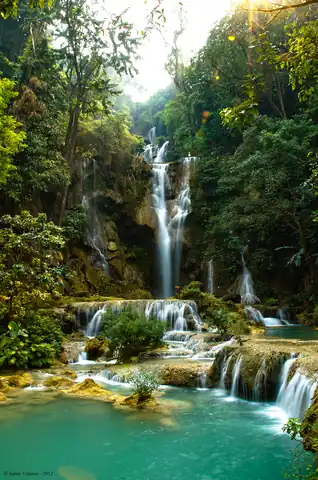
Laos's best-known waterfall, a staircase of turquoise travertine pools