Lonely Planet SwitzerlandLonely Planet
Guidebook
Lonely Planet Switzerland
Lonely Planet · 2024
Current Lonely Planet covering Schaffhausen, the Lauterbrunnen valley, Meiringen and Glarus, with transport and pass details.

Switzerland · Schaffhausen & Zürich
Europe's largest plain waterfall by volume: the whole Rhine throws itself 23 metres over a 150-metre limestone ledge beside a thousand-year-old castle. Small boats land you on the rock in the middle of it, fifty minutes from Zürich by train.
Full guide Checked September 2026 by David Bussell · 49 sources
The Rheinfall is not tall — 23 metres — but it is wide and relentlessly heavy. The Rhine, already a major river after draining Lake Constance, crosses a 150-metre band of hard Late Jurassic limestone and drops over it in several broken channels, averaging roughly 250 cubic metres a second in winter and around 600 in summer, with a recorded peak of 1,250 in 1965. By volume it is the largest plain waterfall in Europe, and in full flow the basin below churns white from bank to bank. Two ragged limestone pillars stand in the middle of the current; the larger, the Rheinfallfelsen, is a remnant of the old riverbank, around 150 million years old, and has barely eroded because the lake upstream traps most of the sediment that would wear it down.
The falls sit on a cantonal border, and the two banks feel like different attractions. On the south side, in the canton of Zürich, Schloss Laufen stands on the cliff directly above the water, and a CHF 5 ticket gets you down a series of walkways and platforms — Belvedere, Känzeli and the cave-like Fischetz — that put you within spray distance of the falling river. On the north side, in Neuhausen am Rheinfall, a free, open quay curves around the basin past Schlössli Wörth, a small castle-turned-restaurant, with a face-on view across the width of the falls. Boats shuttle between the two banks every 15 minutes in season, and a footpath on the railway bridge upstream links them on foot.
What sets this waterfall apart from most is how close you are allowed to get. From Schlössli Wörth, the Rhyfall Mändli boats run into the edge of the left-hand fall and — the headline experience — drop passengers on the central rock for twenty minutes, long enough to climb more than 100 steps to a viewing platform in the middle of the torrent. Add the evening illumination, a treetop ropes park with ziplines over the view, and the medieval towns of Schaffhausen and Stein am Rhein close by, and the Rheinfall rewards a full day rather than the hour most tour coaches give it. Honest caveat for 2026: an exceptional summer drought cut the flow to about a third of normal and cancelled the 31 July fireworks.
Laufen-Uhwiesen / Dachsen, canton of Zürich — station: Schloss Laufen am Rheinfall
The castle — occupied for more than a thousand years — sits on the cliff right above the falls, and this is the side for feeling the Rheinfall rather than just seeing it. A panoramic trail leads down to the Belvedere walkway at the edge of the torrent; stairs continue to the Känzeli and to the Fischetz, reached through a narrow, low cave-like passage. A panoramic glass lift brings you back up, and the Historama tells the castle's story in eleven rooms. The ferry landing below is steep and step-bound.
Schlössli Wörth, Rheinfallquai — station: Neuhausen Rheinfall
The Neuhausen quay wraps around the basin below the falls and gives the broad, face-on view of the full width of the Rheinfall. It costs nothing, never closes, and is where the Rhyfall Mändli boats to the central rock and round the basin depart, beside Schlössli Wörth, a small castle converted into a restaurant. The barrier-free Neuhausen Rheinfall station, opened in 2015, has a lift down to the water. The ropes park, Smilestones miniature world, Rhyality immersive-show hall and Rhyfall Express tourist train are all on this side.
Do both — it's how the site is designed. Start on the Neuhausen side for the free panorama and a boat to the rock, take the ferry (or walk the railway-bridge footpath) across, and finish on the Schloss Laufen platforms. If you can pick only one, choose Neuhausen when the boats are running and Schloss Laufen in winter, when the boats aren't and the close-up platforms are the best thing left.
May, June and July usually bring the heaviest water with the boats in full service; September and October trade some volume for thinner crowds — though in drought years like 2026 the summer flow can fall far below normal.
Flow follows Alpine snowmelt: the Rhine typically peaks in June and July, and the boats to the rock run only from late winter to early November. In 2026, drought overrode the pattern, cutting the flow to a third of normal.
In a normal year this is the Rheinfall at full weight: federal gauge data put June as the highest-flow month on average, the boats run their longest hours (09:30–18:30), and the Schloss Laufen ticket office opens 08:00–19:00. It is also the busiest stretch, especially at weekends and during the Swiss school holidays. The illumination starts late (around 22:00 in June) and switches off at 23:00.
Snowmelt and spring rain push the flow up through April and May, the crowds are thinner than in summer, and the boat season opens — shorter hours from late February and March, fuller service from late March. The Rhyfall Express restarts in April. The Rheinfall Gourmet Festival ran from late April to late May in 2026, pairing local chefs with Schaffhausen Pinot Noir.
Flow drops as snowmelt ends, but the boats keep running daily until 1 November (09:30–17:00 until mid-October, 11:00–17:00 after), the ropes park stays open at weekends until 1 November, and the illumination starts by 19:00–19:30, early enough for an after-dinner look. Vineyard colour on the slopes above Schaffhausen and much smaller crowds make it a good compromise season.
The Rhine never stops — winter flow still averages around 250 m³/s — but the boats scale down to limited weekend trips in November and then stop, and the Schloss Laufen ticket office runs short days (roughly 10:00–16:00 in December and January). In compensation: no queues, the castle's Winter Magic lighting and weekend lounge from mid-November, and a medieval Christmas market spread across both banks (20–22 November in 2026).
The Rheinfall is floodlit every evening from dusk until 23:00 (until 01:00 on New Year's Eve), with the central rock lit up in the middle of the white water. The official 2026 schedule has the lights off on the full-moon night and the night after it, on 31 July, and for a renovation block from 26 October to 27 November 2026. Check the published illumination plan on rheinfall.ch before you plan an evening around it.
Entry, boat, ropes-park and tourist-train prices are the operators' published 2026 rates in Swiss francs, converted at about 1 CHF = $1.21 (late September 2026); tour and hotel figures are 2026 third-party listings and averages. All of them move with exchange rates and season, so treat them as a planning guide, not a quote.
The reason most people come. A traditional wooden boat leaves the Schlössli Wörth landing, noses through the basin and lands you on the Rheinfallfelsen, the limestone pillar in the middle of the falls. You get twenty minutes to climb more than 100 steps — about 30 metres of height — to a viewing platform with water pouring past on both sides. Not suitable for anyone who struggles with steep stairs, and no dogs. Book a timed departure online.
Seasonal timetable within the roughly March–October boat season; to 1 November in 2026
The short, wet version: the boat steers straight at the churning foot of the left-hand fall, loops the basin past the right-hand fall and the central rock, then goes back into the left fall for a second soaking before returning to the landing. The operator says this line is also possible for wheelchair users — book ahead so the ramp and pier lift can be arranged. The best-value close-up if you don't need to stand on the rock.
Roughly March–October; to 1 November in 2026
Pay on the day — nothing to book in advance.
A longer, narrated loop: first downstream to the Nohl bridge, listening to the falls' history through an app or a loaned device in 21 languages, then back up into the basin and twice into the left-hand fall. It adds a quieter stretch of river scenery to the basin drama. The operator notes this boat is not wheelchair accessible and recommends the 15-minute trip instead.
Roughly March–October; to 1 November in 2026
Pay on the day — nothing to book in advance.
The practical crossing between Schlössli Wörth and the Schloss Laufen landing, with an unobstructed view of the falls on the way over. No reservation needed; just turn up and take the next boat. The Schloss Laufen landing is reached by steep natural paths and steps, so it isn't suitable for anyone with limited mobility. Out of season, the footpath on the railway bridge upstream does the same job on foot.
Boat season, roughly March–October
Pay on the day — nothing to book in advance.
The south-bank circuit: through the castle courtyard, down the panoramic trail to the Belvedere walkway, then by stairs to the Känzeli and the Fischetz platforms, the last reached through a narrow, low-ceilinged passage in the rock. The panoramic glass lift carries you back up. The Historama spreads over two floors and eleven rooms. The panoramic trail and lift are step-free; Känzeli and Fischetz are not. Wheelchair and pram tickets are sold only at the visitor centre.
Year-round
Pay on the day — nothing to book in advance.
A treetop ropes park on the Neuhausen side with 14 courses, more than 165 elements and over 1.5 km of ziplines. Two of those lines, Panorama and Panorama Express, are laid out for a view of the falls, and the Swing, Big Swing and Powerfan jumps add a jolt of adrenaline. Walk-ins are usually possible, but reservations are free and worth making on busy days. It closes in heavy rain, wind or thunderstorms, so check the same-day status before you go.
Spring to early November; 2026 season closes 1 November (weekdays groups-only from 19 October)
Pay on the day — nothing to book in advance.
A guided coach tour from the Sihlquai bus station by Zürich's main station, combining the falls — castle platforms included — with a guided walk through Stein am Rhein's small medieval old town. The same operator sells a falls-only version of about four hours from around $54. Worth it only if you'd rather not navigate trains: the S-Bahn gets you to the falls in about 50 minutes on your own.
Year-round; boat option April–October
Two official waymarked loops link both banks without a boat. The small circuit (3.5 km, around 50 m of climb) crosses the Rhine on the footpath of the railway bridge just upstream of the falls and returns past the basin; the grand circuit (7 km, 120 m of climb) extends further along the river. Both give the upstream view few visitors see — the river accelerating into the drop — and they are the only way across once the ferry stops for winter.
Year-round
No booking needed.
A road-going tourist train runs between the falls and the Schifflände boat landing in Schaffhausen's old town, about 3 km upriver. From there, walk up through the vineyard to the Munot, the round 16th-century fortress above the town (free, open 08:00–20:00 May–September, 09:00–17:00 otherwise), and back through lanes known for their 171 carved oriel windows. On Saturdays from April to mid-October it can be booked as the 'Medieval Express' package with a Rhyality show and a guided town walk.
Daily 1 May – 4 October 2026; Thu–Sun in April; reduced timetable to 18 October
The classic pairing with the falls: a scheduled boat from Schaffhausen up the unspoilt Upper Rhine, past the covered bridge at Diessenhofen, to the painted façades of Stein am Rhein. In 2026, low water forced URh to suspend sailings between Diessenhofen and Stein am Rhein from 27 June, running Schaffhausen–Diessenhofen round trips instead. Until the river recovers, take the train to Stein am Rhein and treat the boat as a bonus if the notice is lifted.
April – October; part of the route suspended by low water from 27 June 2026
No booking needed.
Photographs of the Rheinfall show it in full summer flood, but 2026 did not deliver that. An exceptional drought cut the flow to about 165 m³/s in late July, around a third of the July average of roughly 536 m³/s. The federal gauge at Neuhausen was still reading about 121 m³/s in late September, against a long-term average of around 365. The cantons cancelled the Great Rhine Falls Fireworks on 31 July, citing the exceptional drought, and URh suspended boats on part of the Upper Rhine. The falls are still wide and loud, and the boats still run, but at low water you see much more bare rock. Check the live discharge on rheinfall.ch or hydrodaten.admin.ch before you go. One more correction: the fireworks are held on 31 July, the eve of the Swiss National Day, not on 1 August itself.
Nothing sleeps directly on the falls any more, so most visitors base themselves in Schaffhausen's old town, 3 km upriver, or visit as a day trip from Zürich.
The closest conventional hotel to the falls: 57 rooms on Zentralstrasse, free parking and a well-reviewed breakfast. Reviewers describe it as older and basic but clean; the hotel says it renovated in autumn 2024.
A no-frills backpacker hotel on the Neuhausen side, listed by Schaffhauserland Tourism. Reviews praise the staff but mention smoke in the common areas, so it suits travellers after a cheap bed within reach of the falls rather than comfort.
A 3-star hotel with 42 rooms and suites in the middle of the old town, with a busy restaurant and bar and a small city spa with saunas and steam baths. Reviewers mention views towards the Munot.
A small historic mansion built like a miniature castle among old trees: 25 individually furnished rooms and suites, a restaurant with a garden veranda, a well-known bar and even a tennis court with a retractable roof.
A central city hotel that reviewers rate for spacious, clean rooms and friendly staff, with a small but good breakfast. A practical base within walking distance of the station and the Rhyfall Express stop.
The top-reviewed hotel in Schaffhausen on Tripadvisor, close to the station, so the falls are one S-Bahn stop away. Guests single out the breakfast buffet and consistently clean, comfortable rooms.
The nearest Swiss Youth Hostels property to the falls now that the Schloss Laufen hostel has closed: a castle-like building with bright red shutters and multi-bed and private rooms. It is seasonal, so check the opening periods.
A 3-star hotel in a centuries-old riverside building that has operated as a hotel for more than 60 years. It has river-view rooms and a restaurant known for its fish. Stay here to have Stein am Rhein's old town to yourself after the day-trippers leave.
The budget base for a day trip: Swiss Youth Hostels' Zürich property, with direct S-Bahn trains from Zürich HB reaching both Rhine Falls stations in about 50 minutes. Useful if you're covering the falls as one stop on a wider Swiss rail trip.
Search all Schaffhausen accommodation
Roughly 35–45 minutes by road to the falls; by train about 45 minutes with one change to either Rhine Falls station. Switzerland's main long-haul hub, with direct flights from North America, the Gulf and across Europe.
Zürich is the gateway for almost everyone — its airport and main station (Zürich HB) both connect directly to the two Rhine Falls stations by S-Bahn.
The falls have a station on each bank. Schloss Laufen am Rheinfall (south bank) is served by S12 and S33, together half-hourly to Winterthur and Schaffhausen, and the S12 runs directly from Zürich HB in about 50 minutes. Neuhausen Rheinfall (north bank, step-free, with a lift down to the basin) is served by the hourly S9 direct from Zürich HB, also about 50 minutes. The quickest option is often an IC or RE train to Schaffhausen (about 36–38 minutes) and a short S-Bahn ride back. There is no boat from Schaffhausen to the falls. Drivers need a CHF 40 Swiss motorway vignette; parking at the falls costs CHF 5 for the first hour and CHF 2 an hour after that, free 18:00–09:00 (except P4). The Swiss Travel Pass covers the trains to both stations.
The EU's ETIAS pre-travel authorisation has been repeatedly delayed and was not in operation at the time of writing (September 2026), so check before you travel.
 This waterfall
Rhine Falls
Switzerland
Height23 mWidth150 m
 Most similar
Shiraito Falls (Fujinomiya)
Japan
Height20 mWidth150 m
Also a block waterfall, of similar height and similar width
 Largest curtain
Victoria Falls
Zimbabwe · Zambia
Height108 mWidth1,708 m
Largest single sheet of falling water
 Tallest on earth
Angel Falls
Venezuela
Height979 mWidth—
 Widest on earth
Khone Phapheng Falls
Laos
Height21 mWidth10,783 m
Measured across the whole multi-channel system
Angel Falls is 43× taller than Rhine Falls. Victoria Falls is 4.7× taller and 11× wider. Khone Phapheng Falls is 72× wider. Tallest · widest lists.
 9:05
 2:27
 11:54
Chosen from YouTube; videos belong to their creators and play from YouTube's privacy-enhanced player.
Guidebook
Lonely Planet · 2024
Current Lonely Planet covering Schaffhausen, the Lauterbrunnen valley, Meiringen and Glarus, with transport and pass details.

Guidebook
DK Eyewitness · 2024
Illustrated country guide useful for combining the Rhine Falls with the Bernese Oberland on one trip.
Yes, from the Neuhausen side, which is free and open 24 hours a day, 365 days a year. The Schloss Laufen side charges CHF 5 (about $6) for adults and CHF 3 for children 6–15. That ticket covers the Belvedere and other platforms, the glass lift and the Historama. Boats cost extra, from CHF 3 for the ferry to CHF 22.50 for the trip to the central rock.
They do different jobs. Schloss Laufen puts you right beside the falling water on walkways and platforms, and it's the more dramatic close-up. Neuhausen gives the free, wide view across the basin and is where the boats to the rock leave. Most visitors do both, crossing by the five-minute ferry or the railway-bridge footpath.
Yes, on Rhyfall Mändli's Rock Experience, which costs CHF 22.50 (about $27) and leaves from Schlössli Wörth on the Neuhausen side. You get about 20 minutes on the rock to climb more than 100 steps to a platform in the middle of the falls. It runs only in the boat season, roughly March to October, and isn't recommended for children under 1.2 m tall.
By train in about 50 minutes. The direct S9 from Zürich HB goes to Neuhausen Rheinfall on the north bank, and the direct S12 goes to Schloss Laufen am Rheinfall on the south bank. Taking an IC or RE to Schaffhausen and changing is sometimes a few minutes faster. From Zürich Airport, allow about 45 minutes with one change, or 35–45 minutes by car.
Usually in June and July, when Alpine snowmelt is flowing out of Lake Constance. Summer flow averages about 600 m³/s, compared with about 250 in winter. Weather can override that: in the 2026 drought, flow fell to around 165 m³/s in late July and about 121 m³/s in September. Check the live discharge on rheinfall.ch before you go.
By volume, it's the largest plain waterfall in Europe, and Wikipedia calls it the continent's most powerful, with a summer average of around 600 m³/s. It is not high at 23 metres, and Iceland's Dettifoss, which drops about twice as far, is often given a rival 'most powerful' title. Which one wins depends on whether you measure volume or power.
Yes, every evening from dusk until 23:00, with the central rock lit up. The 2026 schedule leaves the lights off on full-moon nights and the night after, on 31 July, and from 26 October to 27 November 2026 for renovation. The Neuhausen quay is open all night, so you can watch for free.
The Great Rhine Falls Fireworks take place on 31 July, the eve of Swiss National Day, not on 1 August. Watching from the Neuhausen quay is free, and the crowds are huge, so arrive early by public transport. The 2026 display was cancelled because of the extreme drought, and the next one is listed for 31 July 2027.
Rhine Falls is in Switzerland (Schaffhausen / Zürich). The nearest base is Neuhausen am Rheinfall and the closest airport is ZRH. Its coordinates are 47.6778, 8.6156.
Prices, fees and entry rules change. We re-check full guides regularly; spotted something out of date? Tell us.
Nearby

The Hirschbach Falls lie between St. Peter and Simonswald in that part of the High Black Forest, which is…

The Triberg Waterfalls are waterfalls near Triberg in the Black Forest in Baden-Württemberg . With a descent…
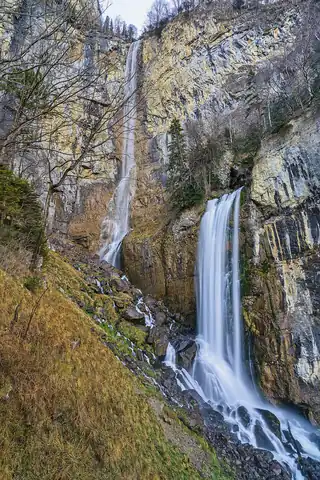
One of the highest total-drop waterfalls in Europe

The Thur waterfalls are two cascades located on the upper part of the river Thur, approximately ten minutes…