
History & travel
The Railway Man
Eric Lomax · 2014
Most Erawan visitors stay in Kanchanaburi; Lomax's memoir explains the Death Railway and bridge you'll pass on the way.

Thailand · Kanchanaburi Province
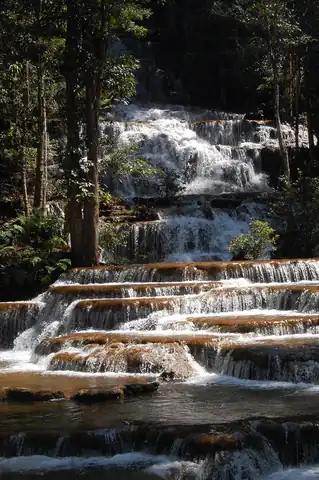
Seven tiers of turquoise limestone pools climbing about 1.5 km through forest west of Bangkok, with fish that nibble your feet and a top tier said to look like a three-headed elephant. Swim in a life jacket; food stops at tier two.
Full guide Checked September 2026 by David Bussell · 35 sources
Erawan is a staircase rather than a single drop. The stream that feeds it, which the Thai tourism directory calls Khlong Mong Lai, runs off the limestone hills of Erawan National Park so loaded with dissolved calcium carbonate that it coats its own bed, building rounded travertine lips that hold the water back in a chain of pools. The minerals scatter the light into the milky turquoise and jade that fill every photograph. There is no famous single height here, and no reliable survey figure for any tier: the drama is in the repetition, seven named falls and dozens of smaller spills stacked one above the other up a forested valley.
You walk it from the bottom up. From the visitor centre a paved path, or a 10-baht golf cart, covers the first 500 metres or so to tier one, and the trail then climbs roughly 1.5 km to tier seven, getting steadily steeper, rootier and quieter. Tiers one and two are wide, shallow and busy, with the famous nibbling fish; tier four has a natural rock slide into a deep pool; above tier five the path narrows into steps, ladders of root and wet rock, ending below Phu Pha Erawan, the cliff whose three spouts give the falls their name after the three-headed elephant of Hindu and Buddhist myth.
Most visitors come on a long day trip from Bangkok, or a half day from the town of Kanchanaburi, and pair the falls with the Bridge on the River Kwai, the Death Railway and the war cemeteries. That works, but Erawan rewards an early start more than almost anywhere in Thailand. Be at the gate for 08:00 on a weekday between November and February and you walk into clear, cool, near-empty pools; arrive at 13:00 on a Saturday and you meet the crowds and the rangers' 15:00 sweep off the top tiers.
Erawan National Park closed completely from 27 to 29 September 2026 after 172.6 mm of rain fell in 24 hours, shutting the falls, Phra That Cave, the trails, bungalows and campsite; swimming had already been banned from 26 September, and nearby Sai Yok closed indefinitely. Check the park's Facebook page or call 034 574 222 before you travel in the wet season. Even in good weather, swimming is only allowed with a life jacket, rented at tier one, and only in pools the rangers have left open.
About 500 m from the visitor centre (golf cart 10 THB)
The first two tiers sit almost on top of each other and hold most of the crowd. Tier two, Wang Matcha, literally the fish pool, is the one in the photographs: a broad, bright turquoise basin full of fish that crowd round your legs and nibble dead skin the moment you stand still. It is also the last place you may eat, with the last toilets and the bottle-deposit checkpoint. Rent your life jacket at tier one before going any higher.
The steep climb above the checkpoint, roughly 15–45 minutes above tier 2
Past the checkpoint the path climbs hard, and the crowd thins with every tier. Tier three is a tall, pretty fall above a deep pool and a favourite for photographs. Tier four, Ok Nang Phi Suea, has the smooth limestone slide that drops you into a deep green pool, the best single swim at Erawan. Tier five spreads into several shallow terraces, catches the best light around late morning, and is where macaques often hang about. Wear shoes with grip; the travertine is slick.
The top of the trail, about 45–60 minutes from tier 1
Tier six is a green, jungly fall with little swimming, and in the late dry season very little water. From there around 200 steep steps and a scramble over roots and wet rock lead to tier seven, Phu Pha Erawan, the cliff that gives the park its name. Two small pools sit at its foot, with fish of their own. In heavy rain the water pours off the cliff in three separate streams, which locals read as the three heads of the elephant Erawan.
Go all the way to tier seven if you are reasonably fit and arrive before about 13:00; the walk is short, the crowds fall away, and the upper pools are calmer. If time is tight, head straight for tier four's slide and swim in tier two on the way down.
November and December give full falls and clearing turquoise water, January and February the clearest and calmest pools, March to May thin flows and haze risk, and June to October high, silty water and swimming bans.
The monsoon decides everything. From November to February the water clears to turquoise and swimming is reliable; from June to October the falls run high and brown, the park bans swimming after heavy rain, and it sometimes closes outright.
The best balance of the year. The pools have cleared after the rains but the falls still carry plenty of water, so every tier is running and the colour is at its strongest. Mornings are cool and dry, the forest is still green, and walking to tier seven is comfortable. It is also high season, with Thai holiday crowds at weekends and around New Year, so weekdays and early starts matter.
The clearest, calmest water of the year and the lowest humidity, with daytime temperatures around the low 30s. The trade-off is flow: by February the upper falls thin out and tier six can be close to dry. It is still the most dependable time for swimming, and weekdays can be surprisingly quiet at opening time.
Very hot, with the lowest water of the year, so the falls look thinner and the pools warmer, though still clear. Forest fires and smoke are the new risk: on 21 April 2026 the park closed for a day after nearby wildfires pushed PM2.5 above Thailand's safety standard. The cold water is welcome, but walk to the top early before the heat builds.
The falls roar, the forest is at its greenest and the pools turn turbid and reddish. The park bans swimming whenever currents rise, as it did from 16 September 2025 and again from 26 September 2026, and it closes completely after extreme rain: the whole park, including Phra That Cave, the campsite and bungalows, shut from 27 to 29 September 2026 after 172.6 mm fell in 24 hours.
In a big rain the water comes off the cliff above tier seven in three separate streams, which Thai media call hua chang Erawan taek, the Erawan elephant's head splitting. It is the one reason to visit in the monsoon. The first split of 2026 was reported on 26 September, with water high and reddish; you may walk up to look, but swimming and kayaking are banned while it lasts, and the park can close entirely if the rain keeps coming.
Park, bus and museum fees are 2026 rates in Thai baht reported by the park, the Department of National Parks and 2026 visitor guides, converted at about 33.5 THB to $1 (late September 2026). Tour and hotel prices are 2026 advertised listings or review-site ranges and change with season and demand, so treat all figures as a planning guide, not a quote.
The reason to come. Rent a life jacket at tier one, which is compulsory for swimming even where the water looks shallow, then work your way up: the fish pool at tier two, the rock slide into deep water at tier four, the terraces at tier five and the small pools under the cliff at tier seven. Rangers mark which pools are open on the day. Leave food below tier two, wear grippy water shoes, and keep bags closed around the macaques.
Best November – February; swimming often banned June – October
Pay on the day — nothing to book in advance.
The trail from tier one to Phu Pha Erawan is only about 1.5 km, but most of the climbing is packed into two stretches, between tiers three and four and between six and seven, where roughly 200 steep steps and a scramble over roots and wet rock lead to the top. It is a proper sweat in the heat. Start before about 13:00, because rangers begin sending people down from the upper tiers in mid-afternoon.
Year-round, weather permitting; tier 7 closes from about 15:00
No booking needed.
A limestone cave in another corner of Erawan National Park, about 544 metres long, full of stalactites, stalagmites and a rock formation that visitors liken to a seated Buddha. A ranger usually leads you through with a torch. You need your own transport to reach it from the falls, and it shuts along with the rest of the park when the rains are heavy, as it did from 27 to 29 September 2026.
Year-round; closes with the park after heavy rain
No booking needed.
The efficient way to do Erawan from Bangkok without driving: an air-conditioned van, an English-speaking guide, the JEATH War Museum and the Bridge on the River Kwai in the morning, then the afternoon at the falls with the park fee and life jacket covered. Groups are capped at 12, and reviews run into September 2026. The catch with any Bangkok day trip is about six hours on the road, and an afternoon arrival at the falls.
Year-round; best November – February
A private version with hotel pickup in Bangkok, a licensed guide, Kanchanaburi War Cemetery and the bridge in the morning, a riverside lunch, then Erawan in the afternoon for the walk and a swim. Because it is private you can ask to reverse the order and reach the falls earlier, which is worth doing. The per-person price falls steeply as the group grows, so it makes most sense for three or more.
Year-round
The surviving section of the Thailand–Burma Railway, built by Allied prisoners of war and Asian labourers in 1942–43, still runs as an ordinary third-class service. From Kanchanaburi it crosses the Bridge on the River Kwai, then edges along the cliff above the Khwae Noi on the wooden Wang Pho viaduct near Tham Krasae before ending at Nam Tok. Fares for foreigners are a flat 100 THB.
Year-round, daily
Kanchanaburi town's three essentials fit into a morning. Walk the steel bridge over the Khwae Yai, stepping aside for the trains; pay respects at Kanchanaburi War Cemetery, where thousands of Allied prisoners are buried; then spend an hour in the air-conditioned Thailand–Burma Railway Centre on the cemetery's western side, the clearest account of how the railway was built and what it cost. It is the context that makes the train ride mean something.
Year-round; railway centre open daily 09:00 – 16:00
Pay on the day — nothing to book in advance.
The most affecting place in the province. A museum above the Konyu Cutting tells the railway's story, then a memorial walk drops into the rock cutting prisoners hacked out by hand and lamplight in 1943. The audio guide, with former prisoners describing the work, is worth the deposit. Walk 40–45 minutes return to the cutting, or about three hours on the longer track. It is roughly 80–100 km beyond Kanchanaburi, so pair it with Sai Yok.
Daily 09:00 – 16:00; annual maintenance closure in May
No booking needed.
Erawan's quieter neighbour in Sri Nakarin Dam National Park, above the Si Nakharin reservoir: seven major tiers and many smaller pools strung along a 2.3 km trail, with swimming in the ponds along the way. It is about 43 km beyond the Erawan junction on a narrow but paved road, and there is no public transport, so you need a car, scooter or driver. Last entry is 16:30. Good for a second waterfall day without the crowds.
Best November – February; has run dry in a severe dry season
Pay on the day — nothing to book in advance.
About 100 km north-west of Kanchanaburi on the Khwae Noi, Sai Yok's waterfalls spill straight into the river beside the visitor centre, and a 2 km trail leads to the cave of Kitti's hog-nosed bat, one of the smallest mammals on earth. The roadside Sai Yok Noi fall near Nam Tok station is separate, and actually managed by Erawan National Park. At the time of writing the whole park was closed by flood risk, with no reopening date.
Normally year-round, 08:00 – 16:30
Pay on the day — nothing to book in advance.
Most visitors sleep in Kanchanaburi town, along the Khwae Yai near the bridge, and treat Erawan as a half-day trip; the park's own bungalows and campsite put you at the gate for opening time.
The town's grandest address: 104 rooms in colonial-style buildings set in big riverside gardens, with a large pool, a separate children's pool and a spa. Guests love the grounds and the food; some find the rooms dated and the site far from the night market.
A 50-room boutique resort with a river-lodge feel, a pool on the water and a restaurant facing the river, a short walk from the Bridge on the River Kwai. One of the best-rated hotels in town, with reviews running through August 2026.
A four-star riverfront hotel on the main walking street, with river views, a pool, in-room jacuzzis and the Railway Restaurant. Handy for bars and restaurants; some reviewers note wear and patchy cleaning at the top of its price range.
Just twelve cottages in teak forest and tropical gardens beside the Khwae Yai, run for about 20 years by its Dutch owner. Consistently one of the top-rated places to stay in the province, with a well-liked restaurant, a pool and private verandas.
A riverside resort with a pool, gardens and a spa, with breakfast included. A comfortable, established option for families or anyone who wants resort grounds without paying Dheva Mantra prices.
Floating bamboo-and-thatch rooms moored on the Khwae Noi since 1976, lit by candle and oil lamp with no electricity on board, next to a Mon village. Best combined with Hellfire Pass and Sai Yok rather than Erawan. Reviews run through July 2026.
Eight park bungalows and a campsite a short walk from tier one, the only way to be first on the trail at 08:00. Book bungalows through the Department of National Parks system; restaurants at headquarters close in the early evening, and alcohol is banned.
Kanchanaburi has a long backpacker strip along the river. Long-running names listed in 2026 include Thai Guesthouse and Smiley Frog, plus simple floating raft rooms. Check recent reviews before booking; standards vary widely.
Search all Kanchanaburi stays on Agoda or compare on Booking.com
Thailand's main international gateway, on the far eastern side of Bangkok. Allow around 3–3.5 hours by road to Kanchanaburi and another 1.5 hours to the falls; by public transport, connect through central Bangkok to the Southern Bus Terminal or Thonburi station.
Bangkok's low-cost airport, used by Thai AirAsia and Nok Air for domestic and regional flights. It sits on the north side of the city, slightly better placed for the drive west to Kanchanaburi.
Bangkok is the only practical gateway: Kanchanaburi town is about 130 km west by road, and the falls roughly 65–70 km beyond that.
Buses leave Bangkok's Southern Bus Terminal (Sai Tai, Taling Chan) through the day: first class takes about two hours for 110 THB, second class two to three hours for 95 THB. Slower but far more atmospheric, trains leave Thonburi station at about 07:45 and 13:55, reaching Kanchanaburi around 10:30 and 16:20, for a flat 100 THB foreigner fare; the same trains continue over the bridge to Nam Tok. From Kanchanaburi bus station, local bus 8170 runs to the falls in about 1.5 hours for 60 THB, departing 08:00, 09:40, 11:00, 13:00, 16:00 (15:00 at weekends) and 17:40, with the last bus back from Erawan at about 16:30. Take the 08:00. A private car with driver costs roughly 800–1,200 THB return with waiting time. Timetables change often, so confirm locally.
The 30-day rule is new and Thailand has changed visa exemptions several times since 2024. Check the Thai Ministry of Foreign Affairs or your own government's travel advice shortly before you go, and use only the official TDAC site, never a paid lookalike.
 This waterfall
Erawan Falls
Thailand
Height—Width—
 Most similar
Pha Charoen Falls
Thailand
Height—Width—
Also a tiered waterfall, with swimming and in Thailand too
 Largest curtain
Victoria Falls
Zimbabwe · Zambia
Height108 mWidth1,708 m
Largest single sheet of falling water
 Tallest on earth
Angel Falls
Venezuela
Height979 mWidth—
 Widest on earth
Khone Phapheng Falls
Laos
Height21 mWidth10,783 m
Measured across the whole multi-channel system
We don't have a reliable crest width for Erawan Falls yet, so it is left off the width chart. Tallest · widest lists.
 17:43
 4:28
 23:14
Chosen from YouTube; videos belong to their creators and play from YouTube's privacy-enhanced player.
History & travel
Eric Lomax · 2014
Most Erawan visitors stay in Kanchanaburi; Lomax's memoir explains the Death Railway and bridge you'll pass on the way.
Guidebook
Lonely Planet · 2024
The 19th edition covers Kanchanaburi for Erawan and the Tak and Mae Sot area near Pha Charoen.
Guidebook
Rough Guides · 2024
For a multi-country trip, one book covering the overland routes between the Southeast Asian falls on this site.
300 THB (about $9) per foreign adult and 150 THB per child aged 3–14; Thai nationals pay 60 THB. A car costs 30 THB and a motorbike 20 THB. Life-jacket rental for swimming is 20 THB, and there is a 20 THB refundable deposit on each plastic bottle taken past tier two. Pay in cash.
Yes, in the designated pools, but only wearing a life jacket, which you rent at tier one for 20 THB. Tier two with its fish and tier four with its rock slide are the favourites. Rangers close pools when currents rise, and in the wet season the park bans swimming altogether, as it did from 26 September 2026.
About 45–60 minutes from tier one to tier seven, covering roughly 1.5 km, and 25–45 minutes back down. The lower half is easy; the climbs between tiers three and four and from six to seven are steep. With swims, allow three to four hours in total, and start before about 13:00 because the upper tiers close mid-afternoon.
The park is open daily from 08:00 to about 16:30, with no entry after roughly 15:30. The upper tiers close earlier: the park has posted tier seven closing at 15:00 and tiers five and six at 15:30, and rangers walk the trail sending people down. In bad weather tiers can close at any time.
Yes. Small freshwater fish crowd the pools, especially at tier two, Wang Matcha, whose name means fish pool, and nibble dead skin from your feet and legs when you stand still. It tickles rather than hurts. Do not feed them: food is banned above tier two, and feeding changes their behaviour.
Take a bus from the Southern Bus Terminal (about two hours, 110 THB) or a train from Thonburi station (about 2.5–3 hours, 100 THB) to Kanchanaburi, then local bus 8170 to the falls (about 1.5 hours, 60 THB). A day tour or private driver does it in one go, but spends about six hours on the road.
Usually, but not reliably. From June to October the water turns turbid, swimming is frequently banned, and the park closes outright after extreme rain: it shut from 27 to 29 September 2026 after 172.6 mm fell in a day. Check the park's Facebook page or call 034 574 222 before travelling between June and October.
Yes. The park has eight bungalows and a campsite near headquarters, a short walk from tier one; camping costs 30 THB a person and a rented tent about 225 THB. Bungalows are booked through the Department of National Parks online system. Most people instead stay in Kanchanaburi, about 1.5 hours away.
Erawan Falls is in Thailand (Kanchanaburi), inside Erawan National Park. The nearest base is Kanchanaburi and the closest airport is BKK. Its coordinates are 14.3712, 99.1489.
Prices, fees and entry rules change. We re-check full guides regularly; spotted something out of date? Tell us.
Nearby

Sai Yok Noi waterfall is a waterfall in Thailand.

The Thi Lo Su Waterfall is claimed to be the largest and highest waterfall in Thailand. It stands 250 metres…

The Nang Rong Waterfall is a waterfall, located in the Tambon of Hin Tang, Mueang Nakhon Nayok district…
A remote highlight of Thailand's far western borderlands